A toll-free number for business in India is an 1800 number that customers can call free of charge, while the business pays for the calls. To get one, sign up with DialDesk, complete KYC, set up your IVR and call routing, and start taking calls. With DialDesk, toll-free plans start at ₹999/month with 1,000 minutes included, and the number is activated the same day after KYC.
Key Takeaways
- A toll-free number starts with 1800. The caller pays nothing; the business pays for the calls.
- It works on the cloud, so calls can ring your team's mobiles, landlines or apps.
- You can add an IVR menu, call routing, call recording and call reports to the number.
- With DialDesk, toll-free plans start at ₹999/month with 1,000 minutes, with same-day activation after KYC.
What is a Toll-Free Number?
A toll-free number is a business phone number, starting with 1800 in India, that customers can call without paying for the call. The business that owns the number pays the call charges instead. Toll-free numbers are commonly used for customer support, service and sales lines, where a business wants customers to call without worrying about cost.
A toll-free number is one type of virtual phone number. To compare it with local and mobile numbers, read our guide on how to get a virtual phone number in India.
How Does a Toll-Free Number Work?
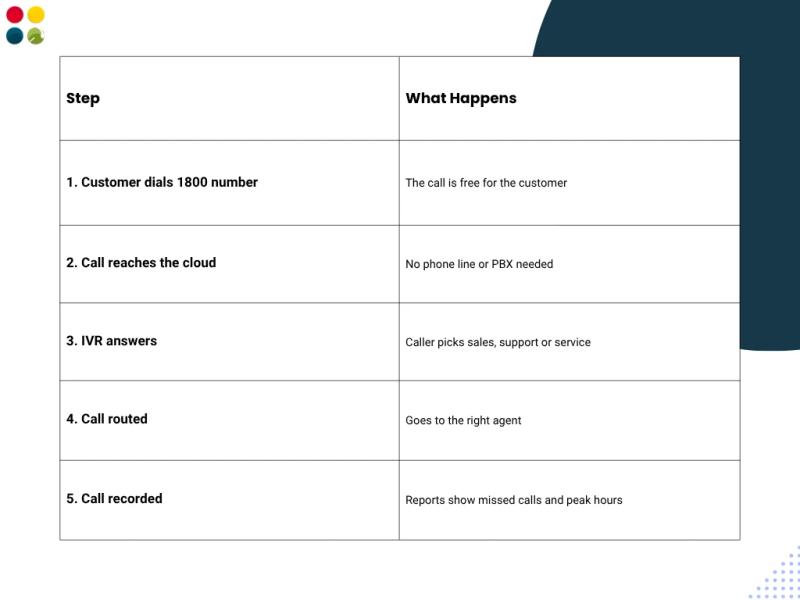
- 1. A customer dials your 1800 number. The call is free for the customer.
- 2. The call reaches DialDesk's cloud platform. No phone line or PBX is needed at your office.
- 3. The IVR answers. The caller hears your greeting and can choose an option such as sales or support.
- 4. The call is routed to the right agent. Routing rules send the call by time, availability or the option chosen.
- 5. The call is recorded and reported. You can see who called, who answered and which calls were missed.
Learn more about menus in our guide to the role of IVR in inbound customer service.
Why Do Businesses Use a Toll-Free Number?
- Free calls for customers: customers can call without paying, which makes it easier for them to reach you.
- One number for all of India: the same 1800 number can be used in every city and on all your marketing.
- Calls reach the right team: IVR and routing send each caller to sales, support or service.
- Every call is tracked: call recording and reports show call volume, missed calls and peak hours.
- No hardware: calls can be answered on mobiles, landlines or apps, in the office or at home.
What Features Should a Toll-Free Number Have?
A toll-free number is only as useful as the tools that come with it. Look for these features:
- IVR: a greeting and menu so callers can choose sales, support or service.
- Smart call routing: calls go to the right agent by time, availability or IVR option.
- Business hours and after-hours rules: so no call goes unanswered outside working hours.
- Call recording: for quality checks, training and records.
- Call analytics: reports on call volume, duration, missed calls and peak hours.
- Mobile and desktop apps: agents can answer calls from any device.
- CRM and helpdesk integration: caller details and call history in one place.
All of these come with DialDesk toll-free numbers.
Toll-Free Number vs Local Number
- Who pays: on a toll-free number the business pays for the call; on a local number the caller pays.
- Format: a toll-free number starts with 1800; a local number has a city code.
- Best for: toll-free suits customer support and service lines across India; a local number suits a business that wants a presence in one city.
- Cost with DialDesk: toll-free plans start at ₹999/month with 1,000 minutes; local numbers start at ₹499/month.
What is the Difference Between 1800 and 1860 Numbers?
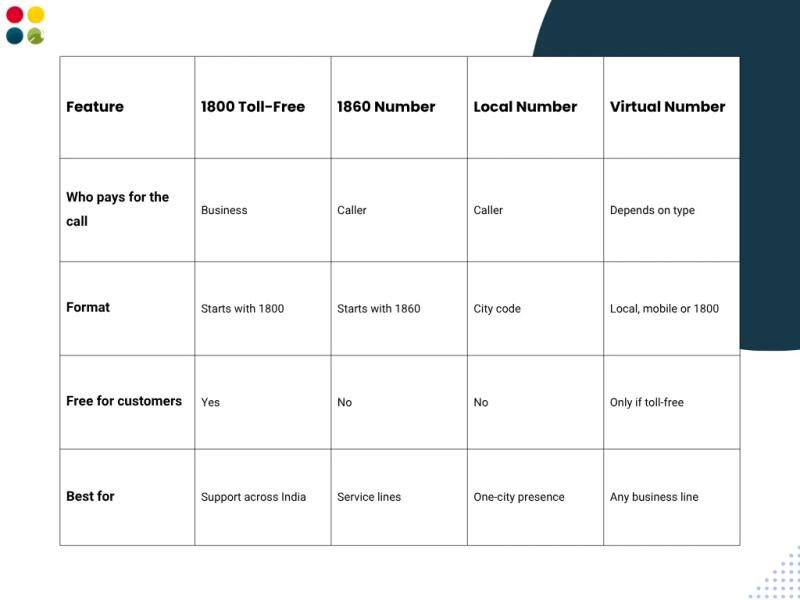
Both look like national service numbers, but they work differently for the caller:
- 1800 (toll-free): the business pays for the call, so it is free for the caller.
- 1860: the caller usually pays, at local or STD rates depending on their telecom operator and plan.
If you want customers to call you without worrying about cost, choose an 1800 number.
Toll-Free Number vs Virtual Number
- Virtual number: any cloud-based business number, such as a local, mobile or toll-free number, that rings your team's phones or apps.
- Toll-free number: a type of virtual number that starts with 1800, where the business pays for the call.
- In short: every toll-free number is a virtual number, but not every virtual number is toll-free.
How Do You Get a Toll-Free Number in India?
Step 1: Decide what the number is for
List who will call the number and why: support, service, sales or all of these. This decides your IVR options and how many agents the number should ring.
Step 2: Sign up with DialDesk
Share your requirement and expected call volume with the DialDesk team, so you get the right toll-free plan.
Step 3: Complete KYC
DialDesk verifies your business before activating the number. See the documents list below.
Step 4: Set up IVR and call routing
Record a greeting, add menu options, map each option to the right agents, and set business hours and after-hours routing.
Step 5: Go live and track your calls
Publish the 1800 number on your website, packaging, ads and Google Business Profile. Use call reports to see missed calls and peak hours, and adjust routing as you grow.
What Documents are Needed for a Toll-Free Number?
DialDesk verifies your business (KYC) before activating a toll-free number. Keep these documents ready:
- Company PAN card
- GST certificate
- Certificate of Incorporation, Partnership Deed or Shop Act licence
- ID proof of the authorised person (Aadhaar or PAN)
- Address proof of the authorised person
- Authorisation letter on company letterhead
- Customer Application Form (CAF)
- Photograph of the authorised person
How Much Does a Toll-Free Number Cost in India?
Toll-free pricing usually has two parts: a monthly plan for the number and a per-minute charge for calls. With DialDesk:
- Toll-free plan: from ₹999/month, with 1,000 minutes included
- Per-minute rates: ₹0.40–1.50, depending on call type
Contact us for a quote based on your expected call volume.
Who Should Use a Toll-Free Number?
- E-commerce and D2C brands that handle order, delivery and return calls. See our e-commerce customer support.
- Healthcare providers that manage appointment and patient calls. See our healthcare call center services.
- Service and support teams that want customers across India to reach them on one number.
- Growing businesses that want a professional support line without buying a phone system.
Get a Toll-Free Number with DialDesk
DialDesk is a Noida-based contact center and cloud telephony company with 18+ years in customer support, 250+ companies served, and ISO 9001:2015 and ISO/IEC 27001:2022 certification. DialDesk toll-free numbers come with IVR, smart call routing, call recording and call analytics, with same-day activation after KYC and no hardware.
See all features on our cloud telephony services page, or talk to our team to get your 1800 number.