What is the Role of IVR in Inbound Customer Service?
Inbound IVR (Interactive Voice Response) is the automated system that receives, routes, and resolves customer-initiated voice contacts before a live agent is required. In Inbound Customer Service, IVR Inbound acts as the intelligent first layer, greeting callers, capturing intent through voice or keypad input, and connecting them to the right agent, self-service option, or resolution path in seconds. Modern AI-powered IVR Inbound systems go beyond static menu trees: they use natural language processing, CRM integration, and intent-based routing to deflect 20–40% of inbound calls autonomously, reducing agent workload, cutting average handle time by 40%, and delivering 24/7 self-service without additional headcount.
Why Inbound IVR Is the Most Underrated Component of Inbound Customer Service
The criticism of IVR in Inbound Customer Service is almost always directed at poor implementations, menus with too many levels, rigid keypad-only inputs, and routing logic that doesn’t account for customer history or intent. This criticism is valid. Bad IVR Inbound design frustrates customers: 74% report frustration when IVR fails to route them correctly (HubSpot, 2024).
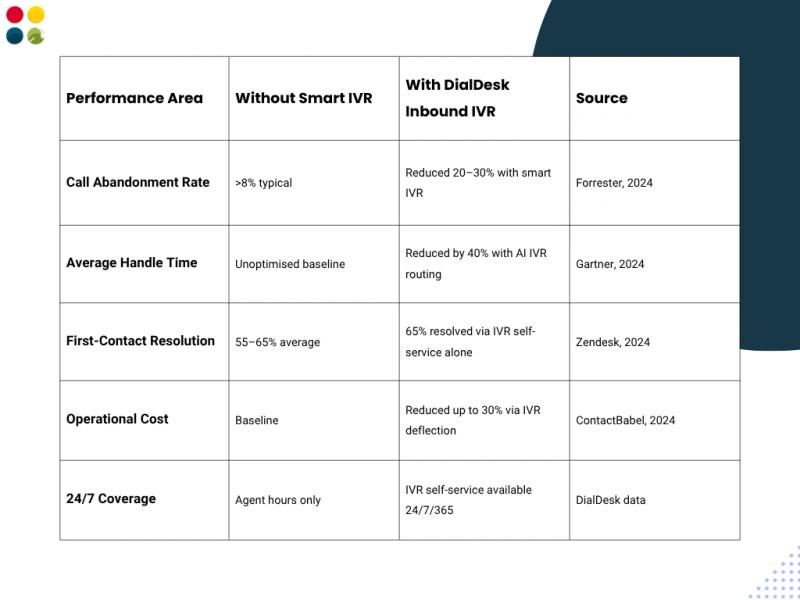
But the same data reveals what good IVR Inbound design achieves. Modern AI-powered IVR systems reduce average call handling time by 40% (Gartner, 2024), reduce call abandonment by 20–30% (Forrester, 2024), and resolve 65% of customer queries before a human agent is ever involved (Zendesk, 2024). These are not marginal improvements; they are structural performance gains that cascade through every Inbound Customer Service metric.
The businesses that dismiss IVR as outdated are typically the ones running outdated IVR configurations. The businesses deploying AI-powered, NLP-driven, CRM-integrated Inbound IVR are running the highest-performing Inbound Customer Service operations in India.
💡 Why It Matters
IVR Inbound systems reduce operational expenditure by up to 30% (ContactBabel, 2024). For a contact centre handling 10,000 inbound calls per month, that represents a direct cost saving without any reduction in Inbound Customer Service coverage or quality.
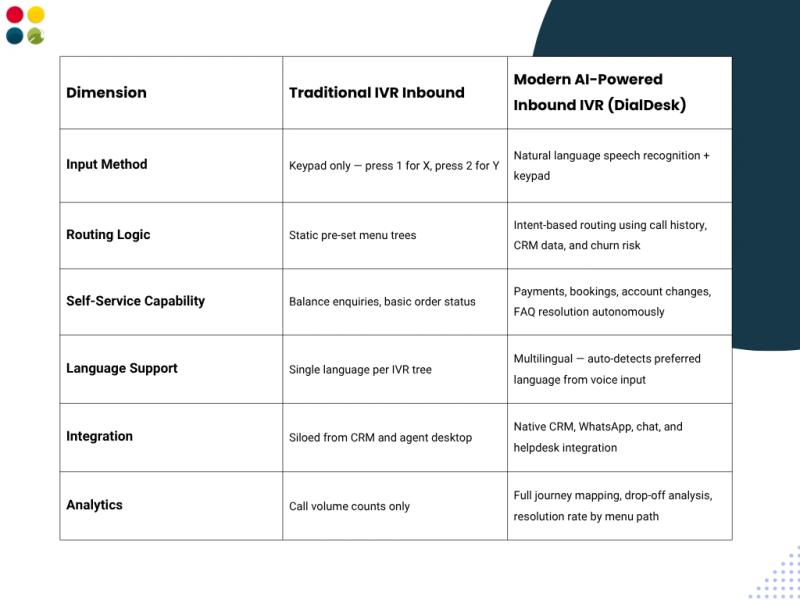
Traditional IVR Inbound vs Modern AI-Powered IVR: What Actually Changed
How IVR Inbound Directly Improves Inbound Customer Service Performance
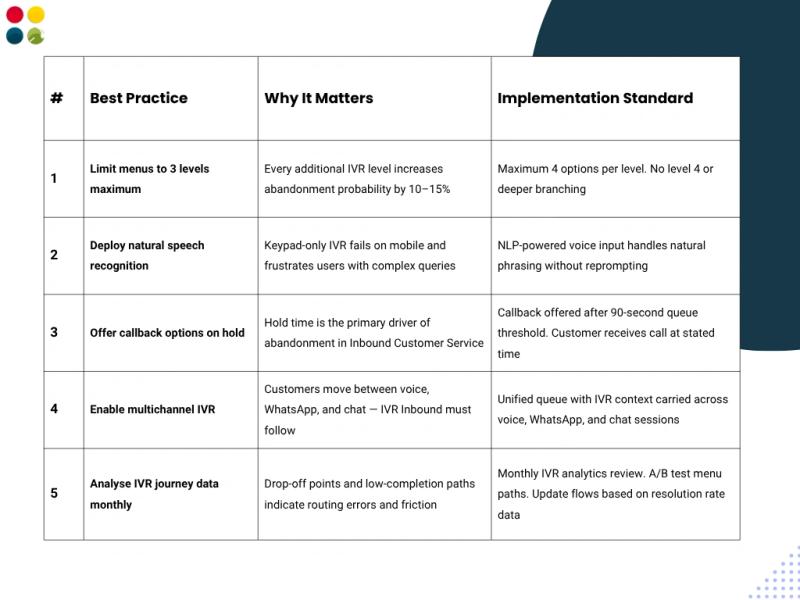
5 Best Practices for a Future-Ready Inbound IVR in 2026
✅ AI-Powered IVR Inbound · Trusted by 500+ Contact Centers Across India
DialDesk’s Inbound IVR platform is ISO 9001:2015 and ISO 27001:2013 certified — AI-powered, multilingual, CRM-integrated, and built for India’s Inbound Customer Service requirements. Trusted by 500+ contact centers across India. Deployable in 48–72 hours with no hardware required.
Key Takeaways
• Inbound IVR is the highest-leverage component of Inbound Customer Service, handling 20–40% of all contacts autonomously before a human agent is required.
• Modern AI-powered IVR Inbound systems use NLP, CRM integration, and intent-based routing, not static menu trees, to deliver personalized resolution at scale.
• Well-designed Inbound IVR reduces average call handling time by 40% (Gartner, 2024) and call abandonment by 20–30% (Forrester, 2024).
• 65% of customers prefer a fast IVR self-service resolution over waiting for a live agent (Zendesk, 2024), making IVR a customer preference, not a compromise.
• IVR Inbound best practice: 3 menu levels maximum, NLP voice input, callback options, multichannel continuity, and monthly journey analytics reviews.
• DialDesk’s Inbound IVR deploys in 48–72 hours- AI-powered, multilingual, CRM-integrated, and ISO 9001:2015 + ISO 27001:2013 certified from day one.
Conclusion
Inbound IVR is not a relic of call center operations. It is the intelligent first layer of Inbound Customer Service, the component that determines how fast customers resolve, how much of that resolution happens without agent involvement, and how efficiently the entire contact centre operates.
The difference between IVR Inbound that frustrates customers and IVR Inbound that delights them is not the technology. It is the design, the menu depth, the routing logic, the self-service scope, and the analytics discipline applied to continuous improvement.
Explore how DialDesk’s AI-powered Inbound IVR platform connects with your CRM, cloud telephony, WhatsApp, and omnichannel stack to deliver smarter Inbound Customer Service from day one, live in 48–72 hours, no hardware required.
Smart IVR Inbound. Faster resolution. Lower cost. DialDesk delivers all three.
📅 Want to Upgrade Your Inbound IVR and Transform Customer Service?
DialDesk’s AI-powered Inbound IVR deploys in 48–72 hours — NLP voice recognition, multilingual routing, CRM integration, and 24/7 self-service included from day one.
Join 500+ contact centers across India already running smarter Inbound Customer Service with DialDesk’s IVR platform.