Key Takeaways
- Cloud telephony moves business phone calling off physical PBX hardware and onto infrastructure hosted and managed by a cloud telephony service provider.
- Calls route through the internet, which allows remote extensions, easier scaling, and features like call routing, IVR and CRM integration without buying new equipment.
- Businesses are moving away from on-premise PBX mainly because of hardware maintenance costs, poor support for remote and hybrid teams, and limited scalability.
What Is Cloud Telephony?
Cloud telephony is a business phone system where the calling infrastructure — routing, switching, storage — runs on a provider's servers instead of hardware inside your office.
Calls are carried over the internet rather than traditional copper phone lines. A business connects through desk phones, softphone apps, or a browser, and the provider handles the underlying infrastructure, maintenance and upgrades.
How Is Cloud Telephony Different From a Traditional PBX?
The core difference is where the infrastructure lives and who maintains it.
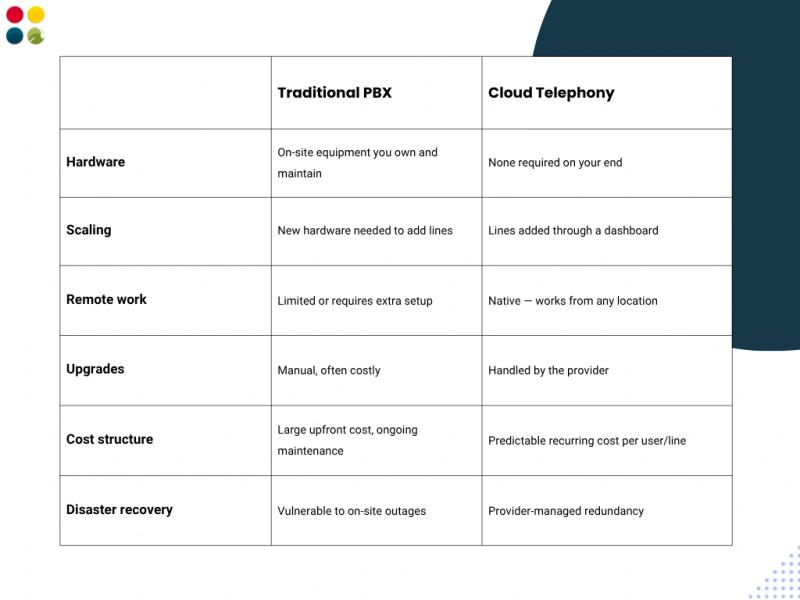
A PBX isn't obsolete because it doesn't work — it's obsolete because it ties your phone system to a single physical location and requires you to manage the hardware lifecycle yourself.
Why Are Businesses Moving Away From On-Premise PBX in 2026?
Businesses are replacing PBX systems because the hardware model no longer matches how teams actually work.
Specific pressures driving the shift:
● Remote and hybrid teams need extensions that work outside a physical office — a PBX wasn't built for that.
● Aging hardware requires maintenance contracts, replacement parts, and specialized technicians that are increasingly hard to find.
● Scaling is slow — adding a new line or location with a PBX means procuring and installing more equipment.
● Vendor end-of-life — many legacy PBX manufacturers have stopped supporting older systems, leaving businesses on unpatched, unsupported hardware.
● Limited integrations — connecting a PBX to a CRM or helpdesk typically requires costly middleware, if it's possible at all.
None of these are hypothetical failure modes — they're the specific reasons IT teams give when a PBX replacement project gets approved.
What Telephony Services Can You Get With a Cloud System?
A cloud telephony service provider typically bundles capabilities that would each require separate hardware or software under a PBX model — these Telephony Services usually include:
● Virtual phone numbers (local, toll-free, international)
● Interactive voice response (IVR) menus
● Intelligent call routing and queuing
● Call recording and storage
● Voicemail-to-email or voicemail transcription
● CRM and helpdesk integration
● Real-time and historical call analytics
● Mobile and desktop softphone apps
● Auto-attendant and business hours routing
● SMS and messaging alongside voice
Which of these matters depends entirely on your call volume and use case — a 5-person sales team and a 200-agent support operation need different subsets of this list, and buying all of it regardless of fit is how telephony costs balloon without adding value. See what's included in DialDesk's Cloud Contact Center Solutions.
What Should You Look for in a Cloud Telephony Service Provider?
Provider selection determines call quality and reliability more than any feature list — this is infrastructure your business depends on every day, not a nice-to-have tool.
Evaluate on:
1. Uptime and call quality — what's the provider's actual SLA, and how is call quality maintained during peak load?
2. Number porting — can you keep existing numbers, and how long does porting take?
3. Integrations — does it connect to your CRM, helpdesk or existing tools without custom development?
4. Scalability — can you add or remove lines instantly, or does it require a contract renegotiation?
5. Security and compliance — is call data encrypted, and does the provider meet relevant compliance requirements for your industry?
6. Support — what happens when a call quality issue occurs at 2 AM?
7. Pricing transparency — are there hidden per-minute charges beyond the advertised per-seat price?
A provider that can't clearly answer the uptime and porting questions in the sales conversation is a preview of how they'll handle a real outage.
What Are the Risks or Challenges of Switching to Cloud Calling?
Cloud telephony isn't risk-free — it trades hardware-management risk for a different set of dependencies. Understanding these tradeoffs upfront is part of evaluating Cloud Calling properly, not an afterthought.
● Internet dependency — call quality is tied to your internet connection; a poor connection means poor calls.
● Number porting delays — moving existing numbers can take longer than expected and needs to be planned around, not treated as instant.
● Training gap — staff used to physical desk phones need onboarding to softphone apps and new features.
● Vendor lock-in — some providers make it difficult to export call data or port numbers back out.
● Data security — call recordings and metadata now live with a third party, which raises questions your compliance team should ask before signing.
These are manageable with planning — they're listed here because skipping the planning is where migrations actually go wrong, not because the technology itself is unreliable.
How Does Migration From PBX to Cloud Telephony Actually Work?
A typical migration follows a sequence, not a single cutover event.
8. Audit current usage — number of lines, call volumes, existing features actually used (not just licensed).
9. Select a provider — based on the criteria above, matched to actual requirements.
10. Port numbers — start this early; it's usually the longest lead-time item.
11. Run in parallel — keep the PBX active while testing the cloud system with a subset of users.
12. Train staff — on softphone apps, new features, and any changed call-handling processes.
13. Cut over — switch remaining users once the parallel run confirms call quality and feature parity.
Skipping the parallel-run step is the most common cause of a disruptive cutover — it's tempting to save time by going straight to full cutover, and it's usually the wrong tradeoff.
What Is the Role of AI in Modern Cloud Telephony?
AI in a cloud telephony system typically handles call intelligence rather than the calling infrastructure itself.
Common applications:
● Real-time call transcription
● Sentiment detection during a call
● Intelligent call routing based on caller intent
● Voicemail summarization
● Natural-language IVR (callers describe their issue instead of pressing menu options)
This layer is what separates a modern Cloud Telephony Service Provider from one that's simply moved a PBX's functionality to the cloud without adding intelligence on top of it.
How Can DialDesk Help?
DialDesk provides cloud telephony infrastructure alongside AI-powered call intelligence, so businesses can replace PBX hardware without losing the features they've built workflows around.
That means real-time transcription, sentiment detection and intelligent routing running on top of reliable calling infrastructure — not a basic PBX replacement with no intelligence layer added.
The same AI layer that makes sense of a phone call works just as well across other conversation channels — from live chat conversations to predicting what a customer needs next before they even call.
Book a demo to see how a migration would actually work for your setup.
Final Takeaway
A PBX isn't failing because it doesn't work — it's failing because it can't move with a business that has remote employees, multiple locations, or a need to connect calling data to a CRM. Cloud telephony solves the location and maintenance problem; the AI layer on top of it is what makes the switch worth more than a like-for-like replacement.