How Fast Can You Set Up a Cloud Call Center?
A Cloud Call Center can be fully operational within 48 hours because it requires no physical hardware, no PBX installation, and no on-site IT setup. DialDesk provides phone numbers, IVR flows, and agent logins entirely online, letting a team go from signup to answering live calls in two days instead of the weeks a traditional setup demands.
Why Traditional Call Center Setup Takes Weeks, Not Days
A traditional call center setup involves procuring PBX hardware, running cabling, installing desk phones, configuring servers, and waiting for IT to test every line. Each step adds days, and any hardware delay pushes the whole launch back further.
Businesses that need to launch fast, a new support line, a seasonal sales push, a disaster-recovery backup, can't wait weeks for Cloud Call Centers to become operational the traditional way. By the time hardware arrives, the opportunity may have passed.
A Cloud Call Center removes every hardware dependency from the launch timeline. Numbers are provisioned instantly, IVR flows are built through a dashboard, and agents log in from a browser, collapsing weeks of setup into 48 hours.
💡 Why It Matters
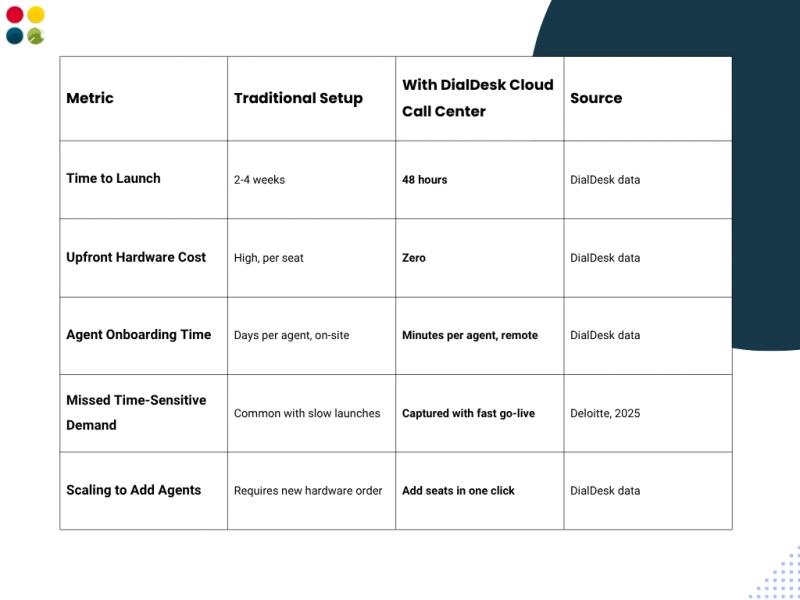
Businesses that can launch new support or sales lines within 48 hours capture time-sensitive demand, such as seasonal spikes or urgent product launches, that slower competitors miss entirely (Deloitte Business Agility Report, 2025).
What Makes a Cloud Call Center Faster Than a Traditional Setup
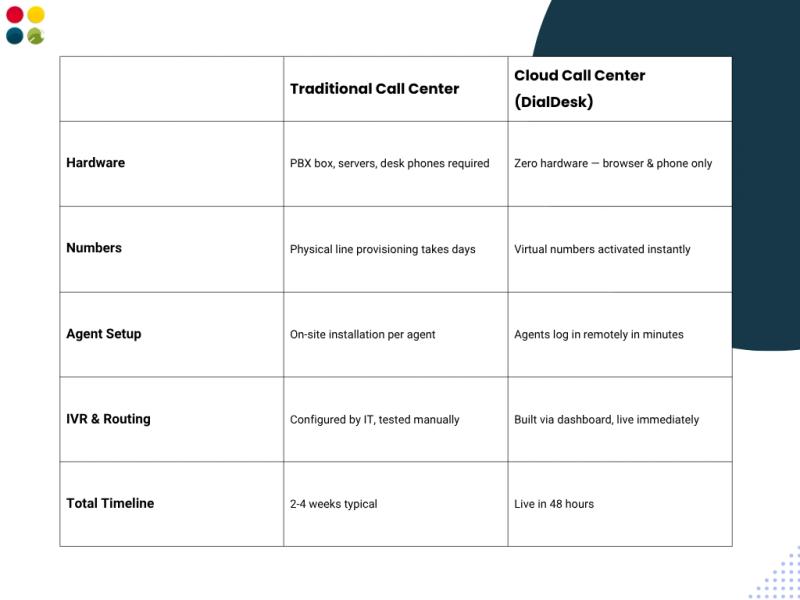
How DialDesk Gets a Cloud Call Center Live in 48 Hours
Setting up Cloud Call Centers quickly comes down to removing every step that traditionally depends on physical hardware or on-site visits.
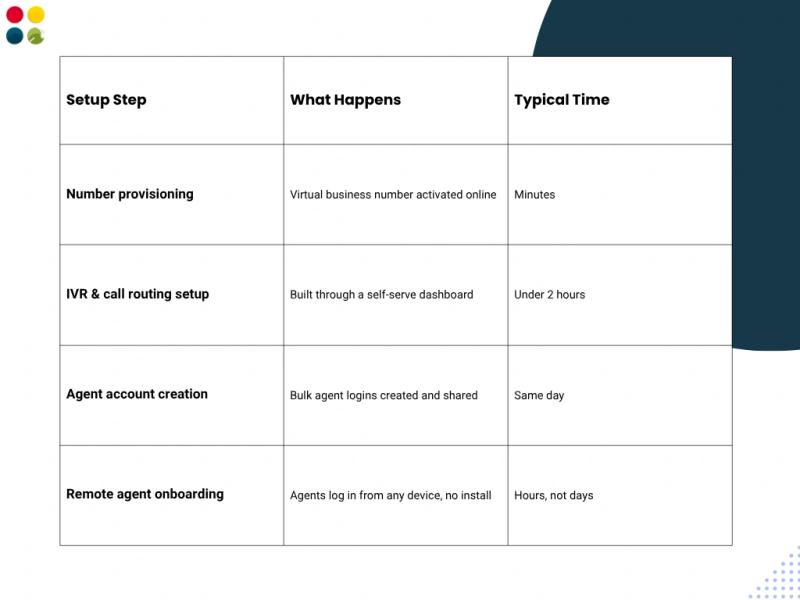
By the end of day two, a fully routed, recorded, and monitored Cloud Call Center is answering live calls — something a traditional setup couldn't achieve before week two.
Business Impact: The Numbers Behind a 48-Hour Cloud Call Center Launch
Businesses that launch on Cloud Call Centers instead of traditional setups see measurable time and cost advantages (Gartner, 2025).
✅ Trusted by 500+ Contact Centers Across India
DialDesk's Cloud Call Center platform is ISO 9001:2015 and ISO 27001:2013 certified, a reliable infrastructure that goes live fast without compromising security. See our full call center software India platform.
Key Takeaways
● Traditional Cloud Call Centers setup takes 2-4 weeks due to hardware procurement and on-site installation.
● A Cloud Call Center removes hardware dependency entirely, enabling a 48-hour launch.
● Number provisioning, IVR setup, and agent onboarding all happen online through a dashboard.
● Fast setup lets businesses capture time-sensitive demand that slower competitors miss.
● DialDesk's ISO-certified platform delivers speed without compromising reliability or security.
Conclusion
A Cloud Call Center is proof that speed and reliability are no longer a trade-off; a fully functional, recorded, and routed call center can go live in 48 hours instead of a month.
Every week spent waiting on hardware or IT installation is a week of missed calls, missed leads, or missed seasonal demand. Businesses that need to move fast can no longer justify the traditional setup timeline.
Explore how DialDesk's Cloud Call Center platform connects with your CRM integration and WhatsApp and chat support stack to launch a complete communication system in two days, not two weeks.
Opportunity doesn't wait for hardware to ship. DialDesk gets you live in 48 hours.
📅 Want to Launch Your Call Center This Week?
DialDesk's Cloud Call Center platform gets you from signup to live calls in 48 hours, no hardware, no IT delays, no waiting. Join 500+ contact centers across India already launching fast with DialDesk.