Key Takeaways
- Live chat is no longer just a customer support channel. In 2026, businesses can use it to answer buying questions, qualify leads, reduce friction, and influence revenue.
- Customers often leave a website not because they aren't interested, but because one unanswered question creates enough uncertainty to delay the purchase.
- Live Chat Support can help businesses engage high-intent visitors, recommend products, handle objections, and connect prospects with sales at the right moment.
- AI is making live chat more scalable by handling routine questions, identifying intent, assisting agents, and enabling businesses to support more conversations without relying entirely on human capacity.
- The most valuable live chat strategy isn't about getting more conversations. It's about creating better conversations that lead to better customer outcomes.
Why Is Live Chat Becoming a Revenue Channel in 2026?
Live Chat is becoming a revenue channel because it lets businesses engage customers at the exact moment they have a question, hesitation, or buying intent.
Instead of waiting for a visitor to fill out a form or contact sales later, businesses can help them while they are already on the website and considering their next step.
Think about what happens when someone visits your website. They look at a product.
They compare plans. They check pricing. They read a case study.
And then they stop. Maybe they have one question:
"Will this actually work for my business?"
It could take a salesperson 30 seconds to answer. But if nobody is available, that visitor may simply close the tab. This is where the role of live chat has changed.
It used to be primarily:
Customer has a problem → Support answers it.
Now, it can also be:
Customer has a question → Business removes the friction → Customer moves closer to a decision.
This shift — from only resolving problems to actively removing friction before a decision — is a very different role for live chat.
Live chat can still support customers.
But it can also help create, influence, and accelerate revenue.
What Does the Data Say About Live Chat and Customer Expectations?
Customer expectations for fast, convenient digital communication have made real-time engagement increasingly important.
Research from major customer-experience platforms consistently shows that customers value speed, convenience, and personalized interactions—and businesses that can respond effectively have an opportunity to influence both customer satisfaction and conversion.
A few industry findings illustrate the shift.
Customers increasingly expect immediate answers
HubSpot's research on customer service has consistently found that 90% of customers rate an "immediate" response as important or very important when they have a customer service question, with "immediate" defined as 10 minutes or less.
That expectation matters before the purchase too.
If a potential customer is comparing three vendors and one answers their question immediately while the others require an email or demo request, responsiveness becomes part of the buying experience.
Consumers value human interaction
Salesforce's State of the Connected Customer research has repeatedly highlighted the importance customers place on connected, personalized experiences.
The broader takeaway for businesses is simple:
Customers don't want to navigate your internal departments. They want their question answered.
This is exactly what makes live chat particularly useful.
A customer doesn't care whether their question technically belongs to sales, support, product, or operations.
They just want help.
Customer experience affects business outcomes
PwC's research into customer experience has found that consumers are willing to pay more for experiences that are convenient and valuable, while poor experiences can push customers away.
Live chat sits directly inside that experience.
When done well, it can reduce the effort required to get an answer.
And reducing customer effort can matter just as much as adding another feature to your website.
Sources: HubSpot, State of Service research; Salesforce, State of the Connected Customer; PwC, Future of Customer Experience research.
What Is the Difference Between Live Chat and Live Chat Support?
Live chat is a real-time communication channel between a business and its website visitors or customers.
Live Chat Support traditionally focuses on resolving customer questions and issues, while modern live chat can also support sales, lead qualification, product discovery, and conversion.
The technology may look similar.
The objective is different.
Traditional Live Chat Support
A customer asks:
"How do I reset my password?"
The support team provides the answer.
Conversation over.
Revenue-focused Live Chat
A visitor asks:
"How much does this cost for a team of 20?"
You could simply send them a pricing page.
Or you could ask:
"Sure. Are you looking for the solution primarily for customer support, sales, or both?"
Now you've learned something.
The visitor has given you context.
You may discover:
- Their team size
- Their use case
- Their current solution
- Their pain point
- Their timeline
- Their requirements
Because a chat can surface this much buyer context, businesses should stop treating every chat as a support ticket.
Some chats are questions.
Some are problems.
And some are buying signals.
How Does Live Chat Influence Buying Decisions?
Live chat influences buying decisions by reducing uncertainty at critical moments in the customer journey. When customers can quickly get answers about pricing, features, compatibility, implementation, delivery, or product fit, they have fewer reasons to postpone their decision or leave the buying journey.
Think about your own buying behaviour.
You rarely buy something expensive without questions.
You want to know:
- Is it right for me?
- Will it solve my problem?
- How much will it cost?
- How quickly can I get started?
- Does it work with what I already use?
- What happens if something goes wrong?
A website can answer many of these questions.
But not all of them.
And sometimes the information is technically there, but the customer doesn't know where to find it.
This is where a conversation helps.
Live chat can remove five common conversion barriers
1. Lack of information
The customer can't find what they need.
2. Uncertainty
They're interested but aren't convinced.
3. Complexity
There are too many products, plans, or options.
4. Risk
They're worried about making the wrong decision.
5. Friction
The next step feels like too much effort.
Live chat gives the customer somewhere to go instead of somewhere to leave.
Where Does Live Chat Fit Into the Customer Journey?
Live chat can support almost every stage of the customer journey, but its commercial value is particularly strong when customers are evaluating products, comparing options, or preparing to make a purchase.
The conversation should change depending on the customer's intent rather than treating every visitor the same way.
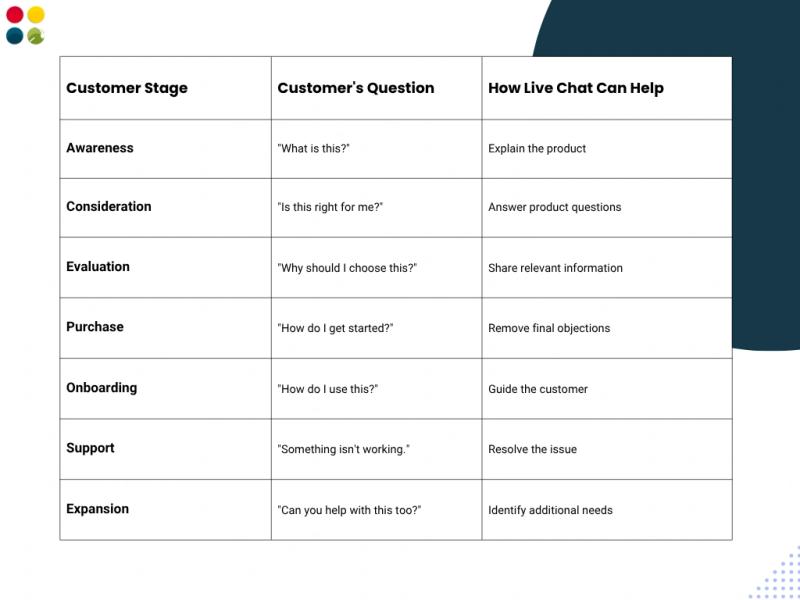
This is why live chat shouldn't necessarily disappear after the sale. A customer conversation can reveal new requirements. A support interaction can uncover an upsell opportunity. A product question can become a qualified lead. The conversation itself contains valuable information.
How Can Businesses Turn Live Chat Into a Revenue Channel?
Turning live chat into a revenue channel requires more than adding a chat widget to a website.
Businesses need to connect conversations with customer intent, lead qualification, sales workflows, and follow-up processes so that high-value opportunities don't disappear when the chat ends.
Here are some practical ways to do that.
1. Identify high-intent visitors
Not every visitor needs a sales conversation.
Someone reading a blog post may simply be researching.
Someone spending several minutes on your pricing page is different.
Someone visiting:
Pricing → Product → Case Study → Demo
is showing a much stronger signal.
Your live chat strategy should recognize that difference.
2. Ask better questions
The purpose of a sales chat isn't to interrogate the visitor.
It's to understand them.
Instead of:
"How can I help?"
Try:
"Are you looking to understand pricing, compare options, or solve a specific support challenge?"
This is a much easier question to answer.
And the response gives your team immediate context.
3. Qualify leads naturally
A conversation can gradually capture information such as:
- Company
- Industry
- Team size
- Requirement
- Current solution
- Implementation timeline
- Contact details
But don't ask for everything upfront.
A visitor shouldn't have to complete a five-field form before they can ask a simple question.
The conversation should earn the information.
4. Recommend the right next step
Not every visitor needs a demo.
Some need:
- A pricing page
- A product comparison
- Documentation
- A use case
- A support article
- A sales conversation
The smarter your live chat becomes, the more relevant the next step can be.
5. Make handoffs seamless
Imagine spending five minutes explaining your requirements to a chat agent.
Then you're transferred to sales. The salesperson says:
"Hi! So, what are you looking for?"
You have to explain everything again. This is a terrible customer experience.
A good live chat system should carry the conversation context forward.
The customer shouldn't have to repeat themselves.
Can AI Make Live Chat More Effective?
AI can make live chat more scalable by answering routine questions, identifying intent, assisting agents, summarizing conversations, qualifying leads, and escalating conversations when human involvement is needed. The biggest advantage is not simply automation—it is giving the right customer the right kind of help at the right time.
This becomes especially important as chat volume grows.
Imagine receiving 500 conversations in a day.
Your team doesn't necessarily need 500 people.
AI can handle straightforward questions such as:
"What are your business hours?"
"Where can I find pricing?"
"Do you integrate with X?"
"How long does onboarding take?"
At the same time, a conversation like:
"We're evaluating this for 5,000 users. Can you explain how implementation works?"
can be identified as high-intent and routed to the right person.
This is where AI becomes useful.
It can help separate:
Information seekers
from
Potential buyers
from
Customers who need human support.
How Can Live Chat Help Sales Teams Qualify Leads?
Live chat can give sales teams an earlier view of customer intent than traditional lead forms. Instead of receiving only a name, email address, and company, sales teams can receive context from the actual conversation, what the prospect wants, what problem they're trying to solve, and how urgently they need a solution.
Consider these two leads.
Lead A
Name: Rahul
Company: ABC Pvt. Ltd.
Message: "Please contact me."
Lead B
Company: ABC Pvt. Ltd.
Industry: Retail
Team: 80 agents
Current challenge: Slow response times
Current platform: Existing help desk
Requirement: AI-powered support
Timeline: This quarter
Which conversation would you rather have?
Lead B already tells the salesperson where to start.
Getting straight to the actual problem instead of re-discovering basic information is the value of conversational qualification.
The sales team doesn't have to spend the first five minutes discovering basic information.
They can start with the actual problem.
What Should You Look for in Live Chat Software?
The right live chat software should do more than display a chat box. It should help businesses manage conversations, understand customer intent, automate routine interactions, assist human agents, capture leads, and connect conversations with broader customer workflows — see how DialDesk's Live Chat Support covers these capabilities.
When evaluating a platform, look for:
Real-time communication
Customers should be able to start a conversation easily without navigating through multiple pages.
AI assistance
Useful capabilities can include:
- Intent detection
- Automated responses
- AI-powered FAQs
- Suggested replies
- Conversation summaries
- Sentiment analysis
Lead qualification
The platform should help identify and capture high-intent visitors without turning the conversation into a form.
Human handoff
AI should be able to bring in a human when the conversation becomes complex, sensitive, or commercially important.
Customer context
Agents should have access to relevant conversation history and customer information.
Analytics
You should be able to understand:
- Number of conversations
- Response time
- Resolution time
- Leads generated
- Qualified conversations
- Conversion rate
- Customer satisfaction
- Agent performance
Because if you're measuring only chat volume, you're measuring activity—not business impact.
How Should You Measure Live Chat ROI?
Live chat ROI should be measured by its influence on business outcomes, not simply by the number of conversations handled. Businesses should track how chat affects leads, opportunities, conversions, revenue, customer satisfaction, and support efficiency.
Some useful metrics include:
1. Chat-to-lead conversion rate
How many conversations become identifiable leads?
2. Lead-to-opportunity rate
How many of those leads become genuine sales opportunities?
3. Chat-assisted conversion rate
How often does a customer who interacted with chat eventually convert?
4. Response time
How quickly does the customer receive an answer?
5. Resolution rate
How many support issues are resolved through chat?
6. Customer satisfaction
Did the customer find the conversation useful?
7. Revenue influenced by chat
This is perhaps the most important question:
How much pipeline or revenue involved a live chat conversation somewhere along the customer journey?
That's a much more meaningful metric than:
"We handled 2,000 chats this month."
The better question is:
"What did those 2,000 conversations actually contribute to the business?"
Is Every Live Chat Conversation a Sales Opportunity?
No. Treating every conversation as a sales opportunity can actually damage the customer experience. Live chat works best when businesses understand customer intent and give people the help they need—whether that's information, support, or a path to purchase.
Someone asking:
"How do I update my email address?"
doesn't need a sales pitch.
Someone asking:
"Which plan would you recommend for a 100-person support team?"
probably does.
The difference is intent.
A good live chat strategy isn't about pushing every customer toward a purchase.
It's about recognizing when a customer is already moving in that direction.
What Does the Future of Customer Support Live Chat Look Like?
The future of Customer Support Live Chat is likely to be more connected, intelligent, and conversational, with AI handling routine interactions while human teams focus on complex support and high-value customer conversations. Sales and support will increasingly share customer context instead of operating as separate channels.
The old model looked like:
Website → Chat → Support
The emerging model looks more like:
Website → Conversation → Intent → AI/Agent → Resolution or Revenue Opportunity
Moving from a fixed website-to-support path to one driven by intent and shared context is a meaningful shift.
Customers don't think in departments.
They don't think:
"This is a sales question."
or:
"This is a support question."
They simply have a question.
The business needs to understand what that question means.
Sometimes it means:
Help me.
Sometimes:
Convince me.
And sometimes:
I'm ready to buy.
The brands that understand the difference will get far more value from their live chat investment.
How Can DialDesk Help Turn Conversations Into Opportunities?
At DialDesk, we believe customer conversations shouldn't live in silos. A customer might arrive with a support question.
Another might be evaluating your product. Someone else might already be ready to talk to sales. The conversation itself provides the context.
DialDesk helps businesses bring AI-powered interactions and human support together so routine conversations can be automated, agents can get better context, and customer intent can be handled more intelligently.
That means live chat doesn't have to remain just another support channel. It can become part of the larger customer journey:
First question → Conversation → Qualification → Conversion → Support → Retention
Because the most valuable conversation isn't always the one that closes a ticket.
Sometimes, it's the one that starts a relationship.
See how DialDesk's Live Chat Support and AI-powered automation work together to turn conversations into revenue opportunities — Book a demo.
Live chat isn't the only conversation channel worth optimizing — see how AI is also transforming help desk ticketing at DialDesk.
Final Takeaway
Live chat started as a convenient alternative to email and phone support.
But in 2026, that's no longer the full story — a live chat conversation can do much more.
In 2026, a live chat conversation can do much more. It can answer a question. Remove an objection. Qualify a prospect. Save a frustrated customer.
Help a salesperson understand what a buyer actually needs.
Or simply give someone enough confidence to click "Buy." The opportunity isn't to have more chats. It's to have more meaningful conversations.
Because sometimes a customer opens a chat because they need help.
And sometimes they open it because they're one good answer away from becoming your customer.