Why Should a Business Consider Switching to Cloud Telephony?
Businesses should consider Cloud Telephony because it removes the upfront hardware cost and maintenance burden of a traditional phone system, gives teams the flexibility to work from anywhere, and provides call recording and analytics that support better customer service. A Cloud Contact Center Solution becomes worth considering the moment a business needs to scale calling capacity, track performance, or support remote or multi-location teams.
Why the Decision to Switch Often Gets Delayed Longer Than It Should
Many businesses keep running their existing phone system simply because it still technically works, calls connect, and customers get through. But "still works" and "still serving the business well" are different standards, and the gap between them widens as a business grows.
The trigger to evaluate a Cloud Contact Center Solution is rarely a single dramatic failure. It's usually a slow accumulation of missed calls, inconsistent customer experience, and a manager who has no visibility into what's actually happening on calls.
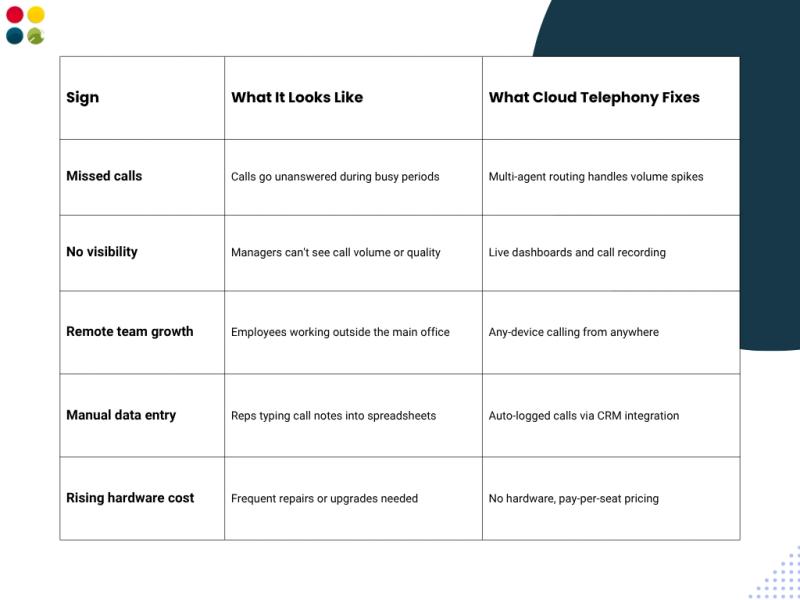
Cloud Telephony becomes worth considering the moment any of these signs appear, because delaying the switch rarely fixes the underlying problem; it just accumulates more missed opportunities.
💡 Why It Matters
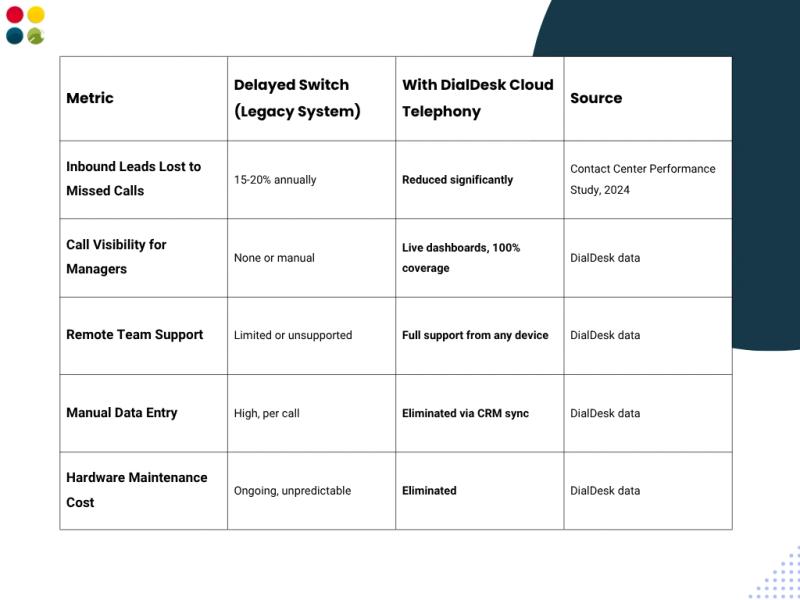
Businesses that delay evaluating a modern calling solution report losing an estimated 15-20% of inbound leads to missed or poorly handled calls each year (Contact Center Performance Study, 2024).
Signs It's Time to Consider a Cloud Call Center Solution
How to Evaluate Whether a Cloud Contact Center Solution Fits Your Business
Deciding on a business phone system upgrade comes down to matching a handful of practical questions to what your current system can and can't do.
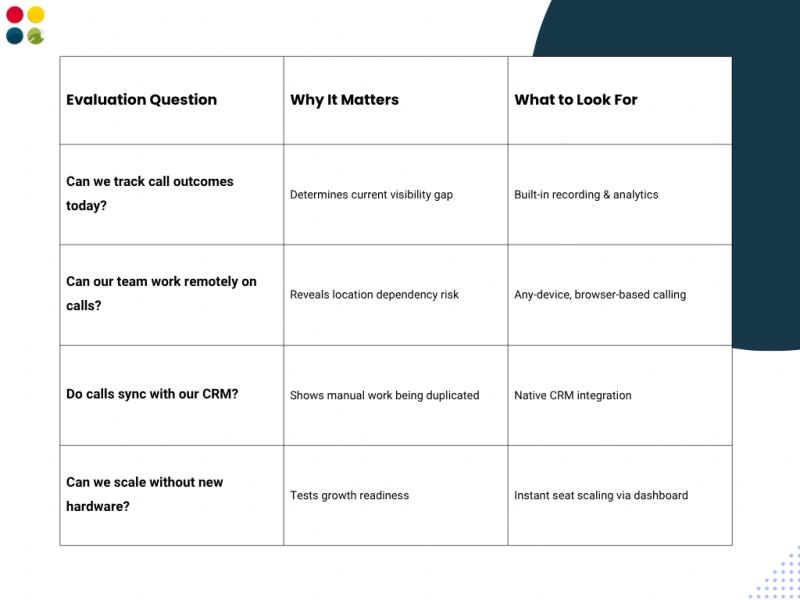
If more than one of these questions reveals a gap, it's a strong signal that a Cloud Call Center Solution would deliver immediate, measurable value.
Business Impact: The Numbers Behind Switching to Cloud Telephony
Businesses that make the switch to Cloud Telephony see measurable improvements in lead capture and operational visibility (Contact Center Performance Study, 2024).
✅ Trusted by 500+ Contact Centers Across India
DialDesk's Cloud Telephony platform is ISO 9001:2015 and ISO 27001:2013 certified — a proven Cloud Contact Center Solution for businesses ready to make the switch. See our full call center software India platform.
Key Takeaways
● The need to switch to Cloud Telephony rarely arrives as one dramatic failure; it builds up through missed calls and lost visibility.
● Missed calls, no call tracking, and manual CRM entry are all signs a business should evaluate a switch.
● A Cloud Contact Center Solution fixes these gaps with automated routing, recording, and CRM sync.
● Delaying the switch has a measurable cost: businesses lose an estimated 15-20% of inbound leads annually to missed calls.
● DialDesk's ISO-certified platform gives businesses a proven path to make the switch confidently.
Conclusion
The question isn't really whether Cloud Telephony is worth considering, it's how many missed calls, lost leads, and manual hours a business is willing to accept before making the switch.
Businesses that wait for a dramatic failure to force the decision usually discover the cost was accumulating quietly the whole time. Evaluating a Cloud Contact Center Solution proactively avoids that slow leak.
Explore how DialDesk's Cloud Telephony platform connects with your CRM integration and IVR and call routing stack to see what switching actually looks like.
The best time to switch was before the missed calls started. The next best time is now.
📅 Want to Evaluate Cloud Telephony for Your Business?
DialDesk's Cloud Telephony platform fixes missed calls, manual data entry, and visibility gaps in one system. Join 500+ contact centers across India already making the switch with DialDesk.