Why Is My Call Center Ineffective?
A call center becomes ineffective for seven compounding reasons: lack of clear goals and measurable KPIs, insufficient customer focus and segmentation, poor or absent inbound call handling processes, misaligned customer-centricity (optimising internal metrics over customer outcomes), inadequate agent training and technology, an absence of dedicated call center infrastructure and accountability, and no systematic performance monitoring. Each reason compounds the others — making it possible for a call center to be genuinely busy while being genuinely ineffective. DialDesk’s ISO-certified platform addresses all seven through structured implementation.
Why Busy Call Centers are Not the Same as Effective Ones
An ineffective Call Center is rarely idle. It is often busy — handling high volumes, maintaining headcount, and absorbing operating costs. What it is not doing is converting those inputs into the outcomes that matter: customer satisfaction, first-call resolution, and retention.
In India’s competitive service landscape — from Delhi’s enterprise market to Bengaluru’s tech sector — an ineffective call center does not just frustrate callers. It drives them to competitors. 67% of customers cite poor service as the primary reason they switch brands (Zendesk, 2024). Understanding why a call center underperforms is the prerequisite for fixing it.
💡 Why It Matters
Call center ineffectiveness is not a customer service problem. It is a revenue problem. Businesses lose $75 billion annually to poor customer service (Forbes, 2024). For dedicated call centers in India handling hundreds of daily interactions, each identified inefficiency is a recoverable revenue opportunity.
The 7 Reasons Your Call Center Could Be Ineffective and How to Fix Each One
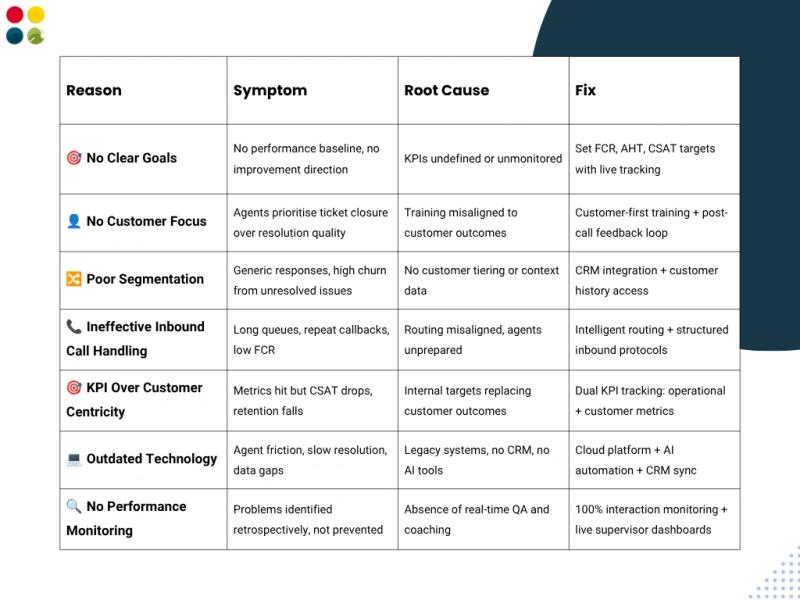
Breaking Down Each Reason: The Cost and the Fix
1. Lack of Clear Goals and Measurable KPIs
Without knowing what success looks like, improvement is impossible to direct. Call centers operating without defined FCR targets, AHT benchmarks, and CSAT floors cannot identify where performance is leaking or demonstrate improvement to stakeholders. The fix is establishing specific, measurable KPI targets and tracking them in real time — not quarterly.
2. Absent or Misaligned Customer Focus
Call centers that train agents to close tickets rather than resolve customer needs generate the metrics that look like success while delivering the experiences that create churn. 67% of customers switch brands due to poor service (Zendesk, 2024). A customer-focused training model measures agent success by the quality of resolution and the customer’s post-interaction sentiment — not by call count or wrap-up speed alone.
3. Lack of Customer Segmentation
Treating all customers identically is the most efficient path to satisfying none of them adequately. Without segmentation by value tier, product type, or issue category, call centers cannot prioritise their highest-value interactions, route complex queries to specialist agents, or personalise communication in the way that 73% of customers say influences their loyalty decisions (PwC, 2024).
4. Ineffective Inbound Call Handling
Poor inbound call handling compounds faster than any other call center failure. Calls routed to the wrong agent, callers asked to repeat information they have already provided, and interactions that end without full resolution all generate callbacks — each one more expensive than a first-contact resolution. Intelligent routing and structured inbound call handling protocols reduce repeat contacts by up to 22% (DialDesk data).
5. Optimising Internal Metrics Over Customer Outcomes
A call center that achieves its AHT target by shortening interactions before resolution is not an efficient one — it is a churn generator. The most common form of call center ineffectiveness in India’s Dedicated Call Center market is the divergence between what the operation measures and what its customers actually need. Aligning KPIs to customer outcomes — FCR, CSAT, retention rate — alongside operational metrics corrects this misalignment.
6. Outdated Technology and Missing Infrastructure
Legacy on-premise call center systems, absent CRM integration, and no AI automation create an operating environment where even well-trained agents perform below their capability. A dedicated call center without modern cloud infrastructure, real-time dashboards, and omnichannel capability is structurally disadvantaged against competitors who have invested in the right technology — regardless of agent quality.
7. Absence of Systematic Performance Monitoring
Call centers that discover performance problems in monthly reports have already absorbed weeks of customer churn, agent bad habits, and compliance risk. Real-time performance monitoring — covering 100% of interactions through AI-powered quality tools — surfaces problems the day they emerge, enabling supervisors to coach, correct, and prevent before the damage compounds.
✅ Trusted by 500+ Contact Centers Across India
DialDesk’s dedicated call center platform addresses all 7 ineffectiveness drivers through structured implementation: ISO 9001:2015 and ISO 27001:2013 certified, with intelligent inbound call handling, AI-powered real-time monitoring, CRM integration, and PAY AS YOU USE pricing that makes the fix accessible at every business scale.
Key Takeaways
• A busy call center is not the same as an effective one — 67% of customers switch brands due to poor service, making call center ineffectiveness a direct revenue problem, not just a support one.
• The 7 primary causes of call center ineffectiveness are: absent KPIs, missing customer focus, no segmentation, poor inbound call handling, internal-metric misalignment, outdated technology, and absent performance monitoring.
• Ineffective Inbound Call Handling is the fastest-compounding failure mode — each misrouted or unresolved call generates a more expensive callback, degrading both cost-efficiency and CSAT simultaneously.
• Real-time performance monitoring covering 100% of interactions identifies problems the day they occur — eliminating the weeks of compounding damage that monthly QA cycles allow.
• DialDesk’s ISO-certified dedicated call center platform addresses all 7 ineffectiveness drivers through structured implementation — with AI monitoring, intelligent routing, CRM integration, and PAY AS YOU USE flexibility.
Conclusion
Call center ineffectiveness is never caused by a single failure. It is the compounding result of several gaps operating simultaneously — each one amplifying the others. The good news is that each gap is identifiable, addressable, and measurably improvable with the right technology, training, and operational framework.
The dedicated call centers that reverse ineffectiveness are not the ones that invest in the most expensive technology. They are the ones that identify their specific gaps, implement targeted fixes, and measure the improvement in real time rather than retrospect. In India’s dynamic service economy, this discipline is what separates the call centers customers stay with from those they abandon.
Explore how DialDesk’s dedicated call center platform addresses every root cause of call center ineffectiveness — from intelligent inbound call handling and CRM integration to real-time performance monitoring and structured agent training.
Every inefficiency has a fix. DialDesk implements the right ones.
📅 Want to Identify and Fix What’s Making Your Call Center Ineffective?
DialDesk’s dedicated call center platform delivers intelligent inbound call handling, real-time AI monitoring, CRM integration, and structured agent training — ISO certified, PAY AS YOU USE, with measurable KPI improvement in the first quarter. Join 500+ contact centers across India already performing at their potential.