What are the Key Strategies for Optimizing a Call Center?
The key strategies for optimising a call center are seven evidence-backed actions: investing in the right technology stack (including CRM integration and cloud infrastructure), prioritising agent training and engagement, using real-time data to drive decisions, automating repetitive workflows, improving call routing and scheduling precision, maintaining a customer-first operating model, and implementing continuous feedback loops. Call centers that execute all seven consistently report measurably higher CSAT, lower AHT, and stronger agent retention. DialDesk’s platform delivers all seven as a single ISO-certified managed service.
Why Call Center Optimisation Is Never a One-Time Project
India’s call centers operate in a market where customer expectations shift quarterly, technology evolves annually, and competitive pressure is continuous. A Call Center optimised two years ago on yesterday’s technology is an underperforming one today. Optimisation is not a project; it is an operating posture.
Call centers tracking FCR, AHT, and CSAT consistently outperform those relying on periodic reviews (Forrester, 2024). In Delhi, Mumbai, Bengaluru, and India’s Tier-2 growth markets, the businesses that treat optimization as a daily operating standard, not a quarterly initiative, build the competitive separation that sustains growth.
💡 Why It Matters
A 1% improvement in first-call resolution reduces call center operating costs by approximately 1%, compounding across thousands of daily interactions into material savings. For call centers in India handling 500+ interactions daily, systematic optimization is the highest-ROI operational investment available.
The 7 Strategies That Actually Optimise a Call Center
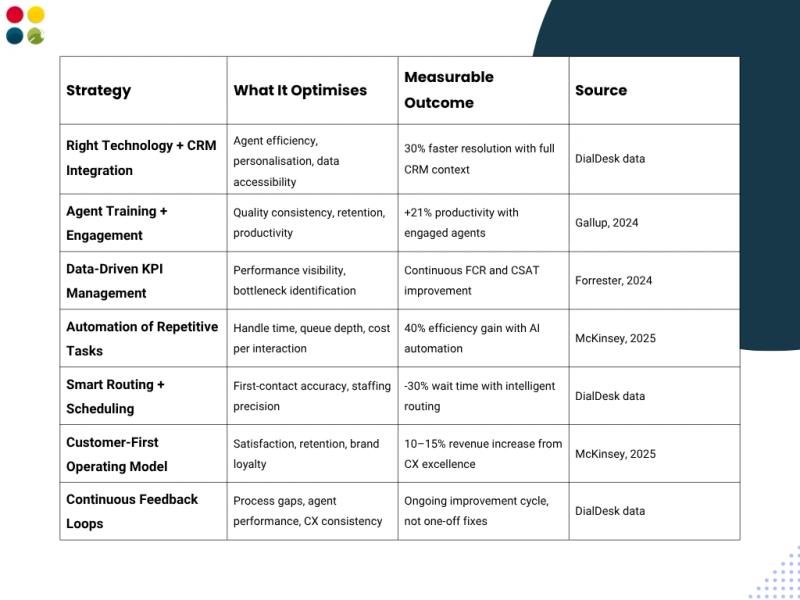
Strategy Deep Dives: How to Execute Each One
1. Invest in CRM Integration and the Right Technology Stack
CRM integration is the single highest-impact technology investment a call center can make. When agents see complete customer history, purchase records, and prior interaction context the moment a call connects, resolution speed increases by 30% and personalisation improves immediately. A cloud-based platform that unifies CRM, call management, chat, and WhatsApp into a single agent dashboard eliminates the system-switching overhead that converts capable agents into frustrated ones.
2. Prioritise Agent Training and Engagement
Training is not a one-time onboarding event. It is a continuous investment in the capability on which every other technology component depends. Scenario-based training, real-time AI coaching prompts, and gamified performance recognition increase agent productivity by 21% while reducing attrition by up to 31% (Gallup, 2024). The most optimised call centers treat their agents as strategic assets, not interchangeable headcount.
3. Use Real-Time Data to Drive Decisions
Numbers do not lie, but delayed numbers lie by omission. FCR, AHT, CSAT, call abandonment rate, and queue depth reviewed in weekly reports miss the daily performance gaps that compound into monthly problems. Real-time dashboards surface these signals as they occur, enabling supervisors to intervene, coach, and reallocate within the same shift rather than after the damage is done.
4. Automate Where Repetition Is the Work
Repetitive tasks are the silent efficiency drain in every call center. IVR self-service handles FAQ queries without agent involvement. Automated call routing eliminates manual transfer overhead. AI chatbots deflect up to 40% of routine digital queries (McKinsey, 2025). Automation does not reduce the quality of customer service; it concentrates human agents' capabilities on the interactions where they create the most value.
5. Improve Call Routing and Workforce Scheduling
Nothing frustrates callers faster than being bounced between agents who cannot help them. Skill-based routing, matching caller intent to agent capability before the call connects, reduces transfers, improves FCR, and shortens handle time simultaneously. Precise workforce scheduling that aligns staffing to forecast demand prevents both the cost of idle agents and the CSAT damage of understaffed queues.
6. Maintain a Customer-First Operating Model
Call center optimization that focuses exclusively on internal efficiency metrics- AHT, cost per call, wrap-up time- without reference to customer outcomes optimises the wrong variable. The call centers that sustain performance improvement are those that track customer satisfaction, post-interaction NPS, and retention alongside operational KPIs. Both matter. Neither alone is sufficient.
7. Build Continuous Feedback Loops
Customer surveys reveal what the business cannot see from inside. Agent feedback identifies process gaps that management metrics miss. The call centers that improve fastest are those that capture both, act on both, and close the loop by communicating changes back to the teams that provided the input. This feedback culture is the operating system that makes every other optimization strategy sustainable.
✅ Trusted by 500+ Contact Centers Across India
DialDesk’s call center optimization platform delivers CRM integration, AI automation, real-time analytics, structured training, and intelligent routing as one ISO 9001:2015 and ISO 27001:2013-certified managed service. India’s only PAY AS YOU USE model.
Key Takeaways
• Call center optimization is an operating posture, not a one-time project; businesses that treat it as continuous consistently outperform those that treat it as periodic.
• CRM Integration is the highest-impact individual technology investment in call center optimization, improving resolution speed by 30% and enabling agent personalisation from the first second of every call.
• AI automation handles up to 40% of routine queries, freeing agents for the complex, high-value interactions where human judgement and empathy drive the strongest customer outcomes (McKinsey, 2025).
• Agent training and engagement deliver compound returns: 21% higher productivity, 31% lower attrition, and measurably higher CSAT, making people investment the highest-ROI optimisation lever available.
• DialDesk’s platform delivers all 7 optimisation strategies as a single ISO-certified managed service, with real-time analytics, CRM integration, and AI automation from day one.
Conclusion
Call center optimization is not about making one big change. It is about consistently improving technology, processes, and people in alignment. Every strategy in this guide compounds with the others; CRM integration makes training more effective; real-time data makes routing more accurate; automation makes agent engagement more sustainable.
The call centers that implement all seven strategies, in India’s metro markets and beyond, build the operational capability that turns customer interactions from a cost into a competitive advantage. Those that optimise one variable in isolation find that the gains are real but limited.
Explore how DialDesk’s call center optimisation platform delivers CRM integration, AI automation, real-time analytics, and structured training as one certified, scalable solution built for India’s most demanding call center environments.
Optimisation is the strategy. DialDesk is the execution.
📅 Want to Optimise Your Call Center With the Right Strategies?
DialDesk’s call center optimisation platform delivers CRM integration, AI automation, real-time analytics, intelligent routing, and structured agent training — ISO certified, PAY AS YOU USE, built for India’s call center reality. Join 500+ contact centers already delivering measurably better CX.