What are the Key Components of an Efficient Call Center?
An efficient call center is built on seven key components: a skilled and well-managed workforce, advanced technology infrastructure (including a cloud-based contact center platform), intelligent call routing and IVR systems, workforce management and scheduling tools, quality monitoring and performance management, real-time reporting and analytics, and omnichannel customer support. When these components operate in alignment, call centers reduce handle time, improve first-call resolution, and build customer loyalty that drives long-term revenue. DialDesk integrates all seven components into one ISO-certified, PAY AS YOU USE platform.
Why Most Call Centers Underperform — And What the Top 10% Do Differently
Having a Call Center is not the same as having an efficient one. Businesses across India’s growing digital economy invest in call center infrastructure and still experience slow response times, poor first-call resolution, and high agent attrition — because the components that power efficiency are absent, disconnected, or outdated.
Call centers that deploy cloud-based contact center infrastructure alongside AI automation and real-time analytics are 40% more cost-efficient than those on legacy on-premise systems (McKinsey, 2025). The difference is not effort — it is architecture. The right components, properly integrated, convert a call center from a cost centre into a competitive advantage.
💡 Why It Matters
Companies that invest in call center efficiency see 10–15% revenue increases from improved customer experience (McKinsey, 2025). For businesses in India’s competitive service economy, every component of the call center either adds to or erodes the customer loyalty that sustains growth.
The 7 Key Components of a High-Efficiency Call Center
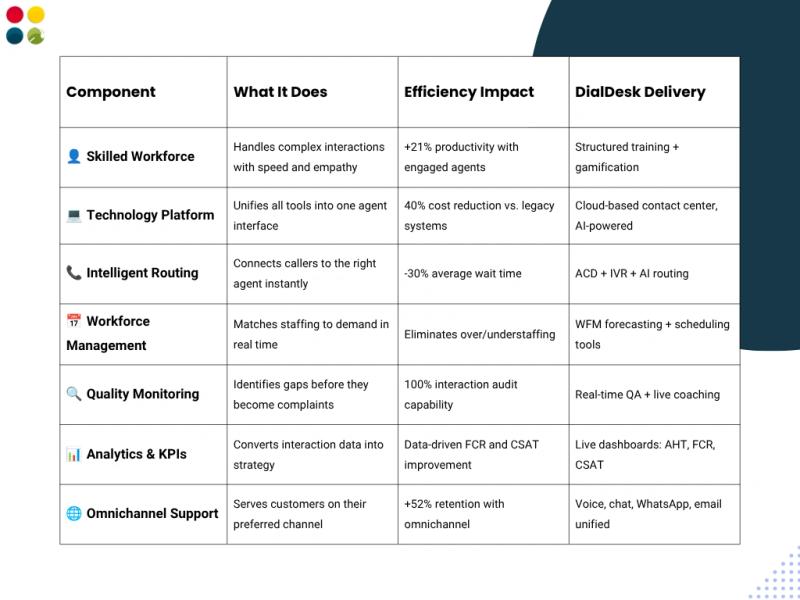
Deep Dive: The 7 Components That Drive Call Center Efficiency
1. Skilled Workforce and Agent Management
Agents are the call center’s primary delivery mechanism. Every component that follows amplifies — or wastes — their capability. Engaged agents deliver 21% higher productivity and generate 10% higher customer satisfaction scores (Gallup, 2024). The most efficient call centers invest in continuous training, real-time coaching, and recognition programs that retain experienced agents rather than constantly replacing them.
2. Cloud-Based Contact Center Infrastructure
A cloud-based contact center replaces expensive on-premise hardware with scalable, always-on infrastructure accessible from anywhere. It integrates voice, chat, email, and WhatsApp into a single agent dashboard — eliminating the system-switching that consumes agent time and erodes customer experience. Cloud platforms are 30–40% more cost-effective than on-premise equivalents and deploy in days rather than months (Deloitte, 2024).
3. Intelligent Call Routing and IVR
Every second a customer waits in the wrong queue is a second of frustration compounding. Intelligent routing — powered by ACD, skill-based logic, and AI intent detection — connects callers to the right agent in under 30 seconds. IVR self-service deflects routine queries entirely, reducing agent workload by up to 20% without reducing the quality of customer resolution (Gartner, 2024).
4. Workforce Management and Scheduling
Overstaffed shifts waste budget. Understaffed shifts damage CSAT. Workforce management tools forecast call volume by hour, day, and season — enabling precise scheduling that keeps staffing aligned with demand without the manual overhead. Real-time monitoring allows supervisors to adjust in-shift when volume spikes, preventing SLA breaches before they occur.
5. Quality Monitoring and Performance Management
Quality in a call center is only sustainable when it is continuously measured. AI-powered quality monitoring tools review 100% of interactions — not the 5–10% that manual sampling covers — flagging compliance risks, coaching opportunities, and escalation signals in real time. This continuous feedback loop is the difference between a call center that maintains quality standards and one that discovers they have slipped in the next customer satisfaction survey.
6. Real-Time Reporting and Analytics
Data without visibility is waste. Real-time dashboards displaying AHT, FCR, CSAT, queue depth, and agent performance enable supervisors to identify and resolve performance gaps the same day they emerge — not the same quarter. Call centers that track and act on live KPI data consistently outperform those relying on periodic reports (Forrester, 2024).
7. Omnichannel Customer Support
Modern customers move between voice, WhatsApp, chat, and email within a single interaction lifecycle. A call center that operates these channels in silos forces customers to repeat themselves at every transition. An integrated omnichannel platform — where conversation context travels with the customer — increases retention by 52% compared to fragmented multi-channel operations (Aberdeen, 2024).
✅ Trusted by 500+ Contact Centers Across India
DialDesk’s cloud-based contact center platform integrates all 7 efficiency components into one ISO 9001:2015 and ISO 27001:2013-certified managed service. India’s only PAY AS YOU USE model means businesses access enterprise-grade call center infrastructure without the CAPEX commitment.
Key Takeaways
• An efficient call center is built on 7 integrated components — skilled agents, cloud infrastructure, intelligent routing, workforce management, quality monitoring, analytics, and omnichannel support. Weakness in any one degrades the others.
• Cloud Based Contact Center infrastructure is 30–40% more cost-effective than on-premise alternatives — and the foundation that makes every other efficiency component work at scale.
• Intelligent routing reduces average wait time by 30% while IVR self-service deflects up to 20% of routine queries without agent involvement (Gartner, 2024).
• Companies investing in call center efficiency see 10–15% revenue increases through improved customer experience — making each component an ROI-positive operational decision.
• DialDesk’s integrated platform delivers all 7 components as one managed service — ISO certified, AI-powered, and scalable on India’s only PAY AS YOU USE model.
Conclusion
Call center efficiency is not a single initiative. It is the compounding result of seven components working in alignment. Technology without trained agents underperforms. Analytics without action is noise. Omnichannel without context continuity frustrates the customers it was designed to serve.
The call centers that maximise efficiency are those that deploy all seven components in integration — and measure the outcome continuously. In India’s competitive digital economy, this efficiency is the infrastructure that separates the businesses customers stay with from those they leave.
Explore how DialDesk’s cloud-based contact center platform integrates all seven efficiency components into one certified, scalable, AI-powered managed service.
Efficiency is built component by component. DialDesk builds all of them.
📅 Want to Build a More Efficient Call Center?
DialDesk’s cloud-based contact center platform delivers all 7 key efficiency components — AI routing, real-time analytics, omnichannel support, workforce management, and quality monitoring — in one ISO-certified managed service. India’s only PAY AS YOU USE model. Join 500+ contact centers already delivering measurable efficiency gains.