What is AI in Customer Service?
AI in Customer Service is the use of machine learning, NLP, and predictive analytics to automate and improve support operations. In agent scheduling, it replaces manual planning with demand-accurate, self-improving workforce intelligence — predicting volume with 95–98% accuracy and matching the right agent to the right query at the right time.
The Scheduling Problem That's Quietly Killing Your CX
Picture a Monday morning at a growing D2C brand. Orders are live. WhatsApp tickets are piling up. The phone queue is building. And half the support team is on a break they don't technically need right now, while the other half is fielding three conversations simultaneously.
This is not a talent problem. It is not a motivation problem. It is a scheduling problem, and it is happening in contact centres every single day, at every scale.
The root cause is almost always the same: scheduling decisions are made based on yesterday's averages rather than tomorrow's actual demand. Managers work from historical spreadsheets, gut estimates, and WFM tools that were not built to handle the speed, volume, or channel complexity of modern AI in Customer Service operations.
The consequences are compound. When agents are in the wrong place at the wrong time:
• Customers wait longer than they should — and 72% expect resolution in minutes, not hours (Salesforce, 2024)
• SLA breaches happen — not because of poor service quality, but poor timing
• Agents handling disproportionate workloads burn out — feeding India's 30–45% annual contact centre attrition rate (NASSCOM, 2024)
• Managers fire-fight instead of lead — reacting to queue crises rather than preventing them
The most expensive scheduling mistake is not paying for too many agents. It is losing customers and agents alike because the right people were never in the right place at the right time.
Why Traditional Scheduling Always Falls Short?
Manual workforce management has three structural limitations that no spreadsheet improvement will solve:
1. It Uses Averages, Not Patterns
Traditional scheduling takes last month's volume and applies it to next month's rota. This works until it doesn't, the moment a campaign launches, a policy changes, or an evening query spike emerges that no average captures. AI customer service scheduling, by contrast, analyses 13+ months of interaction data to find patterns that aggregate views will always obscure.
2. It Is Blind to Channel Shift
Customers are not loyal to one channel. A query that would have arrived by phone in 2022 now arrives via WhatsApp at 9 PM. Traditional WFM tools were not built to model this dynamic cross-channel demand. AI is.
3. It cannot React Fast Enough
Even when a manager identifies a queue problem, the corrective window is often 20–40 minutes. AI customer experience dashboards surface reallocation recommendations in under 60 seconds — transforming the manager's role from firefighter to strategic decision-maker.
The Full Cost of Broken Scheduling and the AI Fix
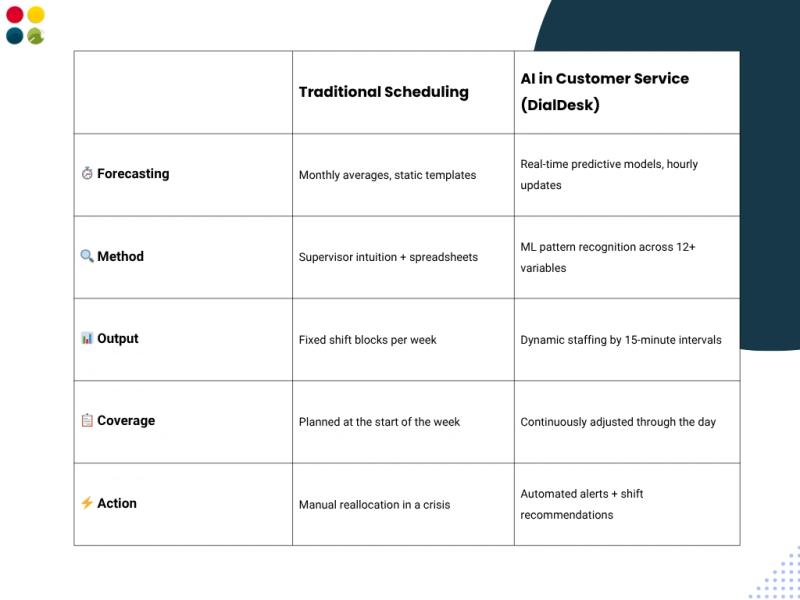
Every scheduling failure mode has a measurable business cost. Here is how AI in customer service resolves each one:
How AI in Customer Service Optimizes Scheduling: The 6-Step Engine
AI agent scheduling is not a single feature — it is a pipeline of interconnected intelligence that converts raw interaction data into precise, self-improving workforce decisions.
1. Demand Forecasting: AI analyses historical ticket volumes, seasonality patterns, campaign calendars, and real-time channel shifts to predict demand with 95–98% accuracy — per channel, per hour, per day. This eliminates the guesswork that causes both overstaffing and understaffing in a single model.
2. Automated Roster Generation: AI builds shift plans, break patterns, channel assignments, and peak-hour backup schedules automatically — factoring in agent availability, skill profiles, predicted volume, and SLA targets. No Excel. No WhatsApp coordination. No last-minute changes.
3. Skill-Based Assignment: AI maps each forecasted query type to the agent profile most likely to resolve it in the fewest interactions — reducing unnecessary transfers, cutting AHT, and improving first-contact resolution rates.
4. Real-Time Queue Intelligence: Live dashboards monitor queue depth, shift adherence, and real-time sentiment scores simultaneously. When a risk threshold is breached, an AI-generated reallocation recommendation reaches the manager in under 60 seconds, not 60 minutes.
5. Workload Equity Management: AI tracks cumulative peak-shift exposure per agent and flags when workload distribution is becoming unequal. This directly reduces the burnout patterns that drive attrition — translating to 22% lower burnout markers and 17% higher agent satisfaction scores (Gartner, 2024).
6. Continuous Learning Loop: After every completed shift, AI updates its forecasting model using resolution outcomes, CSAT scores, and escalation rates. Every interaction makes the next forecast more accurate — creating a compound improvement effect unavailable in any static WFM tool.
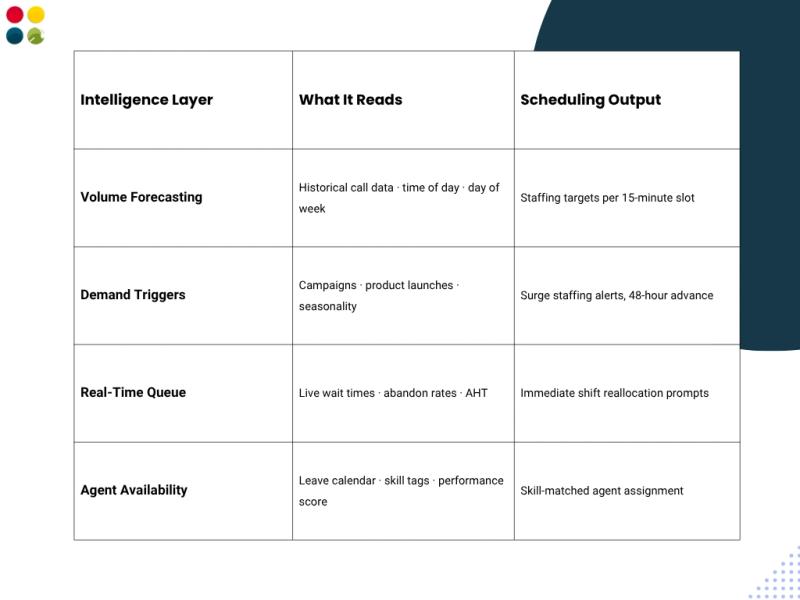
AI Scheduling Mechanisms: What They Analyze and What They Output
A practical breakdown of every AI layer in the scheduling engine — what data it reads and what decision it produces.
Still Scheduling on Spreadsheets?
DialDesk maps your demand patterns — by channel, time slot, and query type — in under 48 hours. See exactly where your staffing gaps are before they cost you, customers.
▶ Get a Free Scheduling Audit → dialdesk.in
What AI in Customer Service Scheduling Means for AI Customer Experience?
Scheduling is not an internal operations function that sits separate from AI Customer Experience. It is the hidden variable that determines whether a customer waits 40 seconds or 4 minutes, whether they speak to an agent equipped to help them or one who is already on their seventh consecutive escalation of the hour.
When AI in customer service aligns staffing with real demand:
• Customers reach the right agent faster — shorter queues, lower abandon rates, higher CSAT.
• Agents handle query types they are trained for — higher FCR, fewer unnecessary transfers, stronger quality scores.
• Escalations fall — not because customers are asking less complex questions, but because the team is resourced to answer them.
• Agents feel equitably treated — less burnout, longer tenure, and notably better empathy in customer-facing interactions.
The fastest CX improvement most brands can make is not hiring more agents. It is ensuring the agents they already have are in the right place, at the right time, with the mental capacity to deliver their best work.
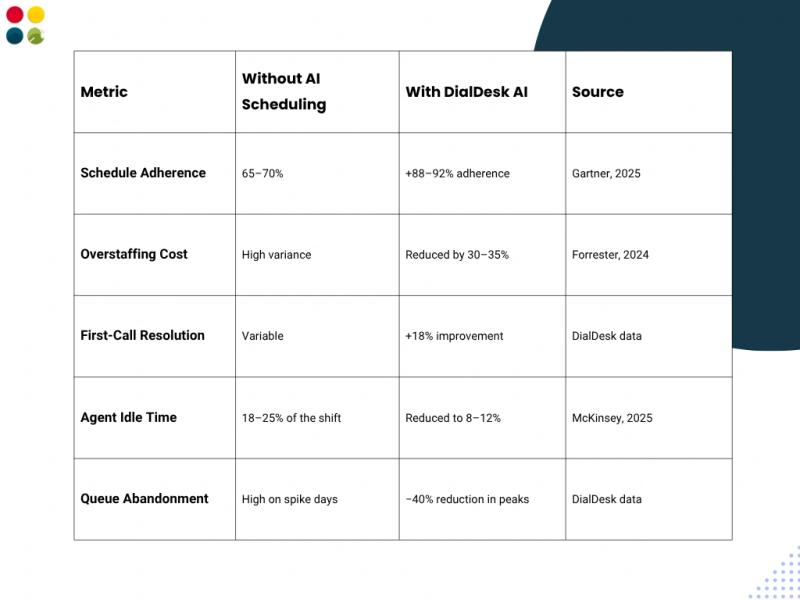
Measurable Impact: AI in Customer Service Scheduling by the Numbers
✅ In a 7-day DialDesk deployment, a mid-sized furniture brand reduced peak-hour response times by 41% — without adding a single agent. AI identified an 8:30–9 PM query surge that 13 months of manual reporting had never flagged. One scheduling adjustment. Immediate, measurable CX improvement.
The Agent Wellbeing Dimension: Why Scheduling Is a Retention Strategy
Agent attrition is one of the most expensive and underacknowledged costs in contact centre operations. In India, annual attrition rates run at 30–45%, with poor scheduling consistently ranking among the top five stated reasons for departure (NASSCOM, 2024).
AI in customer service addresses this directly. When AI scheduling ensures:
• Fair rotation of peak and off-peak shifts across the team
• Predictable break patterns rather than ad hoc, pressure-driven break cancellations
• Workload matched to individual agent capacity rather than queue priority alone
• Advance notice of shift changes rather than last-minute WhatsApp scrambles
...agents experience the scheduling environment as equitable and stable. The result: 22% reduction in measurable burnout markers and 17% improvement in agent satisfaction scores (Gartner, 2024).
Reduced attrition has a direct financial and CX value. Every agent retained is knowledgeable, and quality and consistency are preserved. Every agent lost is an onboarding cost, a performance lag, and a customer-facing inconsistency introduced.
✅ DialDesk is ISO 9001:2015 and ISO 27001:2013 certified. Our AI scheduling engine is specifically trained on Indian contact centre data — accounting for regional language patterns, festive demand cycles, and WhatsApp-first query behaviours unique to the Indian market.
Real Example: How AI Scheduling Transformed a Furniture Brand's Evening CX
Case Study — Mid-Sized Furniture Brand, DialDesk Deployment
A mid-sized furniture brand handling 1,500+ orders a month kept missing SLAs in the evening.
The assumption was obvious: they needed more agents. In fact, they were about to hire four. Then AI stepped in and looked at the data differently.
DialDesk analyzed 13 months of interactions and found a very specific pattern. Queries weren’t just “higher in the evening.” They were spiking sharply between 8:30 and 9 PM, when customers got home and checked their deliveries.
That small window was getting lost in broader reports.
The fix didn’t require hiring. The team simply adjusted shift schedules to add coverage during that peak time.
The impact was immediate. Response time dropped by 41% within a week. SLA breaches during the evening disappeared. Agent stress during peak hours went down. And the hiring budget stayed intact.
This is what Customer Service AI looks like in workforce management. Not more dashboards, just clearer decisions based on what was always there, but easy to miss.
Key Takeaways
- AI in customer service moves teams away from reactive, average-based scheduling to something far more precise. It predicts demand with up to 95–98% accuracy, so you’re not constantly playing catch-up.
- And when scheduling is off, it shows up directly in the customer experience. Longer queues, missed SLAs, burned-out agents, and higher attrition. These issues don’t stay isolated; they build on each other.
- With AI-led scheduling, teams typically see 12–18% lower staffing costs and 20–40% higher agent productivity, while the customer experience improves at the same time (Deloitte, 2024; McKinsey, 2025).
- Because good scheduling isn’t just about filling shifts. It’s about connecting every decision to what the customer feels, shorter wait times, quicker resolutions, fewer escalations, and agents who are actually in the right state to help.
- It also has a real impact on the agent's well-being. When workload is distributed more fairly, burnout drops by 22% and satisfaction increases by 17% (Gartner, 2024).
- For most brands, the fastest way to improve CX isn’t hiring more people. It’s using the team they already have more intelligently.
Conclusion
Agent scheduling has usually been treated as a back-office task. Managed in spreadsheets, updated over WhatsApp, and only really noticed when things started to break during peak hours.
AI changes that completely.
With AI, scheduling becomes proactive instead of reactive. It’s based on actual demand patterns, not guesswork. It distributes workload more fairly and connects directly to the kind of customer experience you’re trying to deliver.
The impact goes beyond operations. You see better CX, lower attrition, and teams that are actually set up to do their best work when it matters most.
The brands getting this right aren’t always the ones with the biggest teams. They’re the ones using their teams more intelligently.
A smarter schedule is the most underestimated CX improvement available to you right now.
AI in customer service makes it available — without adding a single headcount.
Make Your Workforce Smarter — Not Bigger
DialDesk's AI in customer service turns scheduling from a weekly headache into a strategic CX advantage. 500+ brands. Proven results. Real-time intelligence.
▶ Book Your Free Demo → dialdesk.in/book-demo