How Do AI and ML Detect Retail Fraud?
AI and ML detect retail fraud by continuously analysing transaction data, customer behaviour patterns, and network signals in real time. Machine learning models identify anomalies, unusual purchase locations, account access patterns, or return behaviour that deviate from established baselines, flagging potential fraud within milliseconds. Unlike static, rule-based systems, ML models automatically adapt to new fraud tactics, making them the most effective and scalable fraud detection tools available to retailers today.
Introduction: Is Your Retail Business Really Protected from Fraud?
Global online retail fraud losses are projected to exceed $206 billion by 2027 (Juniper Research, 2024). In India, where e-commerce is growing at over 20% annually, the threat of fraud is accelerating alongside the opportunity. From payment credential theft to sophisticated account takeover schemes, fraudsters are not slowing down, and neither is the financial damage they cause.
AI and ML technologies have emerged as the most powerful, scalable response to this escalating threat. They process transactions in real time, adapt to new attack patterns automatically, and, when combined with smart Retail Customer Service operations, create a layered defence that fraudsters struggle to penetrate.
💡 Why It Matters
Less than 7% of customers complete post-transaction fraud surveys (Qualtrics, 2024). For most retailers, AI is the only reliable mechanism to detect fraud at scale — before it reaches the customer experience layer.
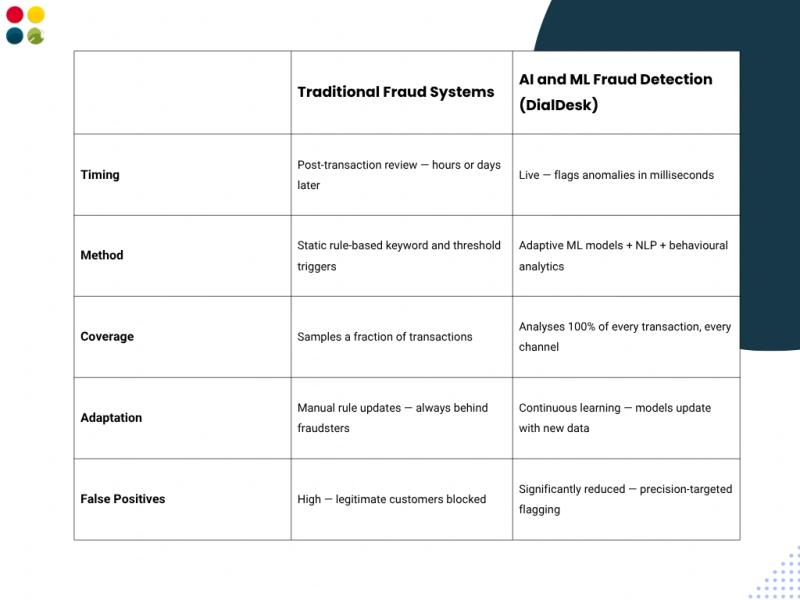
What Makes AI and ML Different from Traditional Fraud Detection?
How AI and ML Detect the Five Most Common Forms of Retail Fraud?
1. Credit Card Fraud: Real-Time Transaction Monitoring
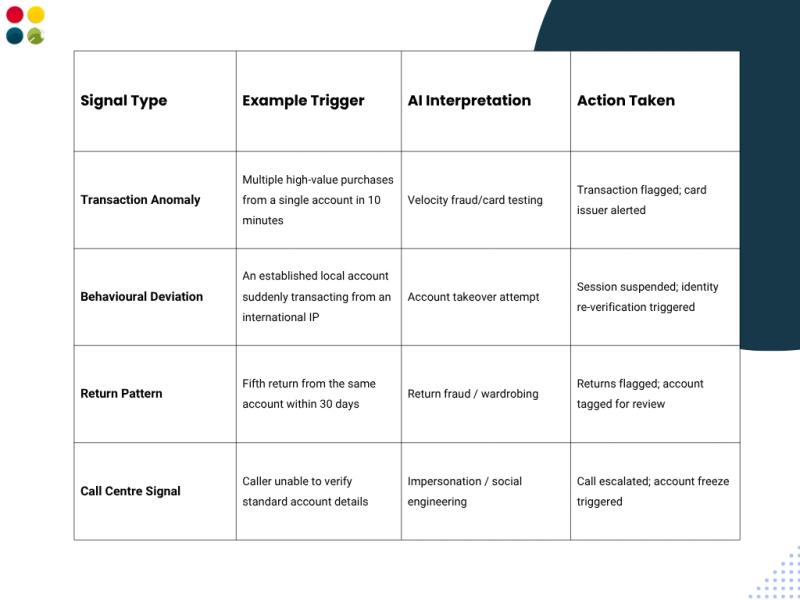
AI and ML algorithms process every transaction against hundreds of risk signals simultaneously, unusual geographic activity, device fingerprint mismatches, and purchase velocity anomalies, flagging suspicious patterns in real time. Where traditional systems catch fraud after the fact, AI intervenes before the transaction completes.
2. Account Takeover: Behavioural Analytics and Pattern Recognition
ML models trained on historical access data establish a precise behavioural baseline for every customer. Deviations, a dormant account suddenly making high-value purchases, a new device accessing an established account from an unusual location, trigger immediate anomaly alerts for review, stopping account takeover attempts before they succeed.
3. Return Fraud: Adaptive Learning That Stays Ahead
Return fraud patterns evolve constantly as fraudsters adapt to detection methods. Unlike static rule-based systems, AI and ML models update continuously based on new data, identifying emerging return fraud techniques, such as wardrobing, receipt manipulation, and cross-channel exploitation, as they appear.
4. Synthetic Identity Fraud: Multi-Signal Correlation
Synthetic identity fraud, where fraudsters combine real and fabricated data to create new identities, is among the hardest to detect with rule-based systems. ML models correlate signals across credit history, device behaviour, transaction patterns, and account activity to identify the subtle inconsistencies that reveal synthetic identities.
5. Call Centre Fraud: AI-Powered Identity Verification
Customer Service in Retail Industry contact points are a prime target for social engineering and impersonation fraud. AI-equipped call centres use voice authentication, real-time behavioural analytics, and account risk scoring to verify caller identity securely, adding a critical human-plus-AI verification layer that prevents fraud at the first contact point.
The Four Signals AI and ML Monitor in Real-Time Retail Fraud Detection
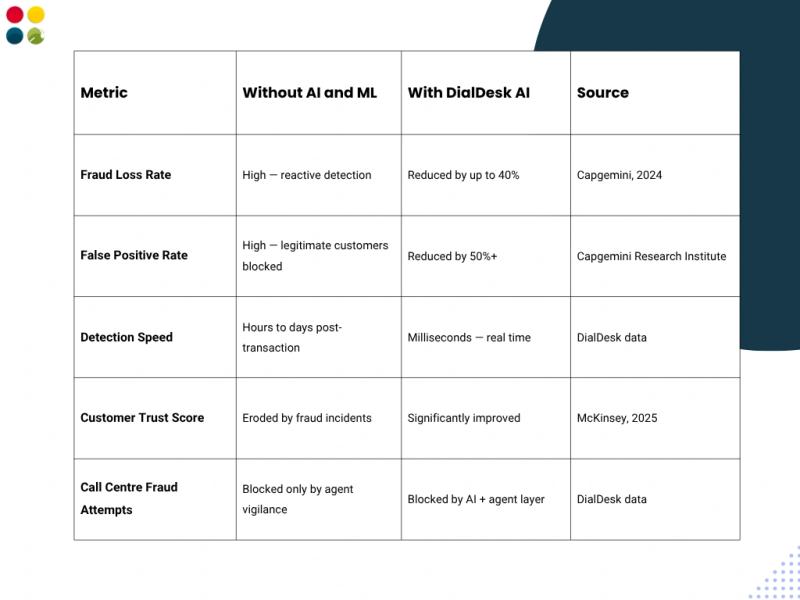
Business Impact: The Numbers Behind AI Fraud Detection
Fraud is not just a security issue — it is a business performance issue. Retailers deploying AI and ML achieve compounding financial and operational benefits (McKinsey, 2025):
✅ Trusted by 500+ Contact Centres Across India
DialDesk's AI and ML fraud detection capabilities are ISO 27001:2013 certified — the gold standard for information security in customer service operations. Deployed across Retail, Banking, and E-commerce clients in India. Explore our full call centre software India platform.
Key Takeaways
- AI and ML detect retail fraud in real time — not hours or days after transactions complete.
- Adaptive learning means ML models evolve with fraud tactics — static rule systems cannot keep pace.
- Retail Customer Service contact centres are a frontline fraud prevention asset when equipped with AI.
- False positive reduction protects legitimate customers from being blocked — maintaining CX quality while improving security.
- Customer Service in Retail Industry professionals trained on AI tools become active fraud educators for customers.
- DialDesk analyses 100% of interactions — flagging fraud signals across voice, chat, WhatsApp, and digital transactions.
Conclusion
AI and ML fraud detection is not a future investment for retailers. It is today's operational necessity for every business that wants to protect revenue, maintain customer trust, and stay ahead of increasingly sophisticated fraud attacks.
The retailers winning in 2025 are not just the ones with the largest fraud teams. They are the ones with the smartest, most adaptive AI systems, detecting fraud in milliseconds, reducing false positives, and integrating seamlessly with Retail Customer Service operations to create a layered, resilient defence. Those still relying on static rule systems are perpetually one fraud evolution behind.
Explore how DialDesk's AI and ML platform connects with your IVR and call routing and cloud telephony India stack to deliver fraud intelligence from day one, no hardware required.
Smarter fraud detection protects revenue. DialDesk delivers both the intelligence and the platform.
✅ Trusted Signal: DialDesk's Certifications
ISO 9001:2015 (Quality Management) · ISO 27001:2013 (Information Security) · Deployed across Retail, Banking, Healthcare, Telecom, and FMCG verticals in India.
Want to Fortify Your Retail Operations Against Fraud?
DialDesk's real-time AI and ML fraud detection engine analyses every transaction, call, and chat interaction, giving your team actionable intelligence to stop fraud before it reaches your customers. Join 500+ contact centres across India already protecting revenue with DialDesk.