How Does AI Detect Escalation Triggers?
AI Customer Experience platforms detect escalation triggers by analysing acoustic signals (raised pitch, speech rate changes), linguistic patterns (repeated phrases, confrontational language), interaction dynamics (long silences, interruptions), and contextual cues (repeat contact history, unresolved ticket flags), simultaneously, in real time, during live conversations. Customer Experience AI processes these signals in under 5 seconds and alerts supervisors or triggers automated routing before the customer requests to escalate. DialDesk covers voice, chat, and WhatsApp from a single platform.
Why Escalations are Predictable and Why Most Teams Miss the Signals?
Every escalation is preceded by a pattern. Customers do not suddenly demand a supervisor; they send signals for 2–3 minutes before the request is made. Rising frustration in tone. Repeated phrases. Long pauses. References to previous failed contacts.
AI Customer Experience platforms are built to read these signals with precision, detecting escalation risk in the seconds after it emerges, not in the minutes after the customer has already disengaged.
The problem with traditional contact center quality management is not a lack of awareness that escalations are costly. It is a lack of real-time infrastructure to detect risk signals at scale and act on them before the damage is done.
💡 The Escalation Cost
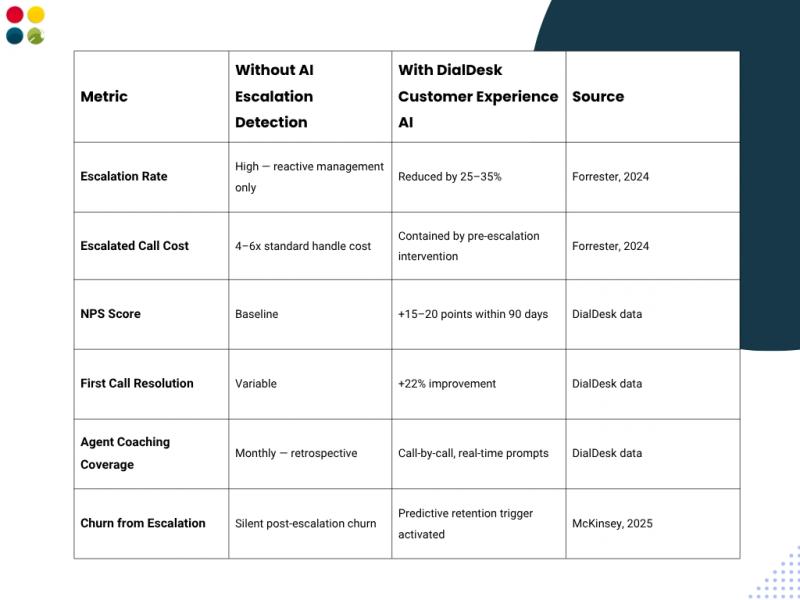
According to Forrester (2024), escalated calls cost 4–6x more to handle than first-contact resolutions. Contact centers that reduce escalation rates by 25% using Customer Experience AI report NPS improvements of 15–20 points within 90 days.
The Four Signal Categories AI Customer Experience Monitors for Escalation Risk
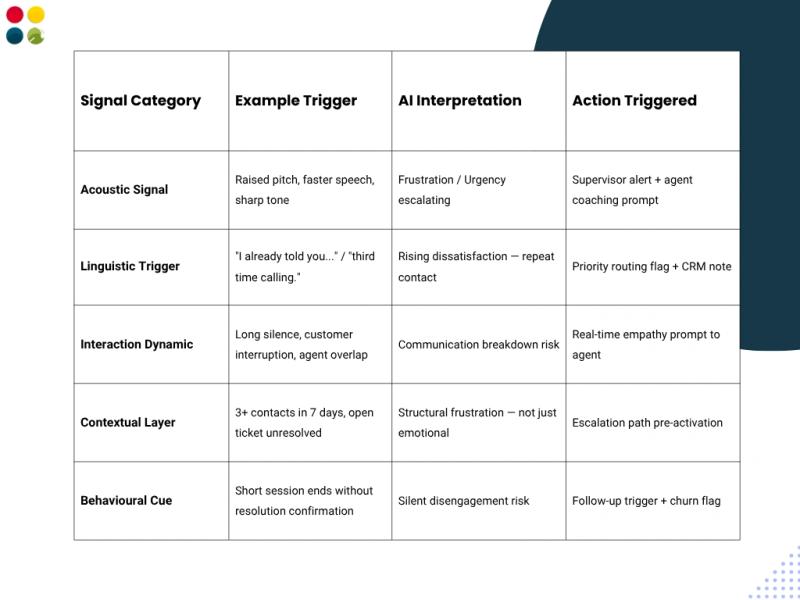
How AI Customer Experience Detects Escalation Triggers in Real Time?
Customer Experience AI does not monitor for a single signal. Escalation risk emerges from signal combinations, and AI reads the full pattern simultaneously:
1. Acoustic and Tone Analysis
Voice AI analyses pitch, speech rate, volume, and pause patterns continuously throughout the conversation. A customer whose speech rate accelerates and pitch rises over a 90-second window is displaying a measurable escalation signature, detectable before any verbal escalation request is made.
2. Linguistic Pattern Recognition
AI Customer Experience NLP models are trained on escalation-preceding language patterns, phrases like 'I already explained', 'this is not acceptable', 'I want to speak to someone else', and repetitive complaint framing. These trigger immediate scoring updates.
3. Conversation Flow Anomaly Detection
AI maps the expected conversation arc for each interaction type and flags deviations, unusually long silence after an agent response, multiple re-explanations of the same issue, or a customer reverting to a complaint after a proposed resolution.
4. Cross-Channel Context Enrichment
Customer Experience AI enriches real-time signals with CRM and interaction history, flagging when a caller has contacted support three times in a week, has an open unresolved ticket, or previously escalated on the same issue. This context transforms a moderate frustration signal into a high-risk escalation alert.
See Escalation Detection Live
Watch how DialDesk's AI Customer Experience platform detects escalation triggers in real time, alerting supervisors, coaching agents, and rerouting at-risk interactions before they collapse.
Business Impact: What AI Escalation Detection Delivers
The operational impact of AI Customer Experience escalation detection is immediate and compounding. Contact centers typically see results within 60 days of deployment:
✅ Trusted by 500+ Contact Centers Across India
DialDesk's AI Customer Experience platform is ISO 9001:2015 and ISO 27001:2013 certified, enterprise-grade escalation intelligence built for India's contact center environment. See our full call center software India platform.
Key Takeaways
- AI Customer Experience detects escalation triggers from acoustic, linguistic, dynamic, and contextual signals. It does this simultaneously, in real time, during live conversations.
- Escalation patterns emerge 2–3 minutes before the verbal request. This gives Customer Experience AI a window to intervene that traditional QA processes cannot access.
- Cross-channel context enrichment (CRM history, repeat contact flags) transforms moderate frustration signals into high-precision escalation alerts.
- Supervisor alerts, agent coaching prompts, and priority routing are triggered automatically. They work without requiring manual monitoring of every call.
- DialDesk's Customer Experience AI reduces escalation rates by 25–35% and delivers measurable NPS improvement within 90 days.
Conclusion
AI Customer Experience does not prevent every escalation. It prevents the escalations that did not need to happen: the ones driven by a missed signal, a delayed intervention, or a supervisor who was not watching the right screen at the right moment.
Every escalation that Customer Experience AI prevents is a cost avoided, a customer retained, and an NPS point protected. At scale, across 500 calls a day, that is a structural CX advantage.
Explore how DialDesk's AI Customer Experience platform connects with your IVR and call routing, and cloud telephony India stack to deliver escalation intelligence from day one.
Every signal matters. AI Customer Experience ensures none of them are missed.
📅 Ready to Detect Escalations Before They Happen?
DialDesk's AI Customer Experience platform detects escalation triggers in real time — alerting supervisors, coaching agents, and preventing avoidable escalations across every channel. Join 500+ contact centers across India already transforming CX with DialDesk.