How Does AI Detect CX Bottlenecks?
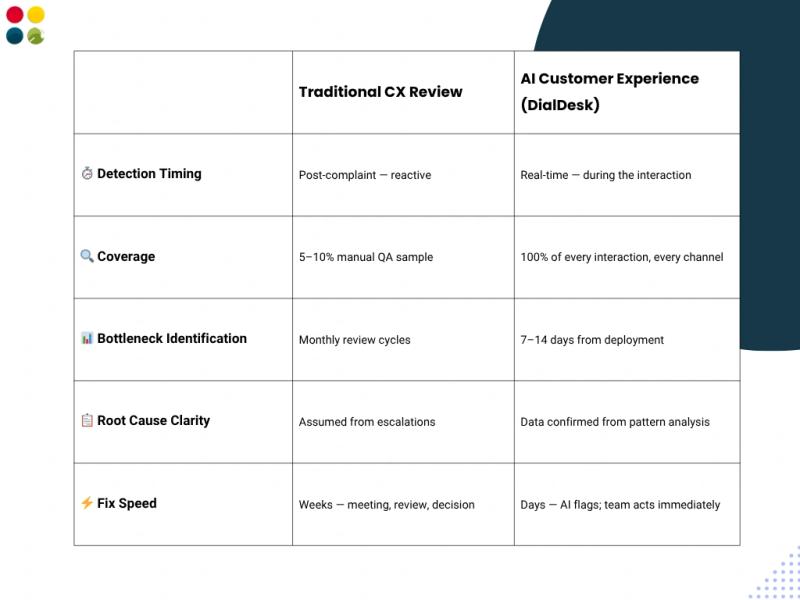
AI Customer Experience tools detect CX bottlenecks by continuously analysing 100% of customer interactions across voice, chat, email, and WhatsApp in real time. Customer Experience AI identifies friction patterns that manual QA sampling (5–10% of interactions) cannot surface: repeated query types, sentiment deterioration across journeys, peak-hour routing failures, and self-serve gaps. DialDesk's CallMaster AI detects bottlenecks within the first 7–14 days of deployment, giving teams the clarity to fix what is breaking CX before it drives churn.
Why CX Bottlenecks Are Invisible Until Customers Leave
60% of support leaders say they cannot identify the root cause of customer frustration fast enough (Gartner). 30–45% reduction in operational inefficiencies is documented for brands using AI for CX (Forrester). The gap between those two numbers is AI Customer Experience, and it is now the defining competitive variable in enterprise support.
CX bottlenecks do not announce themselves. They build silently in repeated queries no one has connected, in sentiment that drops mid-journey, in wait times that erode goodwill before an agent even answers. By the time they appear in a dashboard, they have already cost you, customers. AI in Customer Experience changes the timeline, identifying friction at the earliest possible signal, before it becomes a complaint, an escalation, or a churned account.
💡 Why It Matters
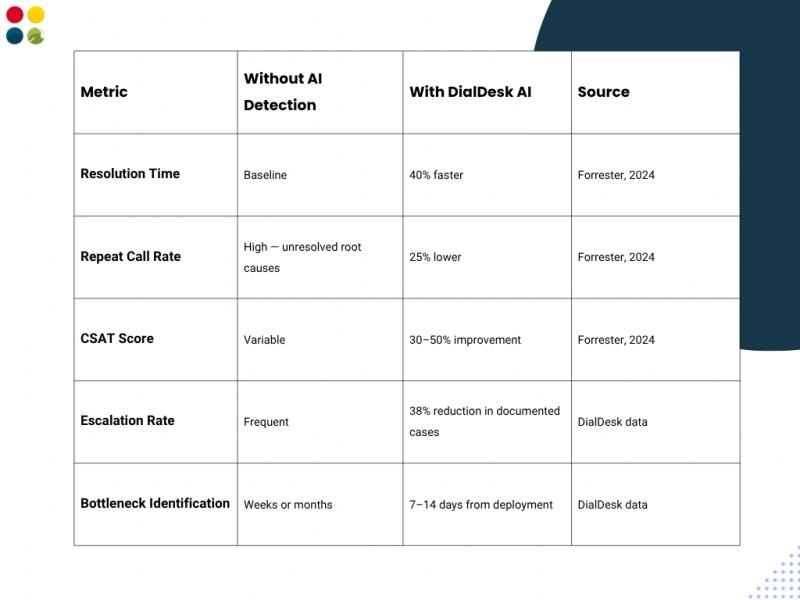
Brands using AI for CX bottleneck detection typically see 40% faster resolution times, 25% lower repeat call rates, and 30–50% improvement in CSAT within the first operational quarter (Forrester, 2024). The ROI is not incremental; it is structural.
Traditional CX Review vs AI Customer Experience Detection
The 5 CX Bottlenecks AI Detects That Humans Miss
1. Routing and Wait-Time Failures
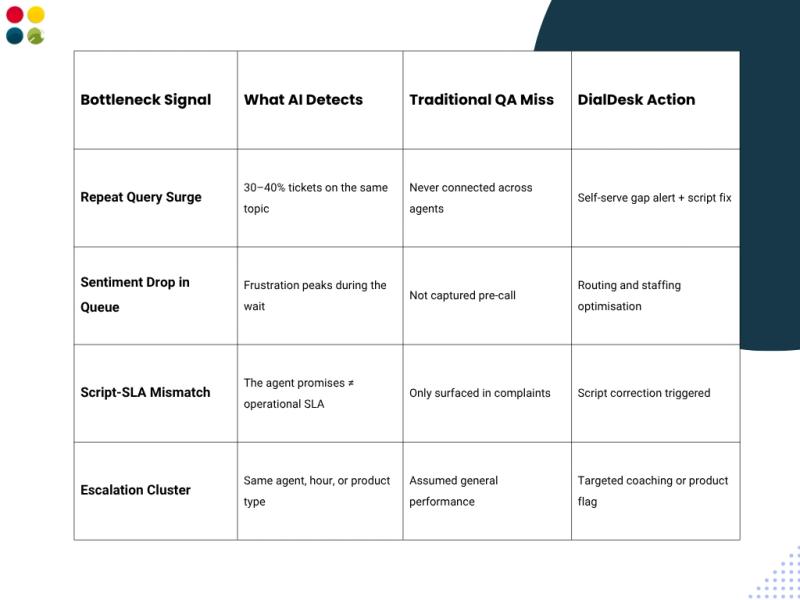
AI Customer Experience analyses peak call spikes, staffing mismatches, and sentiment deterioration during queue wait, identifying the specific hours, channels, and query types where routing is failing. What feels like a 'busy period' is often a structural mismatch that AI can quantify and fix.
2. Repetitive Query Clusters: Self-Serve Is Broken
Customer Experience AI flags when 30–40% of tickets cover the same questions. That threshold is not an agent performance problem; it is a self-serve failure. AI identifies the exact queries that a better FAQ, chatbot flow, or IVR script would deflect entirely.
3. Agent Script and Communication Gaps
AI in Customer Experience identifies when agents are making promises that don't match operational SLAs. A D2C brand reduced escalations by 38% in 10 days after AI identified agents were promising 3-day delivery when the SLA was 5–7 days. The problem wasn't logistics; it was a communication script gap.
4. Sentiment Drift Across Multi-Touch Journeys
Customer Experience AI tracks sentiment across multi-contact journeys — identifying the point in a customer's experience where goodwill begins to erode. This pattern is invisible in single-call QA but completely clear in AI analysis of interaction sequences over time.
5. Escalation Pattern Clustering
AI Customer Experience analyses escalation triggers across agent, hour, query type, and channel, identifying whether escalations cluster around specific agents (a coaching opportunity), specific products (a product issue), or specific channels (a routing problem).
The Four AI Signals That Surface CX Bottlenecks in Real Time
Business Impact: What AI CX Bottleneck Detection Delivers
Brands deploying AI Customer Experience bottleneck detection achieve documented results (Forrester, 2024):
✅ Trusted by 500+ Contact Centers Across India
DialDesk's AI Customer Experience platform — powered by CallMaster AI is ISO 9001:2015 and ISO 27001:2013 certified. It analyses 100% of interactions across voice, chat, and WhatsApp, surfacing CX bottlenecks within the first 7–14 days of deployment. See our full call center software India platform.
Key Takeaways
• AI Customer Experience tools detect CX bottlenecks in 7–14 days, not the weeks or months manual review takes.
• Customer Experience AI analyses 100% of interactions versus the 5–10% sample that traditional QA reviews.
• AI in Customer Experience identifies five bottleneck types: routing failures, self-serve gaps, script mismatches, sentiment drift, and escalation clusters.
• 40% faster resolution, 25% lower repeat calls, and 30–50% CSAT improvement are the documented outcomes of AI bottleneck detection (Forrester, 2024).
• Bottlenecks don't start as complaints; they start as patterns. AI sees the patterns; human QA sees only the complaints that surface.
• DialDesk's CallMaster AI connects to existing telephony stacks from day one, no hardware required, and bottleneck intelligence is operational within two weeks.
Conclusion
AI Customer Experience bottleneck detection is not a reporting upgrade. It is an operational transformation from a reactive model that catches problems after they generate complaints, to a proactive model that surfaces friction before it becomes churn.
The brands winning in customer experience in 2025 are not the ones with the most agents or the most surveys. They are the ones whose Customer Experience AI sees what human QA cannot: the patterns, the correlations, the early signals that predict where the next wave of customer dissatisfaction will emerge.
Explore how DialDesk's AI in Customer Experience platform connects with your IVR and call routing and cloud telephony India stack to surface bottleneck intelligence from day one, no hardware required.
CX problems hide in patterns. AI finds the patterns. DialDesk fixes what is breaking your experience.
✅ Trusted Signal: DialDesk's Certifications
ISO 9001:2015 (Quality Management) · ISO 27001:2013 (Information Security) · 500+ contact centers across India · Deployed across Healthcare, Banking, Retail, Telecom, and FMCG verticals.
📅 Need to Find and Fix Your CX Bottlenecks with AI?
DialDesk's AI Customer Experience platform analyses 100% of your interactions across voice, chat, and WhatsApp, surfacing the friction patterns that are costing you customers, within 7–14 days of deployment. Join 500+ contact centers across India already fixing CX with DialDesk.