Why Do Customer Satisfaction Campaigns Fail?
Inbound Customer Satisfaction campaigns in BPO fail because they measure customer sentiment after the interaction rather than during it. The core issues are low survey response rates, misaligned agent training, poor call routing, and a lack of real-time intervention. DialDesk’s AI-powered platform addresses each failure point with live data, automated escalations, and 100% interaction coverage.
The Customer Satisfaction Gap Nobody Talks About
Most contact centers invest significantly in Customer Satisfaction in BPO programs, post-call surveys, NPS tracking, and CSAT scoring. Yet average inbound campaign satisfaction rates in Indian BPOs remain stubbornly below 72% (Forrester, 2024). The problem is not effort. It is timing and coverage.
Surveys arrive minutes after a customer has already decided how they feel. Agents receive feedback weeks after the conversation. Managers review QA samples covering only 5–10% of actual interactions. The emotional reality of the call is gone, and the campaign fails silently.
💡 Why It Matters
Over 60% of customers who report low satisfaction after an inbound call had already decided to churn before the survey arrived (McKinsey, 2025). Campaigns that rely solely on post-call surveys are measuring a decision that was already made.
What Makes 5-Second Feedback Different from Traditional CSAT
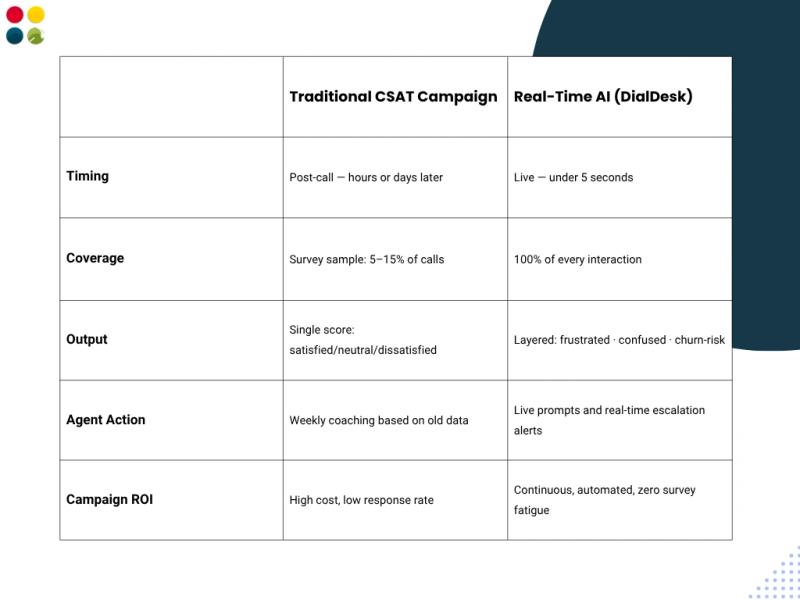
Top 7 Reasons Why Inbound Customer Satisfaction Campaigns Fail
Understanding these failure patterns is the first step to fixing Customer Satisfaction in BPO operations permanently.
1. Low Survey Response Rates
Less than 7% of customers complete post-call satisfaction surveys (Qualtrics, 2024). Campaigns built entirely on voluntary feedback are structurally incomplete. The customers most likely to be dissatisfied are also the least likely to respond, creating a dangerous false positive in your CSAT scores.
2. Misaligned Agent Training
When Customer Satisfaction Call Center data arrives weekly or monthly, agents receive feedback too late to correct behaviour patterns. Training becomes reactive rather than preventive. By the time a coaching session happens, the agent has replicated the same mistake hundreds of times.
3. Poor Call Routing and IVR Design
Routing failures create immediate dissatisfaction before the agent even answers. Customers transferred multiple times, placed in wrong queues, or forced through long IVR trees arrive frustrated, and no amount of agent skill reverses that emotional entry point.
4. No Real-Time Escalation Capability
When a customer begins escalating emotionally, most inbound systems have no mechanism to detect it at the moment. Supervisors only learn of a difficult call after it has ended, or after the complaint arrives. Customer Satisfaction in BPO requires intervention during the call, not after it.
5. Measuring the Wrong Metrics
Average Handle Time (AHT) and First Response Time are operational metrics; they do not measure how the customer felt. Campaigns that optimise for speed over emotional resolution consistently produce low Customer Satisfaction scores despite hitting operational targets.
6. Siloed Data Without Contextual Intelligence
Customer Satisfaction Call Center dashboards that display scores without emotional context leave managers guessing. A 3-out-of-5 satisfaction score tells you the outcome, not the cause. Without call-level sentiment data, the same campaign failures repeat quarter after quarter.
7. No Omnichannel Consistency
Customers move across voice, WhatsApp, chat, and email. Satisfaction campaigns that track only inbound voice miss the majority of interaction touchpoints. A customer who resolves their issue on WhatsApp but receives no satisfaction follow-up represents a lost feedback opportunity, and a retention risk.
Business Impact: The Cost of Campaign Failure
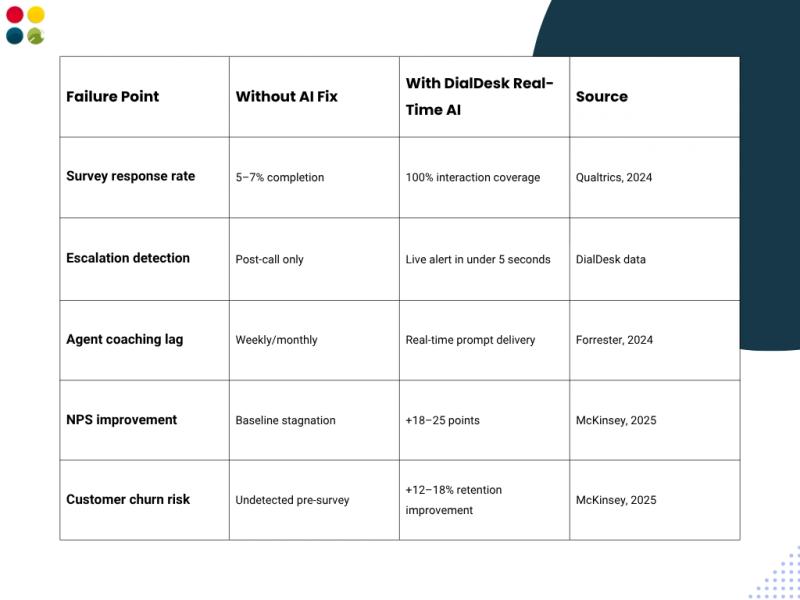
✅ Trusted by 500+ Contact Centers Across India
DialDesk’s Customer Satisfaction platform is ISO 9001:2015 and ISO 27001:2013 certified — enterprise-grade intelligence built for India’s BPO environment. See our full call center software India platform.
Key Takeaways
• Post-call surveys cover less than 7% of actual interactions; they are structurally incomplete as a satisfaction measurement tool.
• Customer Satisfaction in BPO fails when emotion is measured after the call, not during it.
• Poor routing, training lag, and siloed data are the most common and fixable failure points.
• Real-time AI coverage of 100% of interactions replaces survey sampling with continuous intelligence.
• DialDesk connects satisfaction data to live agent coaching, escalation routing, and retention triggers.
Conclusion
Customer Satisfaction in BPO does not fail because teams do not care. It fails because the tools most campaigns rely on-optional surveys, sampled QA, and delayed coaching- are structurally unable to capture the emotional reality of a live inbound interaction.
The solution is not more surveys. It is continuous, real-time intelligence that reads every interaction, detects every escalation risk, and delivers the right information to the right person at the right moment.
Explore how DialDesk’s Customer Satisfaction platform connects with your IVR and call routing and cloud telephony India stack to close the gap between what customers say and what they mean, from the very first call.
Fix the measurement. Fix the satisfaction. DialDesk makes both possible.
📅 Want to Fix Your Customer Satisfaction Campaign?
DialDesk’s real-time AI platform analyses 100% of inbound interactions- voice, chat, and WhatsApp- delivering live satisfaction signals your team can act on immediately. Join 500+ contact centers across India already improving CX with DialDesk.