What does Training Conversational AI on Customer Data Mean?
Training Conversational AI on customer data means feeding real interaction records, call transcripts, chat logs, customer intents, and resolution outcomes into an AI model so it learns the specific language, queries, and behaviour patterns of your actual customer base. A well-trained model understands your products, your customers' vocabulary, and your most common issues, delivering faster, more accurate responses than a generic out-of-the-box AI system.
Why Generic AI Models Fail in Real Contact Centres?
Most Conversational AI solutions arrive pre-trained on general language data. They understand broad English patterns, common phrases, and standard customer service scenarios. But they do not know:
- That your customers say 'recharge issue' when they mean 'failed top-up.'
- That 'delivery pending' in your context triggers a churn risk, not just a logistics query.
- Indian customers frequently switch between English and Hindi mid-sentence.
- That your highest-value customers use specific product names that your competitors do not.
Generic AI gets these wrong consistently. The result: customers who feel misunderstood, agents who must intervene constantly, and AI for Customer Service metrics that never improve beyond initial deployment.
Training Conversational AI on your actual customer data changes this entirely, turning a generic model into a domain expert on your specific business, customers, and CX environment.
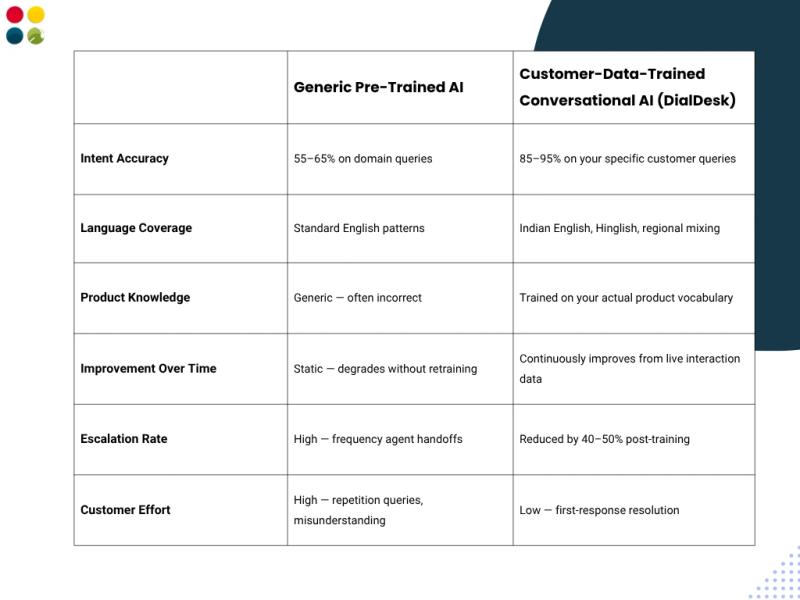
💡 Why It Matters: Conversational AI models trained on domain-specific customer data achieve 40–60% higher intent recognition accuracy than generic pre-trained models (MIT Technology Review, 2024), directly improving first-contact resolution and reducing agent escalation rates.
Untrained AI vs. Customer-Data-Trained AI — Side by Side
6 Proven Strategies for Training Conversational AI on Customer Data
Strategy 1 — Start with Real Call Transcripts, Not Synthetic Data
The highest-value training data for Conversational AI is real interaction transcripts from your own contact centre. Use AI transcription to convert your existing call archive into structured text — then feed resolved interactions (labelled by intent and outcome) as your foundational training dataset. Real conversations contain the exact vocabulary, phrasing, and regional language patterns your customers actually use.
Strategy 2 — Label Data by Intent, Not Just Topic
Topic classification tells the AI what was discussed. Intent labelling tells it why the customer called and what they needed. For AI for Customer Service training, label every transcript with primary intent (billing, complaint, cancellation, upsell), resolution outcome (resolved, escalated, abandoned), and customer sentiment at call end. This creates a multi-dimensional training signal that produces far more accurate response models.
Strategy 3 — Train Specifically on Escalation Patterns
Escalated calls are your most valuable Conversational AI training data, because they represent the edge cases where generic AI fails, and human intervention becomes necessary. Map every escalation to its trigger: the specific query, phrase, emotion signal, or product scenario that caused the breakdown. Training AI to recognise and handle these patterns proactively is what converts a reactive AI system into a genuinely intelligent one.
Strategy 4 — Include Negative Examples and Failure Cases
Most AI training focuses on successful interactions. But Conversational AI models trained only on positive outcomes become overconfident — generating responses that sound right but are wrong for specific edge cases. Include failed interactions, misclassified intents, and incorrect AI responses in your training data, labelled with the correct outcome, so the model learns from its own mistakes systematically.
Strategy 5 — Continuously Retrain on Fresh Customer Data
Customer language evolves. New products launch. Seasonal issues emerge. A Conversational AI model trained 12 months ago on last year's data is already partially stale. Establish a retraining cadence, monthly for high-volume contact centres, quarterly at minimum, feeding the latest interaction transcripts, newly emerging intent clusters, and updated product vocabulary into the model continuously.
Strategy 6 — Validate with Human-in-the-Loop Review
Before deploying a newly trained AI for Customer Service model into live customer interactions, validate it with a human-in-the-loop review process: route a sample of AI-handled conversations to QA reviewers for intent accuracy scoring, response quality assessment, and edge-case identification. This catches model gaps before they affect real customer experience, and creates a feedback loop that accelerates model improvement over time.
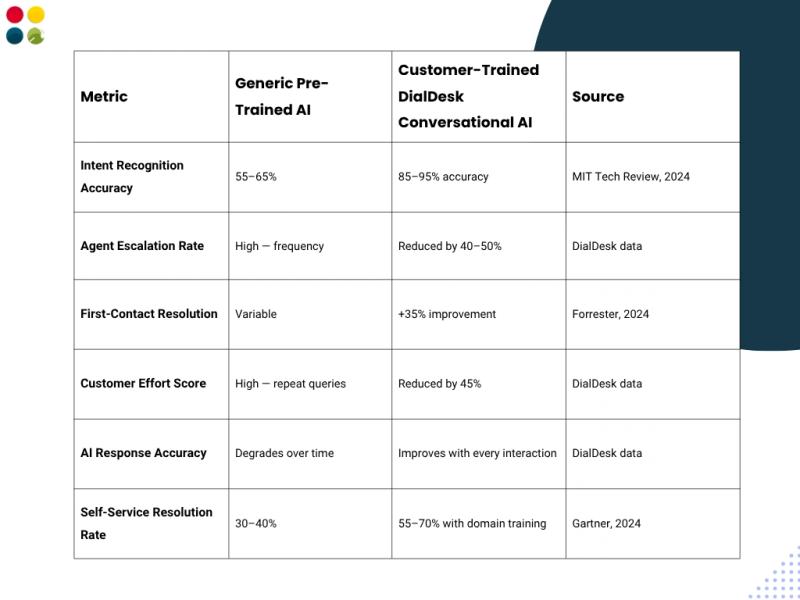
Business Impact: What Well-Trained Conversational AI Delivers
✅ Trusted by 500+ Contact Centres Across India
DialDesk's Conversational AI engine is trained on Indian contact centre data — supporting Indian English, Hinglish, and regional language mixing — and is ISO 9001:2015 and ISO 27001:2013 certified. See our full call centre software India platform.
Key Takeaways
• Conversational AI trained on your real customer data achieves 85–95% intent accuracy, compared to 55–65% for generic pre-trained models (MIT Tech Review, 2024).
• AI for Customer Service training should use real call transcripts, intent labels, escalation patterns, and failure cases, not just successful interactions.
• Continuous retraining on fresh customer data prevents model staleness as products, language, and customer behaviour evolve.
• Human-in-the-loop validation before deployment catches model gaps before they affect real customer experience.
• Well-trained Conversational AI reduces agent escalation rates by 40–50% and improves self-service resolution to 55–70% of inbound queries (Gartner, 2024).
Conclusion
A Conversational AI system is only as intelligent as the data it has been trained on. Deploy it with generic pre-training, and it will perform generically. Train it on your real customer interactions, their exact language, their common queries, their escalation patterns, and it becomes a domain expert that improves with every conversation it handles.
The data already exists in your call archive. AI for Customer Service training is the process that unlocks the intelligence hidden inside it.
Explore how DialDesk's Conversational AI platform integrates with your AI contact centre QA system, AI transcription, and cloud telephony India stack, delivering smarter, continuously improving customer intelligence from day one.
Smarter data. Smarter AI. Smarter customer service. DialDesk delivers all three.
Ready to Train Your AI on Real Customer Data?
DialDesk's Conversational AI platform learns from your actual customer interactions, continuously improving intent accuracy, reducing escalations, and delivering smarter AI for Customer Service responses with every conversation. Join 500+ contact centres across India already running customer-trained AI with DialDesk.