Does Your Startup Need 24/7 Call Center Services?
Your startup needs 24/7 Call Center Services if any of the following are true: customers transact or use your product outside business hours; you operate in eCommerce, fintech, healthcare, or logistics, where time-sensitive queries cannot wait until morning; you are losing customers to competitors who answer after hours; or your product serves customers across multiple time zones. A 24/7 Call Center Company like DialDesk delivers always-on support through a cloud-native, AI-augmented model — at a variable cost that scales with your actual interaction volume, not a fixed headcount.
Why Startups Are Rethinking 24/7 Call Center Services in 2025?
Startups have historically treated 24/7 Call Center Services as an enterprise luxury — something to add after Series B, once there is budget for a dedicated operations team and physical contact center infrastructure. That calculus has changed completely.
Cloud-native 24/7 Call Center Companies have eliminated the infrastructure barrier. A startup can now activate a fully operational, AI-augmented 24/7 call center in 10–14 days, on a per-interaction pricing model, with no hardware and no fixed headcount. The question is no longer ‘can we afford 24/7 Call Center Services’ — it is ‘what is the cost of not having them’.
💡 Why It Matters
Salesforce’s 2025 State of the Connected Customer report found that 83% of customers expect an immediate response regardless of time of day, and 76% say a missed after-hours contact makes them less likely to purchase from that brand again. For startups in competitive markets, after-hours abandonment is direct revenue loss. (Salesforce, 2025)
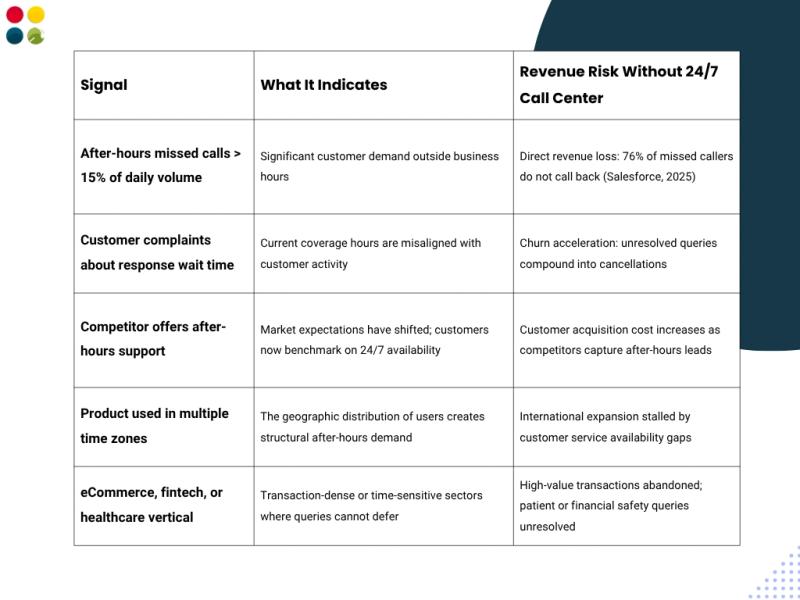
5 Signs Your Startup Needs 24/7 Call Center Services Now
Use this checklist to assess whether your startup has crossed the threshold where 24/7 Call Center Services become a revenue-critical investment rather than a cost:
In-House vs. 24/7 Call Center Company: The Real Cost Comparison
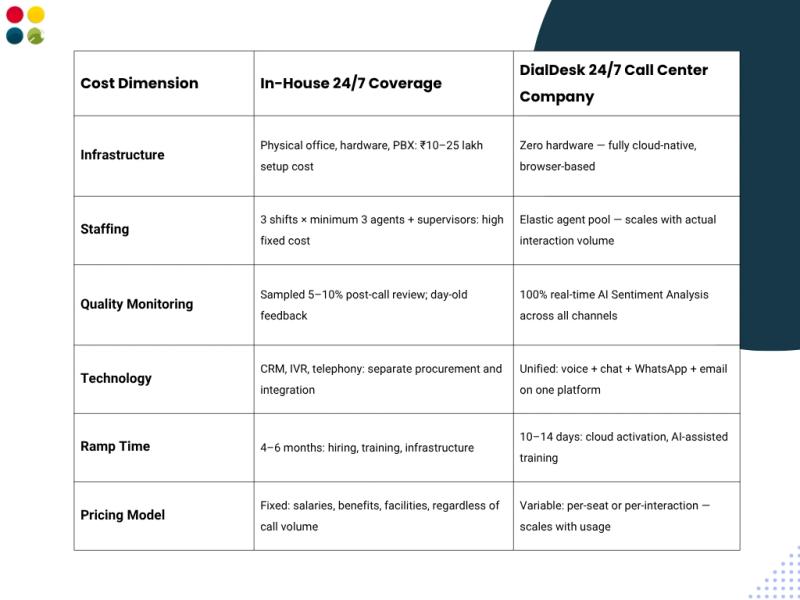
The most common reason startups delay 24/7 Call Center Services is a misunderstanding of the cost comparison. Building in-house 24/7 coverage requires night-shift hiring, infrastructure, management overhead, and quality systems. Here is what the comparison actually looks like:
What a 24/7 Call Center Services Model Looks Like for a Startup?
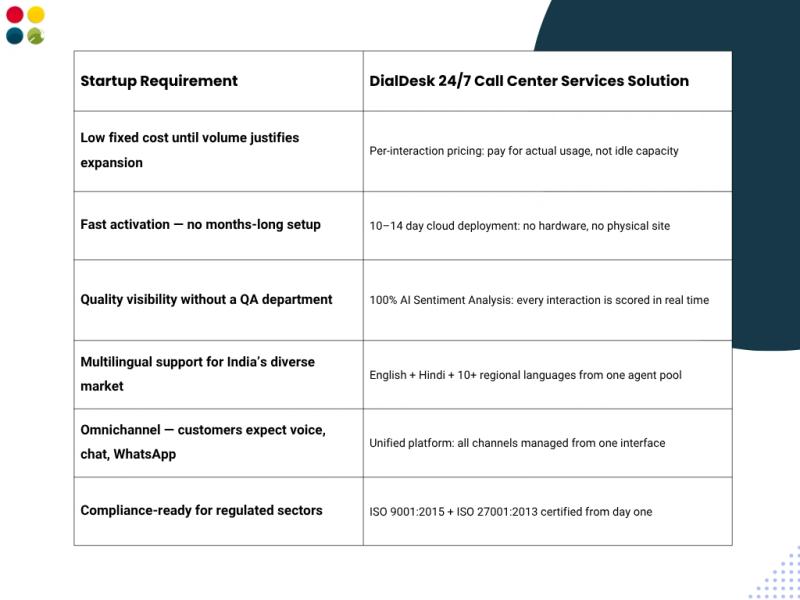
For a startup, the right 24/7 Call Center Services model is not a 500-seat enterprise operation. It is a right-sized, cloud-native deployment that delivers always-on coverage across your actual peak hours, in your customers’ languages, with AI quality monitoring that gives you full visibility into every interaction without a dedicated QA team.
✅ Trusted by 500+ Contact Centers Across India
DialDesk’s 24/7 Call Center Services are ISO 9001:2015 and ISO 27001:2013 certified — cloud-native, AI-augmented, and activated in 10–14 days. Trusted by 500+ contact centers across India, including fast-growing startups in eCommerce, fintech, healthcare, and logistics. See our full BPO call center services platform.
Business Impact: What 24/7 Call Center Services Deliver for Startups
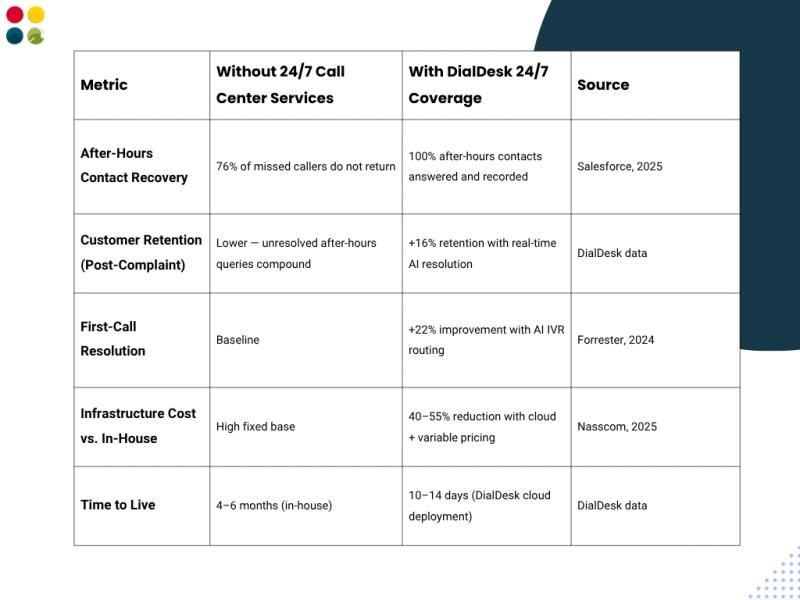
Startups that activate 24/7 Call Center Services through a cloud-native 24/7 Call Center Company report measurable commercial improvements within the first 60 days (Salesforce, 2025 / DialDesk data):
Key Takeaways
• Your startup needs 24/7 Call Center Services if after-hours missed contacts exceed 15% of daily volume, competitors offer after-hours support, or your product operates in a time-sensitive sector.
• 83% of customers expect immediate responses regardless of time of day — missed after-hours contacts are direct revenue loss, not just inconvenience. (Salesforce, 2025)
• Cloud-native 24/7 Call Center Companies eliminate the infrastructure barrier: variable pricing, 10–14 day activation, no hardware required.
• DialDesk’s 24/7 Call Center Services deliver AI Sentiment Analysis across 100% of interactions, omnichannel coverage, and multilingual support from one ISO-certified platform.
• The right question for startups is not ‘can we afford 24/7 Call Center Services’ — it is ‘what revenue are we losing without them’.
Conclusion
The question of whether your startup needs a 24/7 Call Center has a simple answer in 2025: if your customers are active outside business hours — and in eCommerce, fintech, healthcare, and logistics, they always are — then every after-hours contact that goes unanswered is a revenue event that does not recover.
The barrier that historically prevented startups from accessing 24/7 Call Center Services — high fixed infrastructure cost, long setup timelines, large headcount commitments — has been eliminated by cloud-native 24/7 Call Center Companies. The question is now one of timing, not affordability.
Explore how DialDesk’s 24/7 Call Center Services integrate with your IVR and call routing, WhatsApp and chat support, and cloud telephony India stack to deliver an always-on customer experience from day one — no hardware required.
Your customers don’t stop needing support at 6 PM. DialDesk doesn’t either.
Want to Activate 24/7 Call Center Services for Your Startup?
DialDesk’s 24/7 Call Center Company model gives your startup AI-powered always-on coverage, omnichannel support, and ISO-certified quality monitoring, activated in under 14 days with variable pricing that scales with your growth.
Join 500+ contact centers across India already delivering 24/7 CX excellence with DialDesk.