OVERVIEW
● We will guide you on what support solution best aligns with your intentions in this blog by comparing them on key considerations.
● Whether you are a scaling startup or an enterprise company, this in-depth analysis will assist you in picking the appropriate support stack for improved CX, retention, and ROI.
Introduction: Why This Comparison Matters Now
Customer support isn’t a second-tier function any longer — it’s a distinguishing factor. And with consumers waiting for real-time, personalized help 24/7, the support channels should adapt to stay in line with expectations.
Now, here’s the catch: not all “instant” help tools are developed equally. Live Chat may be your site’s front line, but what does it do if users bounce off? WhatsApp maintains the conversation running — even beyond the browser.
The world is mobile-first. Conversations are on the go. Context is king.
And this change is why so many brands are transitioning from reactive chat boxes to proactive, persistent messaging via WhatsApp Support Solutions.
But does that render Live Chat obsolete? Not quite.
So let’s break it down with data-driven insights, real-world applicability, and decision-ready takeaways.
WhatsApp Support vs Live Chat: A Head-to-Head Comparison
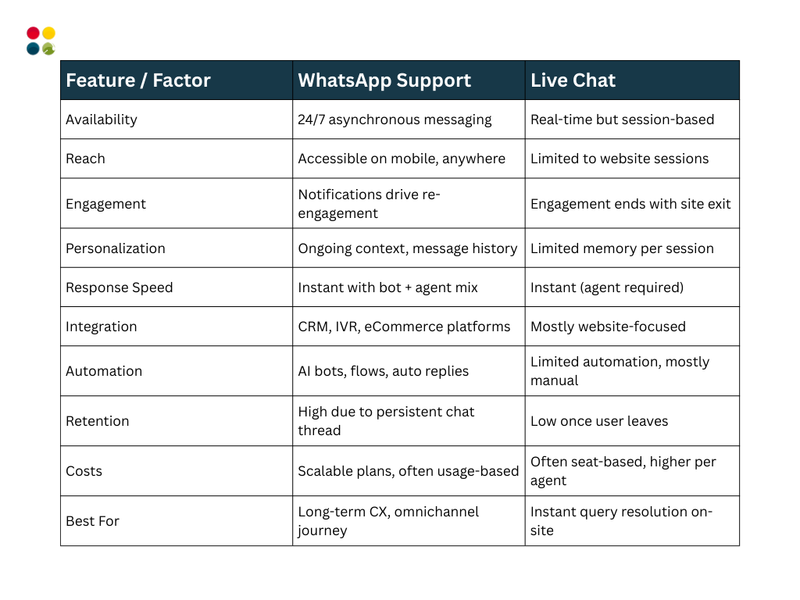
1. Accessibility & Availability
WhatsApp Support:
With more than 2.78 billion users worldwide (Statista, 2024), WhatsApp is a native app on almost every phone. Discussions may begin and be interrupted at any time — no need for the user to remain online or even on the same device.
Live Chat:
It only functions when the user is on your site or application. As soon as they close the browser window, the interaction stops (unless there is email capture). Not the best choice for high drop-off paths.
Winner: WhatsApp Support
2. Personalization & Contextual Support
WhatsApp Support:
Preserves chat history, so agents can resume from where the customer left off — even after a few days. Integrates with CRMs for context-aware responses and segmentation.
Live Chat:
Although in real-time, most Live Chat is context-less between sessions unless they are associated with accounts or cookies. Repetition annoys users.
Winner: WhatsApp Support
3. Response Time & Speed
WhatsApp Support:
With WhatsApp Support Solutions, companies integrate AI bots for quick responses and transfer to humans when necessary. Average first-response times can be less than 30 seconds (Meta Business Report, 2024).
Tie: Both are fast, but WhatsApp has the edge with automation.
Live Chat:
When properly staffed, it provides almost-instant responses, particularly for straightforward questions. But availability usually comes with working hours or staff limits.
4. Integration with Customer Journey
WhatsApp Support:
Integrates throughout the funnel — from lead generation through post-sale support. You can send reminders, promotions, feedback surveys, and more — without the user needing to return to your site.
Live Chat:
Primarily lives as a widget for on-site interaction. Excellent for sales or support during a session, but terrible for retargeting or nurturing.
Winner: WhatsApp Support
5. Automation, Bots & Workflows
WhatsApp Support:
Rich automation capabilities through chatbots, menus, FAQs, sentiment analysis, and escalation routes. Suitable for high-volume support.
Live Chat:
Limited (pre-chat forms, canned responses) compared to WhatsApp’s API-based workflows.
Winner: WhatsApp Support
6. Conversion & Retention Impact
WhatsApp Support:
High CTR (60-70%) on campaigns, up to 90% open rate (Meta, 2024), and improved retention due to evergreen threads.
Live Chat:
Enhances in-site conversions by 10-15% (Forrester), but the moment the visitor leaves, the window to convert shuts.
Winner: WhatsApp for full-funnel engagement
7. Cost & Scalability
WhatsApp Support:
Scalable cost based on usage or conversations. With the right partner, even shared agent models save costs by a large margin.
Live Chat:
Typically, costs per seat or license. Gets costly as the team increases, particularly for 24/7 staffing.
Winner: WhatsApp Support for growth-stage businesses
Expert Opinion: When to Use What
● Select WhatsApp Support Solutions if you desire omnichannel CX, lead nurturing, post-purchase interaction, and scalable automation.
● Use Outsource Live Chat Support Services if you require real-time query resolution on your site and have dedicated staff to manage volume in real-time.
The best way? Use both together. Utilize Live Chat for immediate resolution during active browsing and WhatsApp to resume the conversation later.
Thoughts to Ponder
● Are you optimizing for the full customer lifecycle — or only for the on-site moment?
● Is your support channel creating relationships or merely answering questions?
● What’s the cost of not being available where your customers already are?
Wrap Up
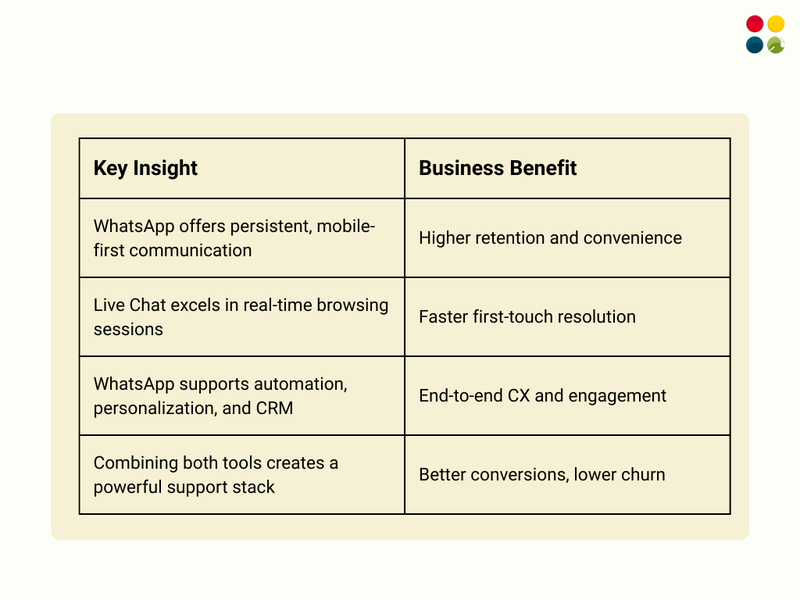
Whereas Live Chat is useful for instant interaction during a site visit, WhatsApp Support Solutions dig deeper — building trust, increasing retention, and driving conversion beyond the browser. It’s not about which is superior — but which is designed for long-lasting impact in a mobile-first, message-first world.
Key Takeaways
Conclusion
Today’s customers want more than quick answers — they want rich, frictionless conversations on their own terms. WhatsApp Support isn’t a support tool — it’s a brand strategy for brands that value retention, personalization, and scale.
If you’re still using Live Call Chat alone, you might be leaving money — and loyalty — behind.
Start Smarter Conversations with DialDesk
At DialDesk, we assist companies in unlocking WhatsApp Support Solutions that operate 24/7, save costs, and drive engagement. From AI automation to shared agent models and CRM integrations — we provide the tools and the team to scale your CX like never before.
Book your complimentary WhatsApp Support assessment with DialDesk today!
No customer left behind. No lead lost.