OVERVIEW
● This blog breaks down what “good etiquette” truly means on WhatsApp for customer support teams. It shows how brands should behave, respond, structure conversations, use automation ethically, and scale support without losing the human touch.
● We look at best practices, data-backed insights, and an actionable etiquette checklist powered by WhatsApp Support Solutions.
Introduction
Most of today’s brands have technology to respond instantly, but not all of them have the etiquette to handle conversations that earn trust.
People open WhatsApp for two reasons: speed and clarity. They don’t want long-winded corporate replies. They don’t want to feel like a ticket number. They want a brand that talks like a human, resolves issues like a pro, and respects the channel the way people use it every day.
And therein lies where most companies fail.
WhatsApp Customer Support etiquette isn’t about being “polite” anymore. It’s about customer psychology, channel behavior, and consistency of experience. When brands get this right, WhatsApp becomes the most efficient support engine in their ecosystem. And when they don’t, customers treat it like spam.
This blog will help you land on the right side of that equation with practical, credible, and modern etiquette rules based on real customer behavior, observed industry shifts, and platform data. Whether you are in retail, D2C, SaaS, logistics, or BFSI, this is the etiquette framework today’s brands cannot afford to ignore.
WhatsApp Customer Support Etiquette Every Brand Needs
1. Respond Like a Human, Resolve Like a System
Consumers want both warmth and structure.
● Use simple sentences without jargon.
● Acknowledge messages immediately, even if by automated response.
● Logically connect responses, don’t copy-paste disconnected scripts.
Why This Matters: According to Zendesk (2024), 82% of customers expect a brand to “sound human and not robotic” on messaging channels.
2. Speed Matters, But Clarity Wins
Quick responses get attention. Clear responses gain satisfaction.
Good etiquette:
● Share actionable next steps.
● Avoid sending multiple 1-liner bursts.
● Never overload a customer with long texts; format for readability.
Example:
Instead of dumping links, share:
“Here’s your return link 👇 (valid for 24 hours).”
3. Use Automation With Boundaries
Automation is powerful — misuse is painful.
Best Practices:
● Utilize chatbots for FAQs, order checks, or onboarding.
● Always provide an escape to a human agent.
● Keep the bot tone neutral, not overly friendly.
Stat: 71% of consumers say they will abandon brands that make it hard to reach a real human (Microsoft CX Report, 2024).
4. Respect WhatsApp as a Personal Space
WhatsApp isn’t an email. It’s not push marketing. It’s conversational.
Etiquette rules:
● Don’t send 3–4 reminders daily.
● Don’t send unsolicited promotions.
● Keep your brand name upfront and not masked with numbers.
● Always allow opt-out.
5. Keep Conversations Contextual
Customers hate to repeat themselves.
Your WhatsApp for Customer Support solution must:
● Capture past conversations
● Maintain agent notes
● Sync CRM information
● Carry context into escalations
Stat: On average, customers repeat themselves 3.1 times when support lacks context. (Forrester, 2023)
6. Use Rich Media Wisely
WhatsApp allows:
● Lists
● Buttons
● Catalogs
● PDFs
● Images & short videos
Etiquette:
● Use media only if it speeds up resolution.
● Don’t send large files without asking.
7. Respect Response Windows
If support runs 10 am – 7 pm, then make that evident.
Etiquette tip:
Send a polite auto-response outside business hours.
Keep it short, not robotic.
8. Close Conversations Gracefully
Closing messages leave a lasting impression.
Examples:
“Glad I could help! If anything else comes up, I’m here.”
“Would you like help with one more thing before we close?”
Avoid: “Closing ticket. Bye.” (cold & transactional)
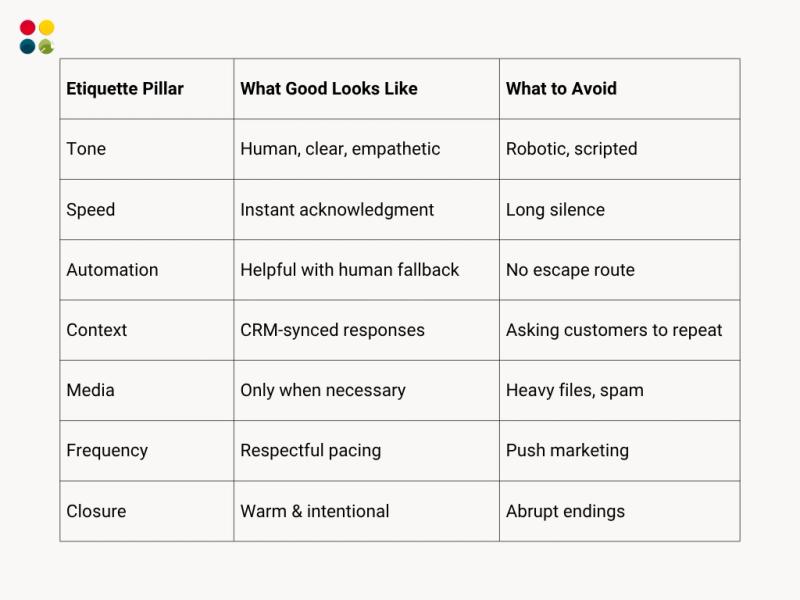
WhatsApp Support Etiquette Checklist
Why Etiquette Impacts Your Business (Not Just Experience)?
● 41% of customers switch brands after a poor messaging experience (PwC, 2024).
● 64% prefer WhatsApp support over email or phone (Meta Business Messaging Report, 2023).
WhatsApp is a service channel first, not a marketing blast zone. Etiquette will determine whether customers trust you enough to keep the conversation going.
Thoughts to Ponder
● Are your agents trained to “talk human,” not “talk script”?
● Does your bot serve customers or serve your queue metrics?
● If your customers screenshot a WhatsApp chat with your brand, would they feel proud or embarrassed?
● Is your support team using WhatsApp as a convenience for you or a convenience for them?
● Is your brand’s WhatsApp truly customer-first?
Key Takeaway
WhatsApp etiquette is not a soft skill; it’s a customer retention strategy. With the proper WhatsApp Support Solutions, your brand can offer clarity, empathy, speed, and structure at scale.
Wrap Up
Treat WhatsApp as if you are stepping into a customer’s personal space. Gain trust through tone, empower through clarity, respect their time, and implement automation ethically. When etiquette turns into operations, WhatsApp will no longer be a support channel; it will be your strongest customer experience advantage.
Conclusion
WhatsApp support etiquette is the difference between being a brand customer’s “message once” versus a brand they rely on for life. As messaging has become the default support channel globally, building etiquette-backed systems and agent behaviors are no longer optional; it’s the foundation for modern customer experience.
If you want WhatsApp Support Solutions that blend automation, context, and human excellence-the kind that customers rave about-it’s time to upgrade how your brand speaks, responds, and solves on WhatsApp.
If you’re ready to deliver support that’s fast, contextual, and etiquette-perfect, WhatsApp support solutions by DialDesk can power your entire customer experience.
From bots to agents to analytics, help you respond smarter, faster, and more human.