BPO (Business Process Outsourcing) means hiring a specialist company to run a business process for you, such as customer support, sales calls, helpdesk or back-office work. The BPO provider supplies the trained people, technology and quality checks, so your business gets reliable service without building the whole team in-house.
Key Takeaways
- BPO is the transfer of a repeatable business process, such as customer support, sales or helpdesk, to a specialist provider that owns the technology, quality and SLA accountability.
- BPO supports customer success by delivering trained agents, standardised quality, AI-assisted interactions and continuous improvement under a single SLA. Read more about customer success as a service.
- Businesses can reduce costs by up to 50–70% through BPO compared with equivalent in-house teams.
- BPO enables 24/7 omnichannel support across voice, chat, WhatsApp and email, without capital investment or hiring lead time.
- With DialDesk, shared support can go live in about 72 hours and a dedicated team in 1–2 weeks.
What Is BPO?
Business Process Outsourcing is a model where a company transfers a repeatable, process-driven business function, such as customer support, outbound sales, technical helpdesk, data entry or back-office processing, to a specialist provider. The provider has the infrastructure, technology and trained workforce to run it at lower cost and higher quality than many companies can sustain internally.
BPO is different from simple staffing. BPO providers own the process, the technology, the quality management and the SLA accountability. They are not filling a seat; they are running a function. Call center work is the most common example, explained in our guide to what a BPO call center is and how it works.
Businesses that want to hand over customer calls, chat or email usually start with a call center outsourcing company.
BPO Meaning With an Example
Imagine an online store that receives many customer calls and chats every day about orders, returns and refunds. Instead of hiring and training its own support team, it hires a BPO provider. The provider supplies trained agents, phone and chat systems, and quality checks, while the store still owns its products, policies and customer relationships. The store focuses on selling; the BPO team handles the day-to-day support.
What Does the BPO Industry Mean?
The BPO industry is the group of companies that provide outsourced business processes to other businesses. India is one of the world’s largest BPO hubs: India’s Business Process Management (BPM) industry reached nearly USD 49 billion in revenue in FY2024, according to NASSCOM. Common BPO clients include BFSI, healthcare, e-commerce and telecom companies.
Types of BPO
Inbound BPO
Handles calls and messages that customers start, such as support queries, orders and complaints.
Outbound BPO
Makes calls to customers or prospects, such as sales, renewals, reminders and surveys.
Back-Office BPO
Handles internal processes such as data entry, order processing and document management.
Inbound and outbound BPO are front-office work because they deal directly with customers. Back-office BPO supports the business behind the scenes.
By Location: Onshore, Nearshore and Offshore
Onshore BPO means the provider is in the same country as the client. Nearshore BPO means the provider is in a nearby country. Offshore BPO means the provider is in a distant country, often chosen for cost and scale.
How Does BPO Work?
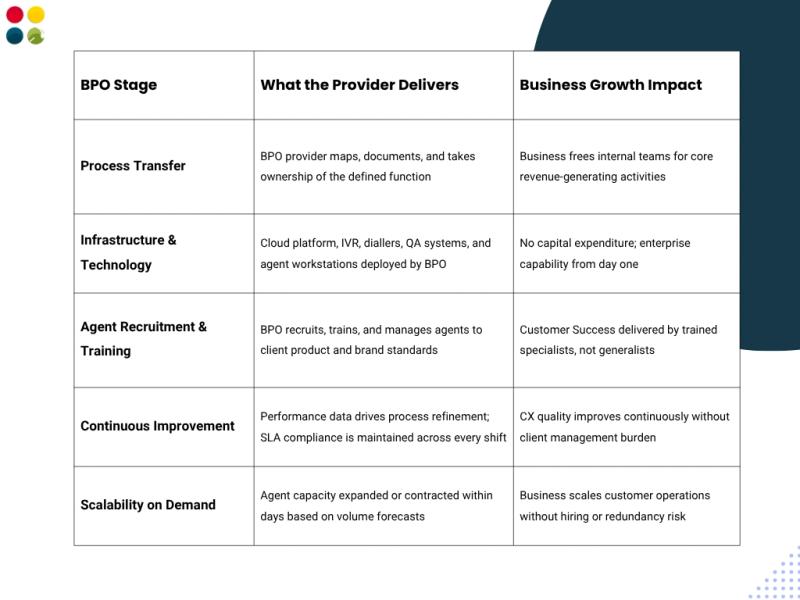
A BPO engagement usually follows four stages:
- Discovery: the provider studies your process, volumes and goals.
- Setup: agents are hired and trained, and technology and workflows are configured.
- Go-live: the team starts handling your customers under an agreed SLA.
- Improve: performance is reviewed regularly and processes are refined.
How Does BPO Drive Customer Success?
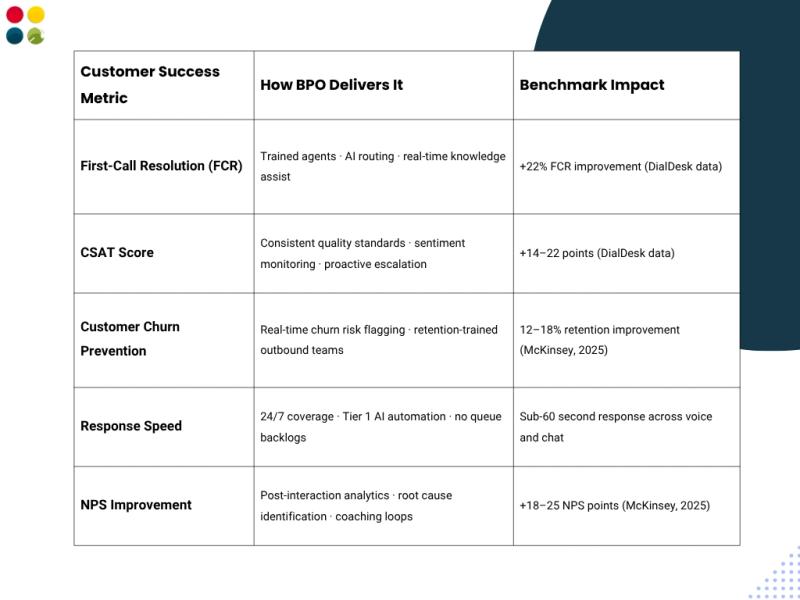
Customer success in a BPO context means more than resolving tickets. It means designing every customer interaction to deepen the relationship, reduce churn and create repeat business. A BPO team does this through trained agents, consistent quality checks, faster response times and regular reporting on customer satisfaction.
How Does BPO Shape Business Growth?
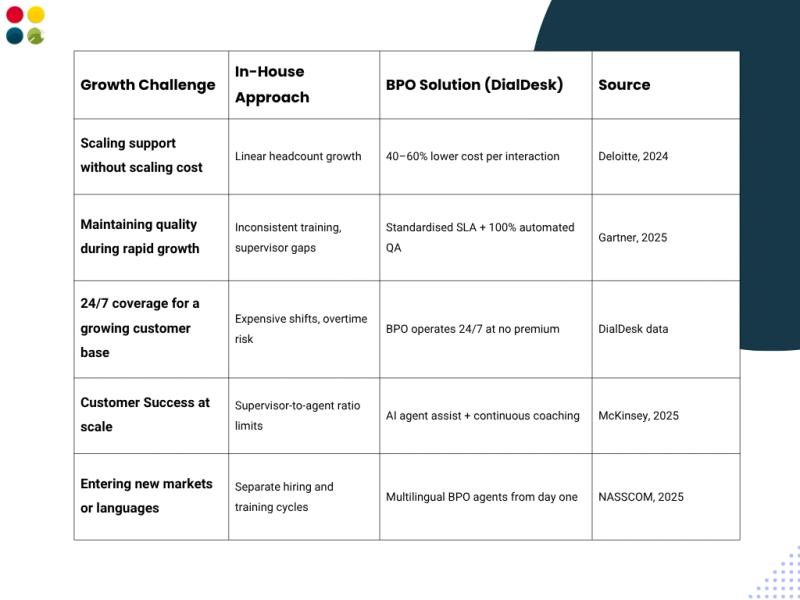
BPO breaks the link between business growth and operational cost. Instead of hiring and training a new in-house team for every increase in demand, a business can scale its outsourced team up or down as needed, and pay for capacity as it grows.
What Are the Advantages and Challenges of BPO?
Advantages
- Lower cost than building the same team in-house.
- Faster start, with trained agents and ready technology.
- Easy to scale up or down with demand.
- More time for your team to focus on core business work.
Challenges
- Less direct day-to-day control over the team.
- The provider needs clear SLAs, scripts and product training to match your brand.
- Customer data must be protected, so security and compliance need checking before you start.
✅ Trusted by 250+ Companies Across India
DialDesk is ISO 9001:2015 and ISO/IEC 27001:2022 certified, delivering customer support and call center outsourcing services for businesses from 20 seats to 2,000+ across BFSI, healthcare, e-commerce, telecom and retail.
Explore how DialDesk connects BPO operations with IVR, call routing and cloud telephony for full inbound and outbound capability, with real-time analytics and ISO-certified data security.
Is BPO the Right Growth Model for Your Business?
BPO is the right growth model if demand is growing faster than you can hire, train and manage an in-house team.
It gives you trained agents, quality management and 24/7 omnichannel coverage at a cost that scales with revenue. Start with processes that are repeatable and customer-facing, such as support or sales calls.
To find the right BPO setup for your business, book a demo below.