OVERVIEW
● With customers checking WhatsApp multiple times a day, the platform is now a powerful tool for fast, authentic feedback.
● This blog reveals how WhatsApp Business API and automation can boost survey completion rates by 3–5x over email, integrate with CRMs, and turn simple post-interaction chats into actionable insights—using the right timing, tone, and personalization to strengthen CX and fuel growth.
Introduction
Customer Feedback in 2025 isn’t a box to tick—it’s the fuel for your customer experience engine.
The challenge?
People are busier, more preoccupied, and less inclined than ever to complete a form that lands in their inbox two days after making a purchase. Meanwhile, they’re checking WhatsApp several times a day. Indeed, WhatsApp is now accessed by more than 2.78 billion individuals globally (Statista, 2025), the most engaged messaging platform on the planet.
For companies, this’s not just a little-known fact—it’s a golden opportunity for genuine, real-time feedback. Rather than relying on customers to click through survey links tucked in an email, you can reach them right where they’re already at.
And all thanks to WhatsApp API and WhatsApp Automation, sending a feedback survey is no longer a human task for your team. It’s instant, personalized, and scalable—converting post-interaction moments into insight-full conversations that come across as more of having a chat with a friend than completing a form.
Why WhatsApp Wins at Customer Feedback?
1. Higher Engagement Rates
● 45–60% average survey completion rate on WhatsApp compared to 5–15% on email (MobileSquared, 2024).
● Messages look like personal conversations, not corporate messages—making them more difficult to brush off.
2. Conversational, Not Transactional
● People react more positively to brief, friendly requests than to formal “Dear Customer” emails.
● WhatsApp allows for rich media—you can include emojis, images, and voice requests to engage respondents in surveys.
3. Speed & Automation
● WhatsApp Automation enables you to send out surveys right after a customer interaction—when it is still fresh in their mind.
● The WhatsApp API can be integrated with CRMs, auto-tagging and auto-categorizing feedback for quicker analysis.
4. Trust Factor
● Customers are more likely to respond on a platform they already trust for one-on-one conversations.
● Opt-in based messaging guarantees adherence to data privacy laws.
How to Use WhatsApp for Customer Feedback Surveys?
Step 1: Set Up Your WhatsApp API
● Integrate with a WhatsApp Business Automation provider (such as DialDesk) for automated sending of surveys.
● Ensure the system has bulk messaging, personalization, and data export capabilities.
Step 2: Design the Survey for Mobile
● Keep it brief: 3–5 questions maximum.
● Use multiple choice, quick replies, and rating scales.
● Don’t use jargon—keep it friendly.
Step 3: Trigger Automation
● Send surveys:
○ After order delivery.
○ After customer service resolution.
○ Post-event or product trial.
Step 4: Personalize the Experience
● Employ the use of the customer’s name and their purchase or service.
● Example: “Hi Priya, thanks for ordering from us yesterday! How was your delivery experience?”
Step 5: Analyze & Act
● Tag feedback as positive, neutral, or negative in your CRM.
● Feed insights into product, service, and training improvements.
WhatsApp Feedback Survey Best Practices
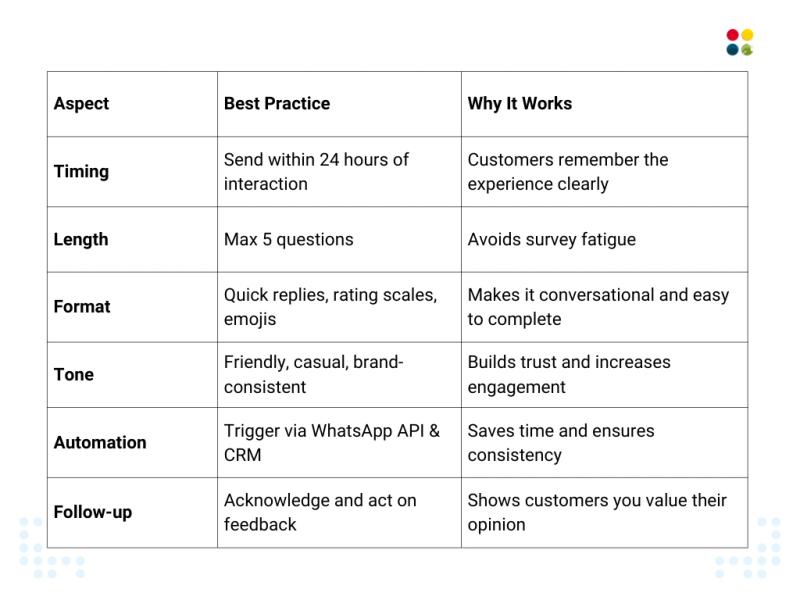
Expert-Level Insights
1. Micro-Surveys Are the Future
Rather than lengthy, 10-question surveys, employ 2–3 brief questions over multiple interactions. This maintains response rates high and insights current.
2. Voice Feedback is Underused
The WhatsApp API enables voice notes—enabling customers to provide richer, emotional feedback in seconds.
3. Automation ≠ Robotic
Personalization tags, emojis, and conversational prompts keep your automation human-feeling.
4. Link Feedback to Loyalty Programs
Providing a little reward, such as additional loyalty points for filling out a survey, can make a big difference in participation.
Thoughts to Ponder
● Is your current feedback collection mechanism designed for how customers interact today—or how they interacted 10 years ago?
● What would you do if you eliminated all the friction points between your customer’s opinion and your capacity to hear it?
● In the automation era, are you leveraging technology to displace human connection or to augment it?
Also Read: The Best Days & Times to Message Customers on WhatsApp
Wrap-Up
Utilizing WhatsApp for customer survey feedback is not only a trend—it’s a paradigm shift in how brands gather and respond to insight. It’s the intersection of reach, trust, and real-time interaction with the might of automation and CRM integration.
The outcome? More responses, quicker responses, and better customer relationships.
Key Takeaways
● WhatsApp surveys have a 3–5x higher completion rate over email.
● Automation through WhatsApp API enables timely, repeatable survey delivery.
● Short, chatty styles suit mobile-first users.
● Personalization is a given—it builds trust and engagement.
● Feedback is only useful if you act on it—close the loop with your customers.
Conclusion
Feedback gathering is moving from cold, one-way questionnaires to warm, two-way conversations—and WhatsApp is at the forefront. By combining the popularity of the platform with automation and smart design, you can convert customer views into business growth drivers.
At DialDesk, we assist businesses in turning WhatsApp into a CX and feedback powerhouse—from WhatsApp Support to WhatsApp Automation and API integrations that seamlessly fit into your current setup.Ready to listen to your customers loud and clear?
Reach out today and begin turning WhatsApp conversations into growth strategies.