What Call Center Metrics Should CX Leaders Track?
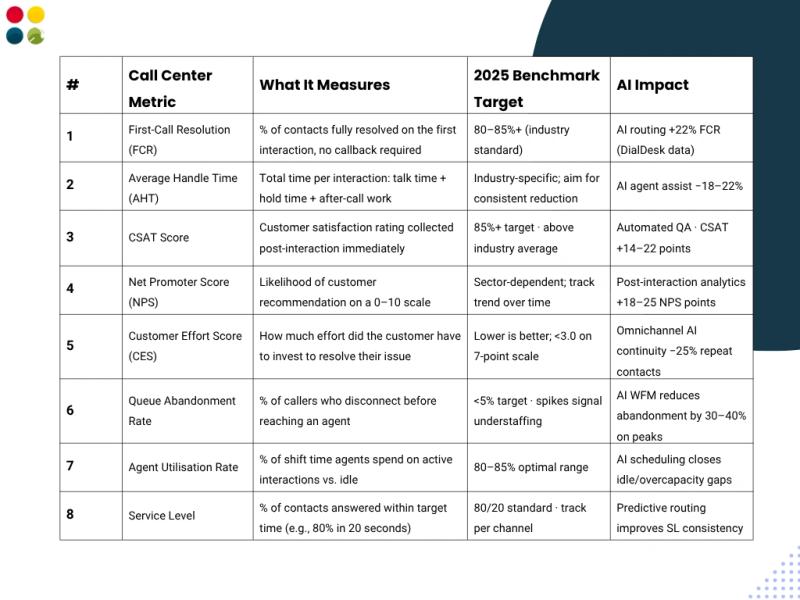
The top Call Center Metrics every CX leader must track in 2025 are: First-Call Resolution (FCR), Average Handle Time (AHT), Customer Satisfaction Score (CSAT), Net Promoter Score (NPS), Customer Effort Score (CES), Queue Abandonment Rate, Agent Utilisation Rate, and Service Level. Each Call Center metric targets a specific operational or CX gap — and AI-powered platforms now track all eight in real time across 100% of interactions, not sampled data.
Why Call Center Metrics are the CX Leader’s Primary Performance Language
A Call Center without tracked metrics is an operation without a compass. Every staffing decision, coaching intervention, technology investment, and process change in a contact center should be driven by metric data — not supervisor intuition or periodic QA samples.
Call Center Metrics matter more in 2025 than at any previous point because AI has changed both the data available and the speed at which it is actionable. Metrics that previously took a week to compile from sampled QA are now updated in real time across 100% of interactions. CX leaders who use this data to make daily operational decisions outperform those still running on weekly cycle reports.
The eight Call Center Metrics below represent the complete performance picture a CX leader needs — covering customer outcomes, operational efficiency, agent performance, and CX sentiment simultaneously.
💡 Why It Matters
Contact centers that track and act on all eight Call Center Metrics in real time achieve 2.1x greater year-on-year CSAT improvement than those tracking fewer than five metrics or relying on weekly QA cycles (Forrester, 2024).
The 8 Call Center Metrics Every CX Leader Must Track in 2025
How AI Changes the Way Call Center Metrics Are Tracked and Acted Upon
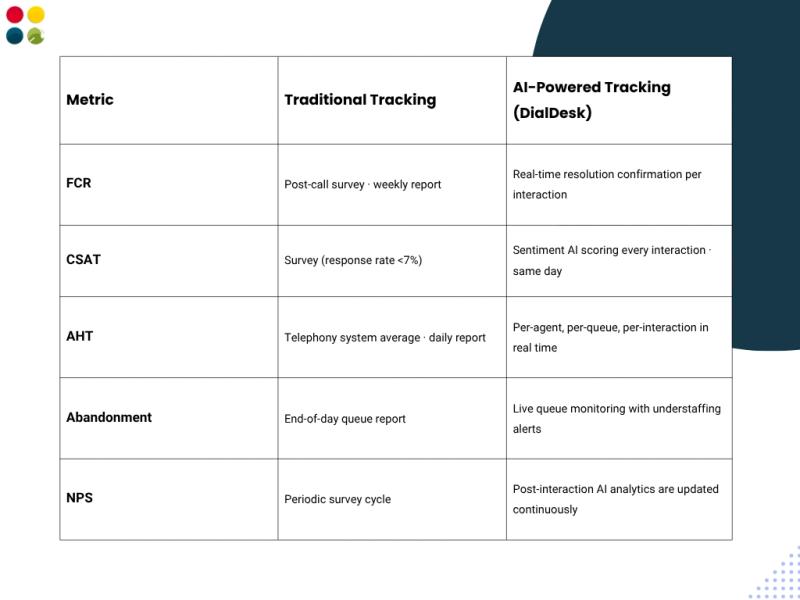
Traditional Call Center metric tracking has two structural weaknesses: it relies on sampled data and lags operational reality by days or weeks. An AHT spike on Monday is visible in a Friday report. A CSAT drop in a specific queue is visible after the next survey cycle.
AI changes both problems simultaneously. Call Center Metrics tracked on AI-powered platforms like DialDesk are updated in real time, from 100% of interactions, with automated alerts when any metric crosses a threshold. A supervisor knows about an AHT spike in queue 3 at 10:47 AM — not on Friday.
✅ Trusted by 500+ Contact Centers Across India
DialDesk’s Call Center Metrics dashboard tracks all eight KPIs in real time across 100% of interactions — voice, chat, WhatsApp, and email — with automated alerts, coaching flags, and workforce management integration from a single ISO 9001:2015 and ISO 27001:2013 certified platform.
Key Takeaways
• The 8 Call Center Metrics every CX leader must track: FCR, AHT, CSAT, NPS, CES, Queue Abandonment Rate, Agent Utilisation Rate, and Service Level.
• Call Center Metrics tracked in real time from 100% of interactions deliver 2.1x greater CSAT improvement than weekly sampled-QA reporting (Forrester, 2024).
• AI-powered Call Centers near me platforms update every metric in real time — enabling same-day coaching, intraday staffing adjustments, and immediate threshold alerts.
• FCR is the highest-leverage metric: a 22% improvement through AI routing reduces repeat contacts, lowers AHT, raises CSAT, and compresses cost per interaction simultaneously.
• DialDesk tracks all 8 Call Center Metrics from 100% of interactions across all channels — with automated coaching flags and workforce alerts from a single dashboard.
Conclusion
Call Center Metrics are not a reporting exercise. They are the operational language that determines whether a Call Center is improving or degrading — and whether the decisions driving that trajectory are based on real data or assumptions.
The eight metrics above give every CX leader a complete performance picture: customer satisfaction, operational efficiency, agent performance, and CX sentiment in a single framework. AI makes all eight trackable in real time, from 100% of interactions, with the immediacy that allows same-day corrections rather than weekly post-mortems.
Explore how DialDesk’s Call Center Metrics dashboard connects with your IVR and call routing and cloud telephony India infrastructure to deliver real-time performance intelligence from day one — across voice, chat, and WhatsApp, with no hardware required.
Track everything. Act immediately. Improve continuously. That is what DialDesk Call Center Metrics makes possible.
📅 Want to Track All 8 Call Center Metrics in Real Time?
DialDesk’s Call Center platform tracks FCR, AHT, CSAT, NPS, CES, Abandonment Rate, Utilisation, and Service Level from 100% of interactions — with real-time alerts, coaching flags, and AI workforce management across voice, chat, and WhatsApp.
Join 500+ contact centers across India already running data-driven CX with DialDesk.