What Are the Top Challenges of Running an In-House Call Center?
The top 5 challenges of running an In House Call Center are: (1) high fixed infrastructure and staffing costs that cannot flex with interaction volume; (2) agent attrition and the continuous quality degradation it creates; (3) technology debt from legacy systems that cannot support modern AI augmentation; (4) inability to scale quickly for peak events without SLA breach; and (5) quality monitoring gaps from sampled QA that misses the majority of interactions. Indian Call Center operations that overcome all five are increasingly migrating to AI-augmented, cloud-native platforms that address each constraint simultaneously. DialDesk helps In House Call Centers modernise their stack without replacing their teams.
Why In House Call Center Challenges Are Structural, Not Operational?
The challenges of running an In House Call Center are not management failures — they are structural features of the in-house model itself. Fixed infrastructure creates fixed costs. Employed agents create a fixed headcount. Legacy telephony systems create technology ceilings. These are not problems to be managed around; they are constraints that compound as the call center scales.
In India’s contact center market, the Indian Call Center landscape has bifurcated in 2025: organisations that have modernised their In House Call Center infrastructure with cloud-native telephony and AI tools are operating at materially higher quality and lower cost than those running the same systems they deployed in 2015–2018. The five challenges below are the operational consequences of that divergence.
💡 Why It Matters
Deloitte’s 2025 Global Outsourcing Survey found that 68% of organisations running an In House Call Center cited ‘inability to scale without proportional cost increase’ as their primary operational constraint — making fixed-cost scalability the defining challenge of the in-house model. (Deloitte, 2025)
Challenge 1: Fixed Infrastructure Cost That Cannot Flex With Volume
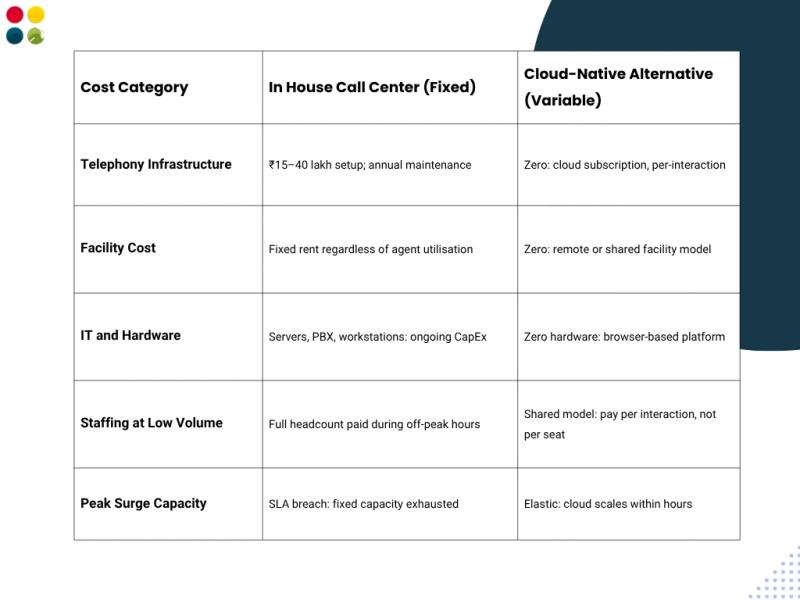
An In House Call Center carries a fixed cost base: facility rent, hardware, telephony systems, IT maintenance, and management overhead are all paid whether the center handles 200 calls or 2,000 in a day. This creates two simultaneous problems: during low-volume periods, the center is expensive relative to output; during peak events, it is under-capacity despite the full cost being borne.
Challenge 2: Agent Attrition and Continuous Quality Degradation
Indian Call Center operations face one of the highest agent attrition rates of any sector: industry average attrition in Indian contact centers runs at 25–45% annually (Nasscom, 2025). Every attrition event creates a quality gap: the departing agent’s knowledge leaves with them; the replacement agent takes 6–12 weeks to reach productive quality; and during that ramp period, customer interactions handled by the new agent are below the quality standard the brand needs to maintain.
AI augmentation specifically addresses the attrition-quality link. When agent assist tools surface correct answers during calls and AI Sentiment Analysis provides real-time coaching prompts, a new agent’s ramp time drops from 6–12 weeks to 10–14 days — and their interaction quality during ramp is consistent with experienced agents because the AI is supplementing their knowledge gaps in real time.
Challenge 3: Technology Debt and the Legacy System Ceiling
Many In House Call Centers in India are running telephony infrastructure deployed in 2012–2018. These systems predate cloud-native architecture, NLP IVR, real-time AI Sentiment Analysis, and omnichannel integration. Upgrading them is not a software update — it is a full infrastructure replacement with significant capital expenditure and operational disruption.
The consequence is a technology ceiling: the In House Call Center cannot deploy the AI tools that its outsourced competitors use as standard, because the underlying infrastructure cannot support them. First-call resolution stays at legacy DTMF IVR levels. Quality monitoring stays at 5–10% sampling. Agent coaching stays weekly rather than real-time. The gap between the In House Call Center’s capability and the market standard widens with every technology cycle it misses.
Challenge 4: Peak Volume Scaling Without SLA Breach
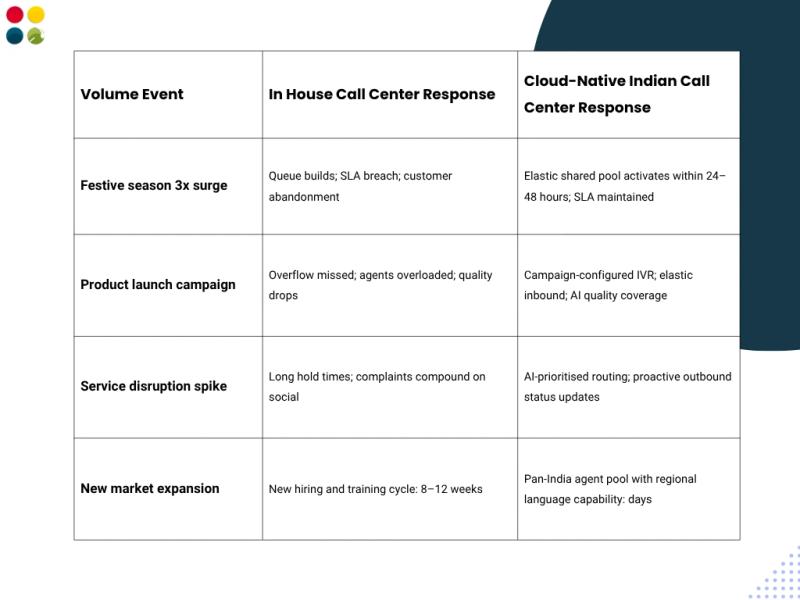
An In House Call Center is sized for normal volume. When volume spikes — festive season, product launch, marketing campaign response, service disruption — the fixed-capacity model produces hold queues, abandoned calls, and SLA breach. Hiring temporary agents is not a viable rapid response: it takes weeks, adds training burden, and creates post-peak redundancy when the surge recedes.
Challenge 5: Quality Monitoring Gaps from Sampled QA
The standard quality monitoring approach in an In House Call Center is sampled post-call QA: a quality team reviews 5–10% of recorded interactions, identifies issues, and provides feedback in weekly or fortnightly sessions. This approach has three structural failures: it misses 90–95% of interactions entirely; the feedback loop is too slow to prevent quality issues from affecting large customer volumes; and it cannot identify real-time moments where intervention would have changed the outcome.
AI Sentiment Analysis at 100% coverage, real-time, eliminates all three failures simultaneously. Every interaction is scored. Supervisor alerts fire during the interaction when emotion thresholds are crossed. Coaching data is generated from every call, not a 5–10% sample. The quality visibility an In House Call Center achieves with 100% AI QA is categorically different from what a sampled human team can provide.
✅ Trusted by 500+ Contact Centers Across India
DialDesk helps In House Call Centers modernise without rebuilding — cloud telephony overlay, AI Sentiment Analysis, 100% automated QA, and NLP IVR can be deployed on top of existing agent teams in 10–14 days. ISO 9001:2015 and ISO 27001:2013 certified. Trusted by 500+ Indian Call Centers. See our full BPO call center services platform.
Business Impact: What Modernised In-House Call Centers Achieve
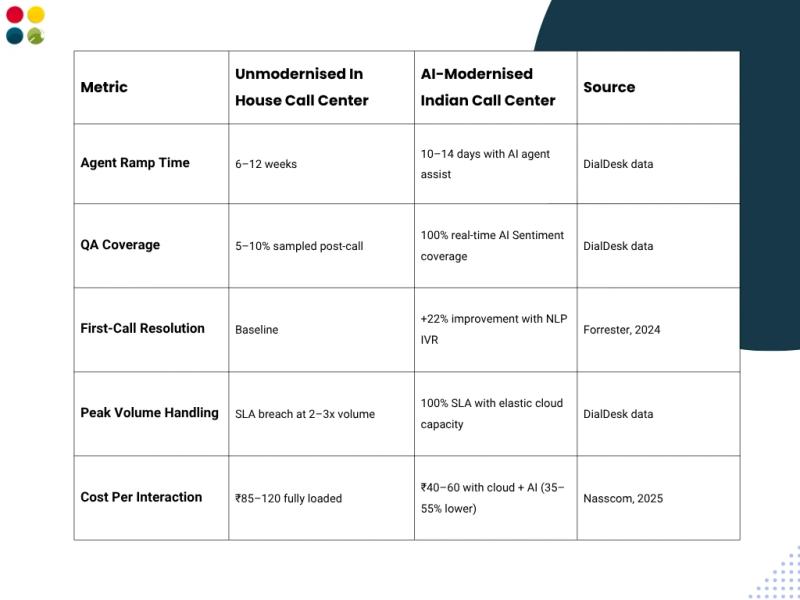
Indian Call Center operations that modernise their In House Call Center with cloud telephony and AI augmentation — without necessarily outsourcing — report consistent performance improvements within the first 90 days (Nasscom, 2025 / Forrester, 2024 / DialDesk data):
Key Takeaways
• The 5 In House Call Center challenges are structural: fixed cost, agent attrition, technology debt, peak scaling inability, and sampled QA gaps — each compounds as the center grows.
• 68% of In House Call Centers cite ‘inability to scale without proportional cost increase’ as their primary constraint. (Deloitte, 2025)
• Indian Call Center attrition runs at 25–45% annually — AI agent assist cuts new agent ramp time from 6–12 weeks to 10–14 days. (Nasscom, 2025)
• 100% AI Sentiment Analysis coverage eliminates the quality blind spots of 5–10% sampled QA — the most consequential modernisation step for any In House Call Center.
• DialDesk modernises In House Call Centers in 10–14 days — cloud overlay on existing teams, no full rebuild required, ISO-certified from day one.
Conclusion
The challenges of running an In House Call Center in India are not unique to any one organisation — they are the structural features of the in-house model operating in a market where customer expectations, technology standards, and competitive benchmarks have moved faster than legacy infrastructure can follow.
The resolution for each of the five challenges exists: cloud telephony for cost flexibility, AI agent assist for attrition-proofed quality, NLP IVR for routing accuracy, elastic shared capacity for peak scaling, and 100% AI QA for quality visibility. The modernisation path is a 10–14 day deployment, not a multi-year infrastructure project.
Explore how DialDesk’s modernisation platform integrates with your existing In House Call Center infrastructure — IVR and call routing, AI Sentiment Analysis, and cloud telephony India — to resolve all five challenges from day one.
The In House Call Center challenges are structural. The solutions are available today. DialDesk deploys them in 14 days.
📅 Want to Overcome Your In-House Call Center Challenges?
DialDesk modernises Indian Call Centers with cloud telephony, AI Sentiment Analysis, 100% automated QA, and elastic peak capacity — deployed on top of your existing team in 10–14 days.
Join 500+ contact centers across India already operating at modern standards with DialDesk.