How Do Expert Call Center Agents Handle Difficult Callers?
Expert Call Center agents handle difficult and angry callers through five field-tested techniques: active listening to validate the caller’s frustration, tone management to de-escalate through calmness, genuine empathy to build connection rather than defensiveness, solution-first focus to shift the conversation toward resolution, and knowing when to escalate professionally. Companies that invest in agent training for handling difficult interactions report 35% higher customer satisfaction scores (LinkedIn Learning, 2024). DialDesk’s Call Center Solutions for Small Business embed all five techniques through structured training, AI real-time coaching, and gamified performance programs.
Why Nasty Callers Are a Bigger Business Problem Than Most Businesses Realise
62% of customers admit to having raised their voices at a service representative when frustrated (Zendesk, 2024). This is not a fringe phenomenon, it is a routine reality for every expert call center handling real customer volumes. How agents respond to these moments determines whether the business retains or loses that customer.
The customer who shouts about a delayed delivery is not primarily angry at the agent. They are frustrated by unmet expectations, powerlessness, and the accumulated friction of a bad experience. Expert Call Center agents understand this distinction, and it is the foundation of every technique that follows.
💡 Why It Matters
78% of customers evaluate their entire brand experience based on the tone and empathy of the customer service representative they speak to (Forbes, 2024). For small businesses where every customer relationship has compounding lifetime value, how agents handle difficult calls is a direct revenue variable.
The Expert Call Center De-Escalation Framework: 5 Techniques That Work
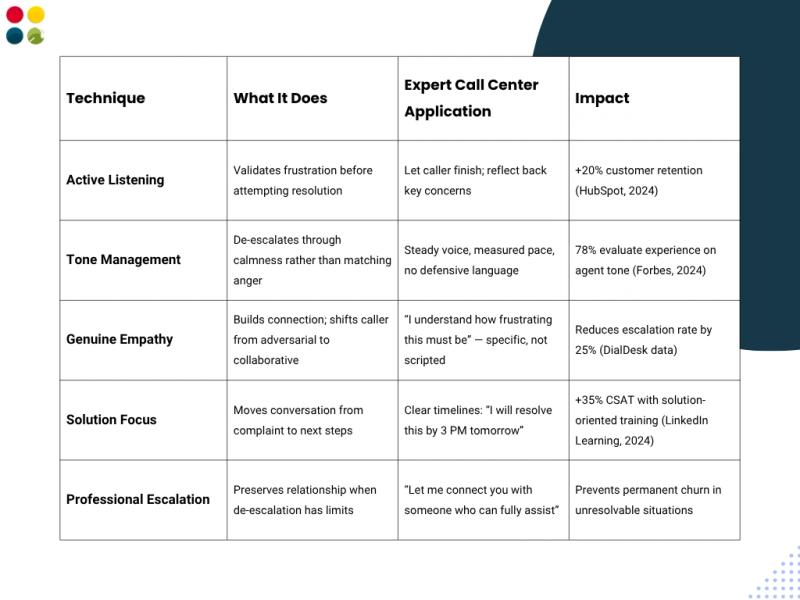
Breaking Down Each Technique: What Expert Call Center Agents Actually Do
1. Active Listening: Hear the Frustration, Not Just the Words
When a caller opens with “I’ve been on hold for 20 minutes and your service is terrible”, the expert call center agent’s first move is silence. Not a defensive explanation. Not an immediate apology. Silence that communicates: I am listening to you completely. Then a reflection: “I hear you, a 20-minute wait is completely unacceptable, and I’m going to fix this right now.” Companies prioritising active listening experience 20% higher customer retention (HubSpot, 2024).
2. Tone Management: Your Calm Is the De-Escalation Tool
Anger is genuinely contagious, and so is calm. Expert call center agents are trained to maintain a steady, warm, controlled tone regardless of the caller’s volume. This is not passive. A calm tone communicates competence, safety, and control, the three things an angry caller most needs to feel before they can engage with a resolution. 78% of customers evaluate their experience based on agent tone alone (Forbes, 2024).
3. Empathy That Is Specific, Not Scripted
Generic empathy, “I’m sorry to hear that”, registers to experienced callers as automated and insincere. Expert call center responses name the specific frustration: “I can absolutely understand why a billing error before the weekend would be so stressful.” The specificity signals genuine attention, not scripted sympathy. This distinction between authentic and performative empathy is what separates Call Center Solutions for Small Business that retain customers from those that lose them.
4. Solution Focus: Give Them the Next Step, Not a Policy
Angry callers do not want to hear why the problem happened. They want to know exactly what happens next and when. Expert call center agents shift from explanation to action: “Here’s exactly what I’m doing right now, and you’ll have confirmation by 3 PM tomorrow.” Specificity in resolution communication reduces callbacks by 18% and increases CSAT by up to 35% (LinkedIn Learning, 2024).
5. Escalation as a Positive, Not a Failure
Knowing when to escalate is a skill, not a weakness. Expert call center agents escalate when: the caller’s issue requires authority the agent does not have, the emotional intensity has passed the threshold for productive resolution, or the caller explicitly requests a supervisor. The professional framing, “I want to make sure you get the full resolution this deserves, let me connect you with a specialist”, preserves the relationship through the handoff.
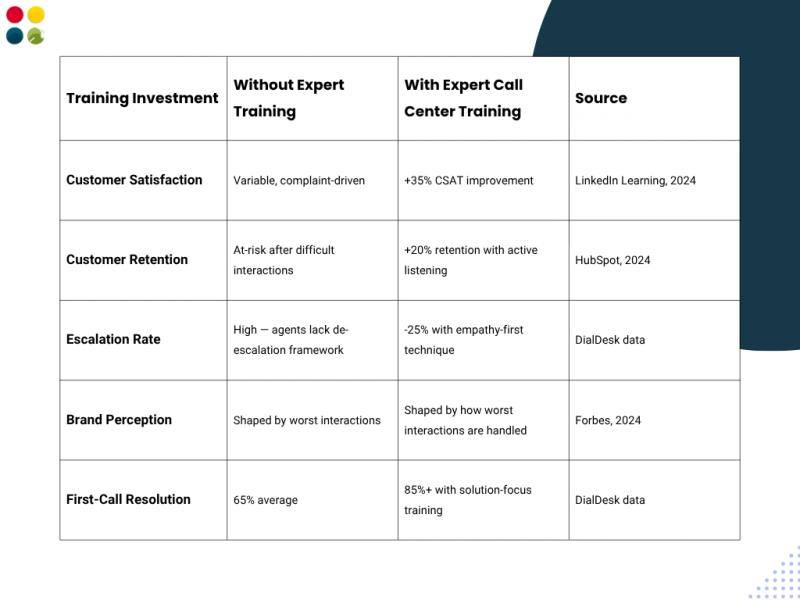
Business Impact: What Expert Call Center Training Delivers
✅ Trusted by 500+ Contact Centers Across India
DialDesk’s Expert Call Center platform delivers structured agent training, AI-powered real-time coaching, and gamification tools as standard features of every deployment, ISO 9001:2015 and ISO 27001:2013 certified. Our Call Center Solutions for Small Business make enterprise-grade training accessible at any scale.
Key Takeaways
• 62% of customers have raised their voices at a service representative, handling difficult callers is not an edge case. It is a daily operational requirement for every expert call center.
• The five expert call center de-escalation techniques are: active listening, tone management, specific empathy, solution focus, and professional escalation, each with measurable CSAT impact.
• 78% of customers judge their entire brand experience on agent tone alone, making expert call center tone management a direct brand equity investment.
• Companies investing in agent training for difficult caller management see 35% higher CSAT and 20% higher customer retention, the ROI of expert training is measurable and compounding.
• DialDesk’s Call Center Solutions for Small Business embed all five techniques through structured training, AI coaching, and gamified performance programs, accessible at any business size.
Conclusion
Nasty callers are not the exception in expert call center operations, they are the reality. The organisations that train their agents with deliberate, evidence-based techniques convert these high-stress interactions from brand risks into brand-defining moments.
The customer who calls furious and leaves satisfied is the most powerful loyalty signal a call center can generate. They know from personal experience that the brand they chose will stand behind them when things go wrong. That is the outcome that expert call center training, delivered consistently at scale, makes possible.
Explore how DialDesk’s expert call center platform and call center solutions for small business deliver structured agent training, AI coaching, and real-time performance tools that transform the most difficult interactions into your strongest loyalty moments.
Every difficult call is a loyalty opportunity. Expert training makes it one.
📅 Want to Build an Expert Call Center Team That Handles Any Caller?
DialDesk’s expert call center platform delivers structured de-escalation training, AI real-time coaching, and gamified performance management — ISO certified, scalable for small business and enterprise alike. Join 500+ contact centers across India already turning difficult calls into loyalty moments.