OVERVIEW – WHAT THIS BLOG COVERS
In this blog, you’ll get:
● Why support teams can’t scale on legacy phone systems ● What cloud telephony actually solves (beyond “it’s cheaper”) ● Real operational gains backed by data ● Scaling frameworks every support leader can apply ● When cloud telephony fails (yes, it can) ● One infographic showing how it transforms support
Why Support Growth Breaks Legacy Telephony
What Cloud Telephony Actually Enables
How Cloud Telephony Helps You Scale Support (Practical Breakdown)
Scaling Support With Cloud Telephony
What Most Companies Misunderstand
Introduction
Support has changed faster than most infrastructure.
Customers expect:
● Instant connectivity ● No call drops ● No busy tones ● No “call back later” ● No losing context ● No delays
Yet many support teams still scale using:
● Fixed PRI lines ● Hardware PBXs ● Rigid routing ● Limited analytics ● Manual expansions ● Delays on capacity
Scaling on legacy telephony is like building a highway using bicycle tools.
Cloud Telephony rewrites all of this.
It isn’t just “phone calls on the internet.”
It’s infrastructure + scalability + analytics + flexibility + resilience, wrapped into a platform that can grow as fast as your demand grows.
This blog goes beyond definitions and explains how support teams actually scale when telephony stops being a bottleneck and starts being a strategic asset.
Why Support Growth Breaks Legacy Telephony
Here’s what support teams face when they try to scale on old systems:
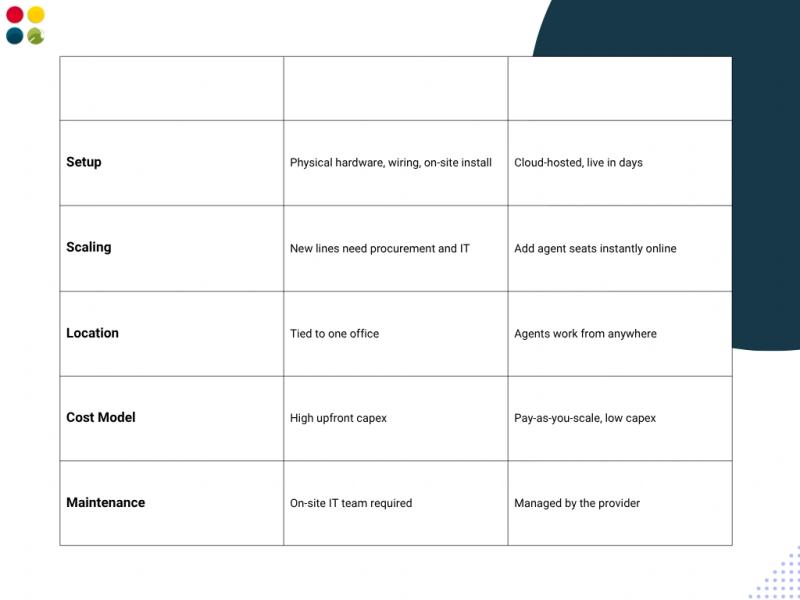
● Adding 10 agents → requires hardware + provisioning + downtime ● Predicting spikes → almost impossible ● Call logs → incomplete or unreadable ● Recording → additional hardware ● Routing → extremely limited ● Remote work → painful ● Analytics → basically non-existent ● Reliability → tied to physical circuits
According to Frost & Sullivan (2024):
● 63% of support outages come from hardware + circuit failures ● 47% of organizations cannot scale call capacity within 24 hours ● Cloud telephony reduces operational cost by 30–50% on average
Support won’t scale unless infrastructure scales.
What Cloud Telephony Actually Enables
Cloud telephony changes support in four structural ways:
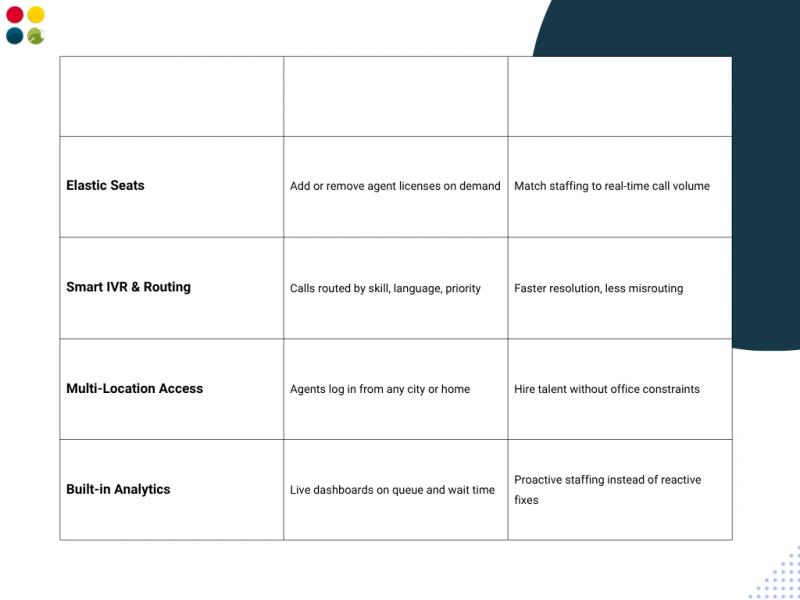
1. Elastic Capacity
Need:
● 10 agents today ● 50 tomorrow ● 500 during sale season
Just scale. No installation. No hardware. No downtime.
2. Anywhere Workforce
Cloud telephony + softphone = agents can work:
● At home ● On mobile ● In satellite offices ● In hybrid teams
This alone reduces hiring bottlenecks massively.
3. Deep Analytics
Because calls happen in software, you get:
● Real-time queue health ● Agent performance ● Talk time patterns ● Call drop heatmaps ● Sentiment + emotion detection ● Customer journey mapping
Legacy systems can’t even measure a fraction of this.
4. Integration
Cloud telephony plugs into:
● Help Desk ● Customer Service CRM ● Call logs ● Conversation intelligence ● IVR builders ● Workforce management
When systems speak to each other, support stops being reactive and starts being intelligent.
How Cloud Telephony Helps You Scale Support (Practical Breakdown)
1. Faster Onboarding
With cloud telephony:
● New agent = login + headset ● No provisioning ● No hardware ● No configuration delays
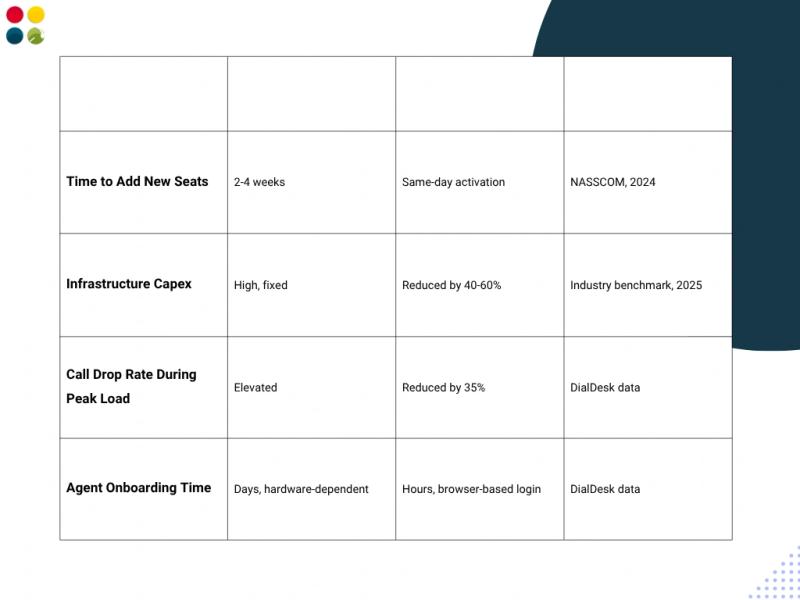
Most teams reduce onboarding time from days → minutes.
2. Smart Routing at Scale
Advanced routing = operational advantage.
Cloud telephony supports:
● Skills-based routing ● Time-of-day routing ● Priority routing ● Geographic routing ● Sentiment-triggered routing ● Load-balancing
When routing improves, resolution improves.
3. Reduce Call Drops & Improve Reliability
Cloud infrastructure uses:
● Distributed data centers ● Automatic failover ● Redundancy ● Encrypted SIP alternatives
Brands experience:
● 99.9% uptime ● Fewer call drops ● No single point of failure
Customer trust grows when the phone simply works.
4. Lower Costs
Savings come from:
● No hardware ● No maintenance ● No circuit charges ● Pay-as-you-grow
Typical reduction:
● 30–50% operational cost ● 20–30% FTE savings due to efficiency
5. Quality + Coaching + Improvement
When calls are stored + transcribed + analyzed automatically:
● Call Center QA becomes objective ● Agent training becomes targeted ● Empathy gaps get caught ● Compliance improves
This is where modern support teams outperform competitors.
6. Scale During Peaks Without Panic
Ecommerce during festive season
SaaS during outages ISPs during downtime Banks during new policy rollout
Cloud telephony absorbs spikes without:
● Losing calls ● Hiring panic agents ● Investing in hardware
Scaling Support With Cloud Telephony
What Most Companies Misunderstand
Here’s the insight most people miss:
Cloud telephony is not about replacing PBX.
It’s about building scalable support as a digital product.
When support becomes digital:
● Insights become available instantly ● Routing becomes data-driven ● Performance becomes measurable ● Customers feel faster resolutions ● Agents feel empowered
The companies that treat telephony as “infrastructure cost” will always lag behind the companies treating it as “CX advantage.”
Learn how the future of technology integration for small businesses is reshaping operations with smarter tools, seamless automation, and scalable digital solutions.
Real Numbers You Should Know
Based on industry benchmarks (Gartner, Forrester, Frost & Sullivan):
● 30–50% reduction in cost ● 20–40% increase in agent productivity ● 15–25% improvements in CSAT ● 50–70% reduction in call drops ● Up to 10x faster scalability
These are not incremental gains.
These materially shift how support delivers value.
Thoughts to Ponder
● What happens when your support grows 10x in a year?
● Can your current infrastructure handle spikes without losing customers?
● Is your data trapped in hardware?
● Are you scaling support… or just firefighting it?
Key Takeaways
● Cloud Telephony Solutions removes scaling constraints completely
● It increases reliability, reduces cost, and improves insight
● Remote + hybrid support becomes effortless
● Advanced routing + analytics create measurable CX gains
● Teams that adopt early build a long-term competitive advantage
Conclusion
Scaling support isn’t about hiring more people.
It’s about removing infrastructure ceilings, giving teams better data, and enabling faster responses at every stage of the customer journey.
Cloud telephony turns support from a cost center into a scalable, data-driven growth engine.
If your support still depends on hardware and slow provisioning, you’re scaling on yesterday’s infrastructure.
The future belongs to teams who scale as fast as customers demand.
Wrap-Up
Support teams that adopt cloud telephony don’t just grow — they transform.
If your customers expect speed, reliability, and personalization, your infrastructure must deliver it too. Dialdesk’s Cloud Telephony + AI-powered support infrastructure helps you scale without losing clarity, quality, or customer trust.
Want to build support that grows with you?
Book a demo with DialDesk today!
It’s a phone system built on cloud infrastructure instead of physical hardware, allowing scalable, reliable, data-rich calling.Yes. Modern providers use encryption, compliance controls, and secure SIP protocols.Absolutely. This is one of its strongest benefits.Yes, integration is a core advantage — improving routing + context + analytics.Most organizations reduce operational cost by 30–50% within months.