How Do Shared Call Centers Help Scale Support Teams?
Shared Call Centers help scale Support Teams by providing access to an elastic pool of trained agents, AI-augmented technology, and cloud infrastructure that expands or contracts with actual interaction volume — without the hiring cycles, training timelines, and fixed facility costs of building in-house support teams. A Shared Call Center activates additional Support Team capacity in hours, not weeks, with full AI quality monitoring from day one. DialDesk delivers Shared Call Center support team scaling for 500+ businesses across India, with 100% AI Sentiment Analysis coverage and ISO-certified security.
Why Scaling Support Teams with a Shared Call Center Outperforms Building In-House?
Every growing business reaches the point where its Support Teams cannot scale at the rate its customer base is growing. Hiring takes 4–6 weeks per agent cohort. Training adds another 2–4 weeks. Office space, hardware, and telephony procurement add further delay. By the time the in-house Support Team is ready, the volume it was built for has already passed.
A Shared Call Center removes all four constraints simultaneously. The agents are already trained, the technology is already deployed, and the infrastructure is already running. When interaction volume grows, the Shared Call Center activates additional capacity from its existing pool, sometimes within 24 hours. When volume drops, the per-interaction pricing model means there is no idle capacity cost. For growing businesses, this is not just a cost advantage. It is a competitive advantage.
💡 Why It Matters
Deloitte’s 2025 Global Outsourcing Survey found that 72% of companies that used Shared Call Center models to scale Support Teams reported activation timelines under 72 hours for volume increases of up to 3x normal capacity. Companies attempting to scale in-house Support Teams to the same volume required an average of 6–8 weeks. (Deloitte, 2025)
The 5 Scaling Challenges Shared Call Centers Solve for Support Teams
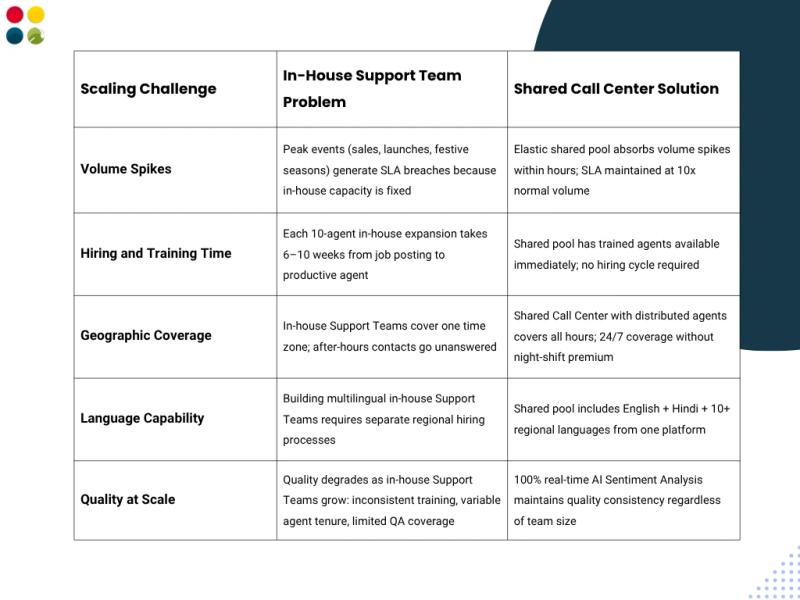
How Shared Call Centers Scale Support Teams: The Operational Model
Understanding how a Shared Call Center scales Support Teams requires understanding the three operational layers that make elastic scaling possible:
Layer 1 — Agent Pool: A Shared Call Center maintains a trained, continuously available pool of agents across multiple client brands. When your interaction volume increases, additional agents from the pool are allocated to your queue without any recruitment or onboarding delay. AI agent assist tools mean even newly allocated agents deliver quality equivalent to agents with months of brand familiarity.
Layer 2 — Technology Infrastructure: The cloud-native platform scales automatically with volume — no additional hardware, no IVR reprogramming, no CRM migration. The same platform that handles 500 daily interactions handles 5,000 without a configuration change. Real-time AI Sentiment Analysis continues covering 100% of interactions regardless of volume.
Layer 3 — Quality Assurance: 100% AI quality coverage means that as Support Team capacity scales, quality monitoring scales with it. There is no QA team to expand, no sampling gap to manage. Every interaction at 500 volume is reviewed to the same standard as every interaction at 5,000 volume.
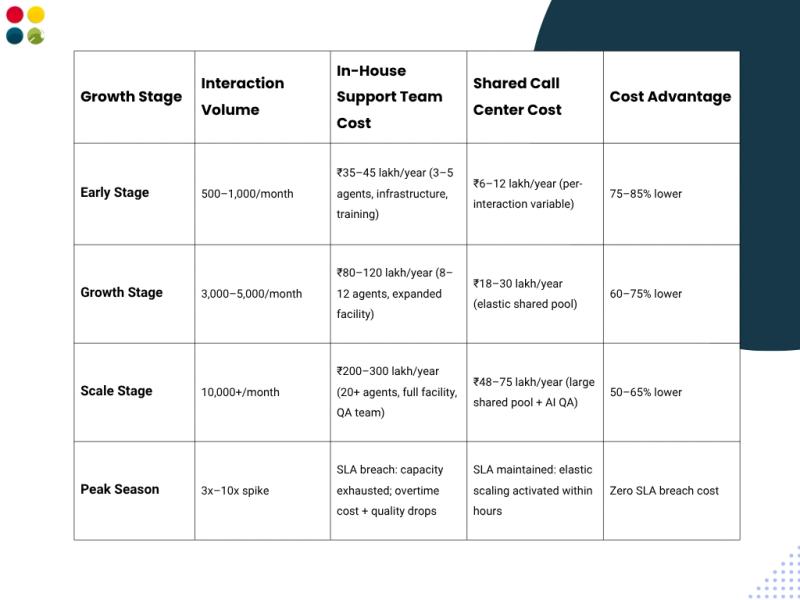
Shared Call Center Support Teams vs. In-House: The Growth Cost Model
Here is what the cost of scaling Support Teams looks like in a Shared Call Center model versus an in-house build across four growth stages:
✅ Trusted by 500+ Contact Centers Across India
DialDesk’s Shared Call Center model scales Support Teams from day one with zero infrastructure cost, full AI quality coverage, and ISO 9001:2015 + ISO 27001:2013 certified security. Trusted by 500+ contact centers across India, including businesses scaling from startup to enterprise. See our full BPO call center services platform.
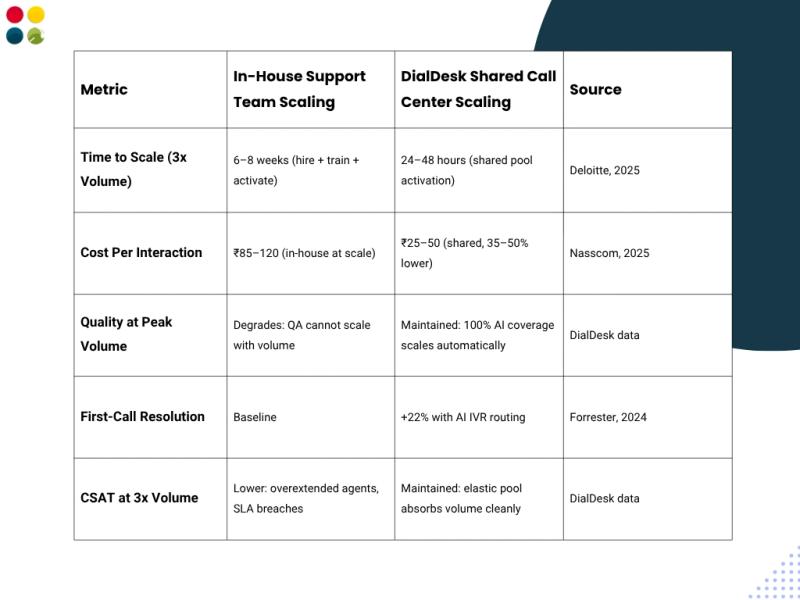
Business Impact: What Shared Call Center Support Team Scaling Delivers
Businesses that scale Support Teams through a Shared Call Center model report consistent improvements across cost, quality, and CX metrics compared to in-house scaling (Deloitte, 2025 / Forrester, 2024 / DialDesk data):
Key Takeaways
• Shared Call Centers scale Support Teams from existing trained agent pools in 24–48 hours — vs. 6–8 weeks for in-house equivalent capacity. (Deloitte, 2025)
• The 5 scaling challenges Shared Call Centers solve: volume spikes, hiring/training time, geographic coverage, language capability, and quality at scale.
• Shared Call Center Support Team scaling is 50–85% cheaper than in-house equivalents at all growth stages, with zero idle capacity cost between peak periods.
• 100% AI quality coverage scales automatically with agent pool size — quality does not degrade as Support Teams grow.
• DialDesk activates Shared Call Center Support Team scaling in 24–48 hours — ISO-certified, AI-augmented, with elastic capacity that grows with your business.
Conclusion
Scaling Support Teams does not have to mean the slow, expensive, quality-risk process of building in-house. Shared Call Centers provide the elastic agent pool, cloud infrastructure, and AI quality tools that make scaling a 24–48 hour operational event rather than a 6–8 week project.
For businesses at every stage — startup handling seasonal spikes, growth-stage companies entering new markets, or enterprises managing product launches — a Shared Call Center is the support team scaling model that eliminates the trade-off between speed and quality that in-house building always creates.
Explore how DialDesk’s Shared Call Center model integrates with your IVR and call routing, WhatsApp and chat support, and cloud telephony India stack to scale Support Teams from day one — no hardware required.
Support Team scaling should take hours, not months. DialDesk’s Shared Call Center makes it exactly that.
📅 Want to Scale Your Support Teams with a Shared Call Center?
DialDesk’s Shared Call Center scales your Support Teams in 24–48 hours — AI-augmented, ISO-certified, and 50–85% cheaper than in-house equivalents, with 100% quality coverage from day one.
Join 500+ contact centers across India already scaling support with DialDesk.