OVERVIEW
This blog dives into whether WhatsApp truly fits the B2B customer service ecosystem. We’ll unpack how behaviour has shifted, what B2B buyers actually expect today, the operational realities of using WhatsApp Support Solutions, and where it delivers ROI. You’ll find expert insights, industry data, structured breakdowns, and a clear decision-making lens for CX and operations teams evaluating WhatsApp for their business.
Introduction
B2B relationships used to revolve around emails, tickets, scheduled calls, and multiple follow-ups across channels. But the way businesses buy, onboard, and seek support today has changed—quietly but dramatically.
Across industries, buyers are behaving less like “businesses” and more like the people behind them: fast-moving, mobile-first, and expectation-driven.
They don’t want to “raise a ticket and wait.” They want answers where they already are.
And increasingly, they are on WhatsApp.
But here’s the twist:
While WhatsApp has already become the default CX channel for B2C, B2B decision-makers still hesitate. Concerns include:
● “Will it be professional enough?”
● “Will my support team get overwhelmed?”
● “Can we track SLAs?”
● “Can WhatsApp work with our CRM?”
● “Is it secure for sensitive account information?”
The real question isn’t whether buyers use WhatsApp.
They do.
The real question is this:
Does WhatsApp make B2B Customer Service smarter, faster, and more reliable—or does it complicate operations?
This blog breaks it down without hype, assumptions, or clichés—just data, strategy, and practical business reality.
Is WhatsApp Truly Suitable for B2B Customer Service?
Let’s evaluate it using the lenses that matter to B2B brands:
Speed • Traceability • Security • Scalability • Personalization • ROI
1. WhatsApp Meets B2B Where They Already Work
Your buyers already use WhatsApp for:
● Supplier coordination
● Logistics updates
● Internal approvals
● Daily business communication
89% of Indian SMBs rely on WhatsApp for daily operations. (Source: Meta India Business Messaging Report 2024).
The platform isn’t “too casual” anymore. It’s operational.
2. B2B Support Needs Speed + Accuracy — WhatsApp Delivers Both
In a B2B Call Center, delays cost money.
WhatsApp improves:
● First response time
● Contextual follow-ups
● Multi-agent workflows
● On-the-go accessibility
● Issue resolution for distributed teams
WhatsApp messages achieve 98% open rates and 40–60% faster responses compared to email. (Source: TechJury & Meta Messaging Benchmark).
3. Professionalism Isn’t Lost — It’s Designed with Structure
With WhatsApp Support Solutions, teams can maintain full professionalism with:
● Approved message templates
● Structured flows (onboarding, escalations)
● Automated routing
● CRM-backed context
● SLA-based alerts
● Role-based permissions
This is not “WhatsApp chat.”
This is business-grade communication.
4. B2B Needs Traceability — Integration Solves It
The biggest hesitancy:
“How do we track conversations, SLAs, and accountability?”
Modern WhatsApp Support solutions integrate with CRMs like:
● Zoho
● HubSpot
● Salesforce
● Freshdesk
● Zendesk
This gives you:
● Chat → Auto ticket
● Chat → Contact record update
● Chat → Task/Follow-up
● Chat → Escalation workflow
● Chat → Knowledge base sync
Nothing is lost. Everything becomes trackable.
5. WhatsApp Builds Stronger Account Relationships
B2B isn’t transactional. It’s long-term, trust-driven, and repeat-revenue-based.
WhatsApp helps account managers:
● Stay closer to clients
● Share important alerts instantly
● Provide real-time updates
● Solve issues faster
● Reduce friction
B2B buyers now expect the same speed and convenience they get as B2C consumers. (Source: Gartner Future of Sales 2024).
Personalization becomes effortless when your team can see the full client context in one place.
6. WhatsApp Reduces Operational Load
WhatsApp API allows automation for:
● FAQs
● Invoice requests
● Demo scheduling
● Policy queries
● Order or SLA status updates
● Escalations
● Repetitive troubleshooting
47% of B2B service volume can be automated using conversational workflows. (Source: McKinsey Service Automation Study 2024).
Your support team handles fewer repetitive tasks, allowing them to focus on strategic accounts.
7. WhatsApp Strengthens Post-Sales & Support Retention
B2B churn often happens due to:
● Poor follow-ups
● Missed updates
● Delayed support
● Untracked issues
● Lack of visibility
WhatsApp reduces churn by enabling:
● Faster support
● Proactive communication
● Regular check-ins
● NPS surveys
● Automated reminders
Brands using WhatsApp for Customer Service saw a 28% increase in retention. (Source: Gartner Service Trends 2024).
Is WhatsApp the Right Channel for B2B?
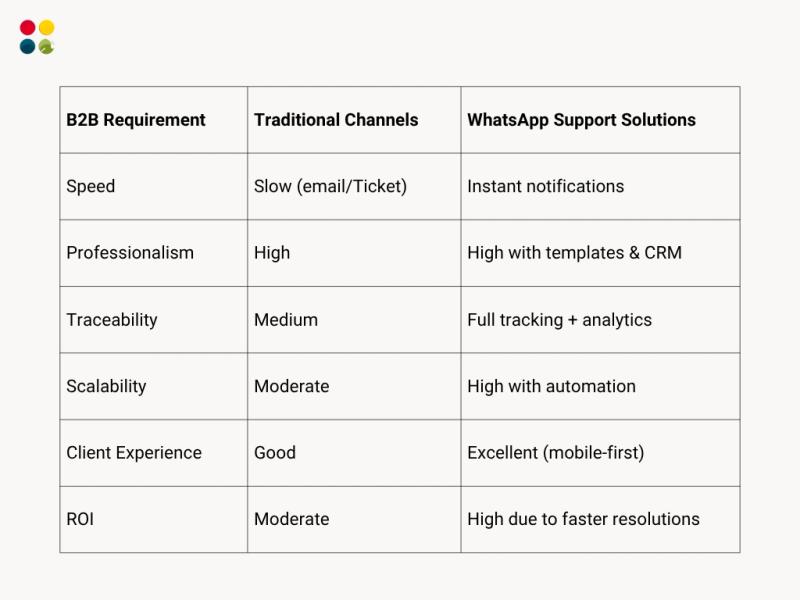
Thoughts to Ponder
● Are your B2B clients waiting too long for email responses?
● Do escalations get lost in cluttered inboxes?
● Can your support team solve issues faster with WhatsApp’s immediacy?
● Are you giving clients a channel they actually prefer?
● Is your business losing deals because you’re slow to respond?
Wrap Up
B2B customer service isn’t defined by the channel.
It’s defined by the clarity, speed, context, and care delivered.
WhatsApp doesn’t replace your CRM Software or ticketing system.
It amplifies them.
The real advantage isn’t that clients use WhatsApp.
It’s that WhatsApp helps your team stay responsive, accountable, and accessible—qualities that every B2B brand is measured against.
If implemented with the right tools, processes, and integrations, WhatsApp becomes not just “a support channel” but a strategic advantage in building long-term B2B trust.
Key Takeaways
● Yes, WhatsApp is suitable for B2B — when used with enterprise-grade tools.
● WhatsApp Support Solutions ensure professionalism, traceability, and compliance.
● CRM integration turns WhatsApp into a full-service support hub.
● B2B clients respond faster on WhatsApp than email or portals.
● It improves onboarding, support, escalations, and relationship management.
Conclusion
WhatsApp has evolved from a messaging app into a mission-critical business communication channel. For B2B brands, the question is no longer “Should we use WhatsApp?”
The real question is:
“How fast can we integrate WhatsApp for Customer Support solutions before the competition does?”
Because in B2B, responsiveness = trust.
Trust = retention.
Retention = lifetime revenue.
WhatsApp strengthens all three.
Want to implement WhatsApp Support Solutions for your B2B customer service?
Dialdesk enables seamless integration, automation, CRM syncing, analytics, and multi-agent workflows — built for modern B2B support teams.
Talk to us today and transform your service experience!