What is QA in a Call Center?
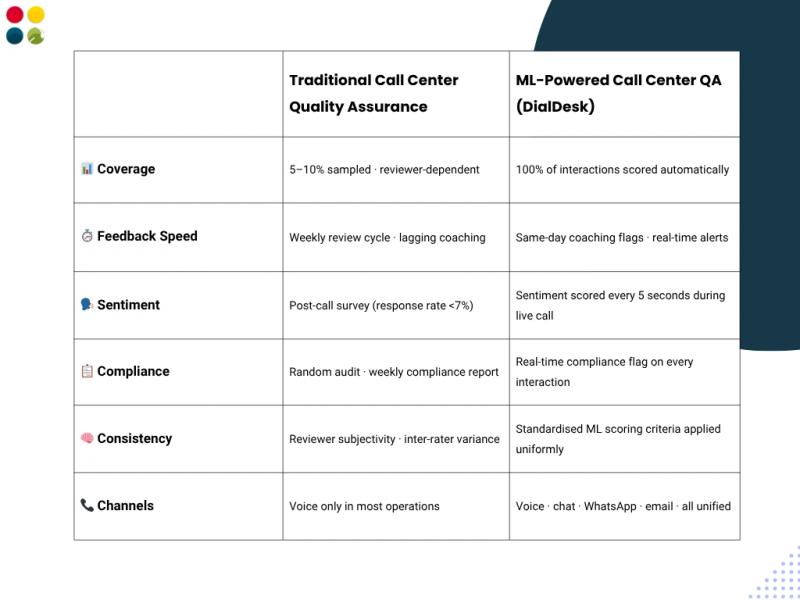
What is QA in Call Center operations? Call Center Quality Assurance (QA) is the systematic process of evaluating agent interactions — calls, chats, emails, and WhatsApp messages — against defined quality, compliance, and customer experience standards. Traditional Call Center QA samples 5–10% of interactions manually. Machine Learning-powered Call Center QA scores 100% of interactions automatically, in real time, flagging compliance risks, sentiment drops, and coaching opportunities without human reviewer involvement.
Why Traditional Call Center Quality Assurance Is No Longer Sufficient?
Every Call Center QA manager faces the same structural problem: there are more interactions to review than any team can manually score. The standard industry response — sample 5–10% of calls, review weekly, raise coaching points — produces a QA programme that is simultaneously too slow and too narrow to catch performance issues before they compound.
The math is blunt. A contact center handling 5,000 interactions per day generates 150,000 interactions per month. A QA team of five reviewers, scoring eight calls each per day, covers 1,200 calls per month. That is 0.8% coverage. The other 99.2% of interactions go unscored, uncoached, and potentially non-compliant.
Call Center Quality Assurance built on manual sampling is not a quality programme. It is a compliance sample. Machine Learning closes the gap — scoring every interaction, flagging every compliance risk, and raising coaching points the same day they occur.
💡 Why It Matters
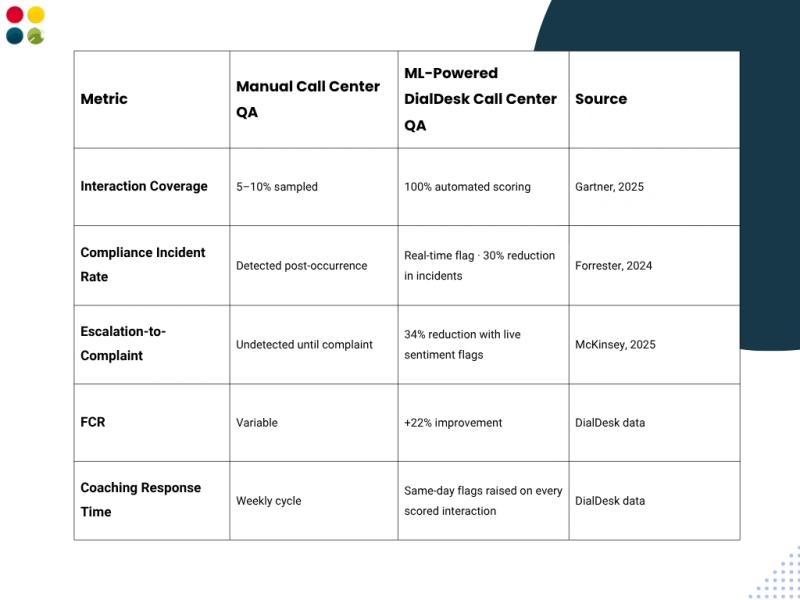
Contact centers that upgrade from manual sampled Call Center QA to ML-powered automated scoring achieve a 22% improvement in FCR, a 30% reduction in compliance incidents, and a 34% reduction in escalation-to-complaint conversion — within 60 days of deployment (Forrester, 2024; McKinsey, 2025).
Traditional vs. Machine Learning Call Center QA: What Changes
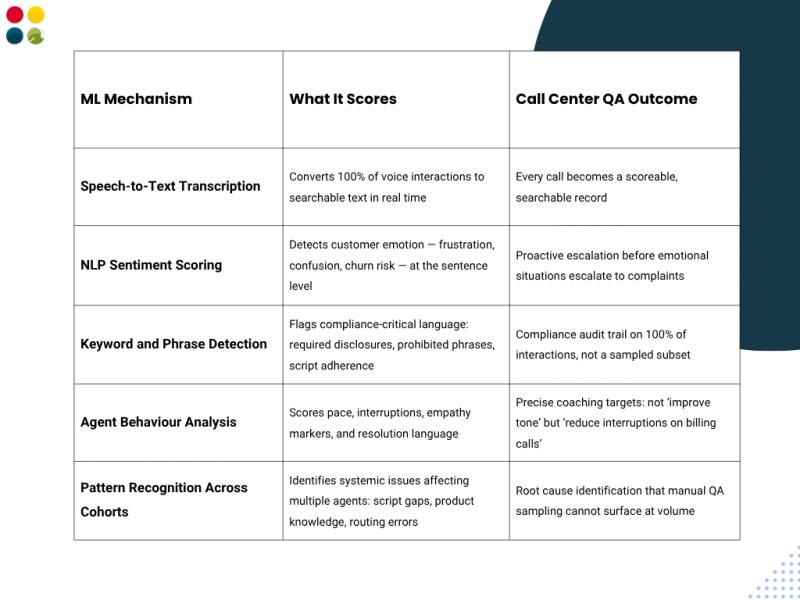
How Machine Learning Improves Call Center Quality Assurance: 5 Core Mechanisms
Machine Learning improves Call Center QA by replacing manual judgement with scalable, consistent intelligence across five core scoring mechanisms:
Business Impact: ML-Powered Call Center QA Performance Benchmarks
Contact centers deploying ML-powered Call Center QA achieve compounding performance improvements that manual QA programmes cannot match (McKinsey, 2025):
✅ Trusted by 500+ Contact Centers Across India
DialDesk’s Call Center QA platform is ISO 9001:2015 and ISO 27001:2013 certified — delivering ML-powered Call Center Quality Assurance across voice, chat, WhatsApp, and email for contact centers from 20 seats to 2,000+ across BFSI, healthcare, e-commerce, and telecom.
Key Takeaways
• What is QA in Call Center? It is the systematic evaluation of agent interactions against quality, compliance, and CX standards — now powered by Machine Learning to cover 100% of interactions, not a 5–10% sample.
• Traditional Call Center Quality Assurance covers less than 1% of interactions at typical contact center volumes — leaving the vast majority of performance gaps and compliance risks undetected.
• ML-powered Call Center QA scores sentiment every 5 seconds during live calls, enabling proactive escalation before customer frustration converts to a complaint.
• Automated QA reduces compliance incidents by 30% and escalation-to-complaint conversion by 34% within 60 days of deployment (Forrester, 2024; McKinsey, 2025).
• DialDesk’s ML-powered Call Center QA platform scores 100% of interactions across all channels — same-day coaching flags, real-time compliance alerts, and unified analytics from a single dashboard.
Conclusion
Call Center QA built on manual sampling is a compliance exercise, not a performance programme. The interactions that go unscored — 99%+ at typical contact center volume — carry the same compliance risks, the same churn signals, and the same coaching opportunities as the 1% that gets reviewed.
Machine Learning closes this gap permanently. Call Center Quality Assurance powered by ML does not sample — it covers everything. It does not review weekly — it flags the same day. It does not observe — it detects patterns across thousands of interactions simultaneously and surfaces the systemic improvements that individual call review can never find.
Explore how DialDesk’s ML-powered Call Center QA platform connects with your IVR and call routing and cloud telephony India infrastructure to deliver 100% interaction coverage from day one — across voice, chat, and WhatsApp, with no hardware required.
Score everything. Coach from data. Improve continuously. DialDesk makes full Call Center QA a reality.
📅 Want to Upgrade to ML-Powered Call Center QA?
DialDesk’s Call Center Quality Assurance platform scores 100% of interactions with ML — real-time sentiment, compliance flagging, and same-day coaching across voice, chat, WhatsApp, and email from a single cloud integration.
Join 500+ contact centers across India already running smarter QA with DialDesk.