What Is a Direct Response Call Center and How Do You Set One Up?
A Direct Response Call Center is a specialised call center operation designed to handle inbound calls generated by direct response marketing campaigns — TV commercials, digital ads, direct mail, SMS, or radio — where the caller is responding to a specific call-to-action. The setup requires five components: a cloud-native telephony platform with sufficient inbound capacity for campaign spikes; trained agents with campaign-specific scripts and conversion protocols; IVR and call routing configured for the campaign’s specific offer; real-time AI Sentiment Analysis to detect caller intent and close probability; and real-time dashboards monitoring conversion rates by campaign, hour, and agent. DialDesk delivers Direct Response Call Center setups in 10–14 days for campaigns across India.
What Makes a Direct Response Call Center Different from a Standard Call Center?
A Direct Response Call Center operates under fundamentally different performance dynamics than a standard inbound support Call Center. Every caller is a warm lead who has already responded to a campaign stimulus — they have a defined interest, a finite decision window, and a specific offer in mind. The Call Center’s job is conversion, not query resolution.
This means the metrics that define success are different: it is not first-call resolution rate that matters — it is conversion rate, average order value, and cost-per-acquisition. It means agents must be trained in consultative selling and objection handling, not just service scripts. And it means the technology infrastructure must handle extreme volume spikes — because campaign-driven inbound surges are immediate and unpredictable, and a missed call during the peak response window is a permanently lost lead.
💡 Why It Matters
Response Media’s 2025 Direct Response Campaign report found that 67% of inbound direct response calls that go unanswered or face wait times over 90 seconds do not call back. A Direct Response Call Center that misses the first-response window loses the majority of those leads permanently. Call answer rate within 30 seconds is the single most consequential metric in direct response operations. (Response Media, 2025)
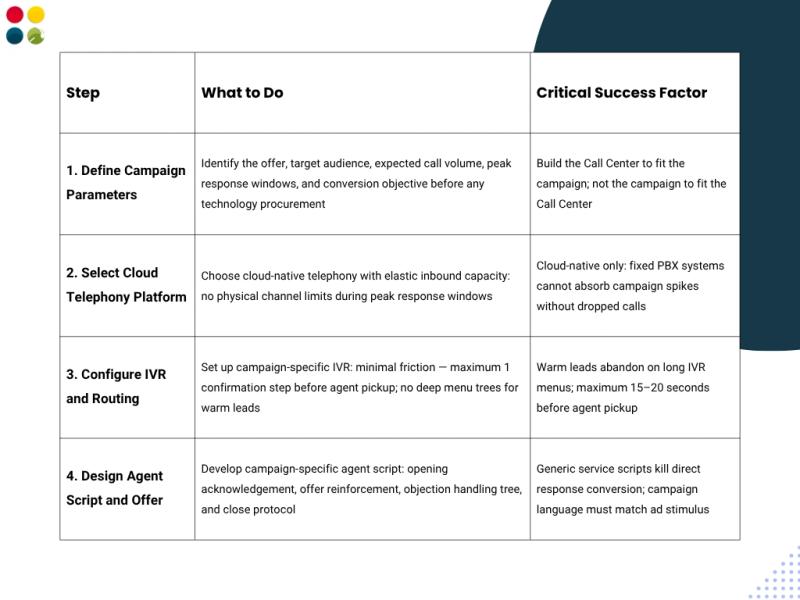
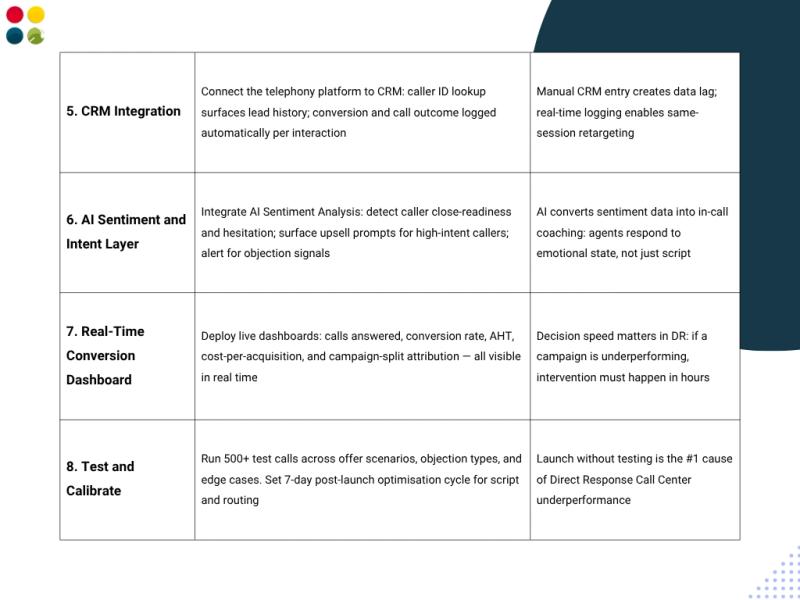
How to Set Up a Direct Response Call Center: 8-Step Implementation Guide
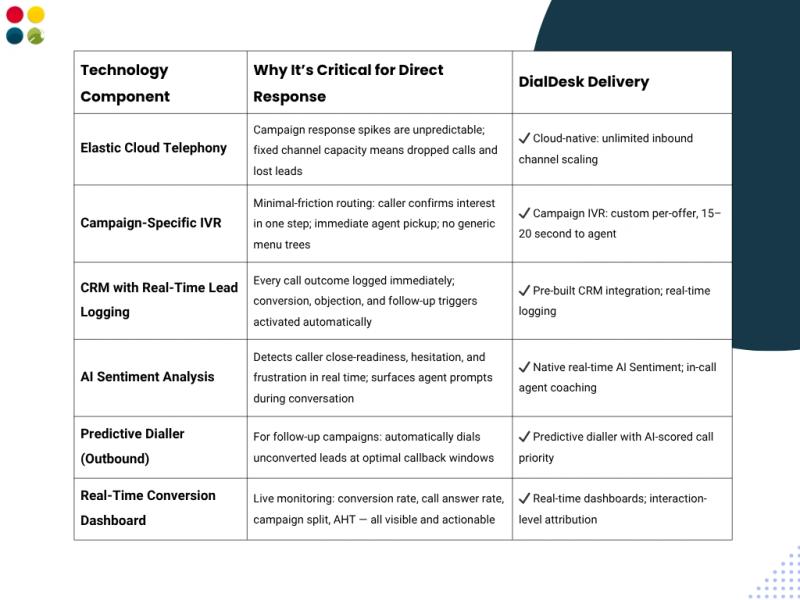
Technology Stack for a Direct Response Call Center
A Direct Response Call Center requires a specific technology configuration that differs from a standard inbound support Call Center. Here is the stack:
✅ Trusted by 500+ Contact Centers Across India
DialDesk’s Direct Response Call Center platform is ISO 9001:2015 and ISO 27001:2013 certified — elastic cloud telephony, campaign-specific IVR, AI Sentiment Analysis, and real-time conversion dashboards. Activated in 10–14 days. Trusted by 500+ contact centers across India. See our full BPO call center services platform.
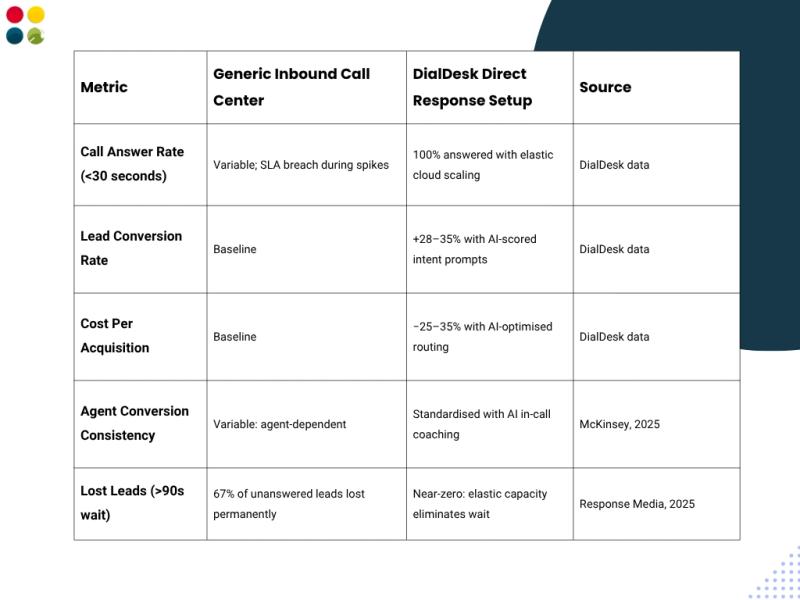
Business Impact: What a Well-Set-Up Direct Response Call Center Delivers
Direct Response Call Centers with the right technology stack, agent training, and AI augmentation consistently outperform generic inbound setups on the conversion and cost metrics that determine direct response campaign ROI (Response Media, 2025 / DialDesk data):
Key Takeaways
• A Direct Response Call Center handles warm inbound leads from marketing campaigns; 67% of leads that wait over 90 seconds do not call back. (Response Media, 2025)
• Setting up a Direct Response Call Center requires 8 steps: campaign parameter definition → cloud telephony → campaign IVR → agent script → CRM integration → AI sentiment layer → real-time dashboard → test and calibrate.
• Cloud-native telephony is non-negotiable: fixed PBX systems cannot absorb campaign response spikes without dropped calls and permanently lost leads.
• AI Sentiment Analysis converts in-call emotional signals into agent coaching prompts — detecting close-readiness and hesitation in real time to improve conversion consistency.
• DialDesk activates a complete Direct Response Call Center setup in 10–14 days — ISO-certified, cloud-native, with elastic inbound capacity and real-time conversion dashboards.
Conclusion
A Direct Response Call Center is a revenue-generating machine when set up correctly and a lead-wasting operation when set up generically. The difference lies in the 8-step implementation discipline: campaign-matched technology, minimal-friction IVR, AI-augmented agent support, and real-time conversion visibility that enables in-campaign optimisation.
The setup timeline for a cloud-native Direct Response Call Center is 10–14 days. The cost of not having one — 67% of warm leads permanently lost to wait times over 90 seconds — is measurable from the first campaign.
Explore how DialDesk’s Direct Response Call Center platform integrates with your IVR and call routing, AI Sentiment Analysis, and cloud telephony India stack to convert campaign responses into revenue from day one.
A Direct Response Call Center is only as good as the speed and quality of its first answer. DialDesk makes both the default.
📅 Want to Set Up Your Direct Response Call Center?
DialDesk’s Direct Response Call Center platform delivers elastic cloud inbound capacity, campaign-specific IVR, AI Sentiment Analysis in-call coaching, and real-time conversion dashboards — activated in 10–14 days.
Join 500+ contact centers across India already converting campaign responses into revenue with DialDesk.