OVERVIEW
● A poor customer experience can easily destroy brand reputation and loyalty, but companies that react swiftly, genuinely, and effectively can transform failure into success.
● This blog discusses why speedy recovery is important, providing actionable tips such as timely acknowledgment, personal apology, empowered fixes, and consistent follow-up.
● It underscores the need for integrating technology for speed and human compassion for relating, using feedback to avoid similar problems in the future and establishing enduring trust.
● Mastering CX recovery enables brands to reclaim disappointed customers and enhance their competitive advantage within a tough market environment.
Introduction
Customer experience isn’t a differentiator in 2025—it’s the pulse of every successful company. The brutal truth? Even the best customer-first brands will eventually drop the ball. A missed delivery. An offensive support representative. A charging mistake at the worst moment. With the instant feedback of the modern era, a single bad Customer Experience can spread across social media within minutes, rewiring the perception of your brand in the minds of thousands.
But here’s the silver lining: a miserable CX moment, executed correctly, can build greater loyalty than a perfect journey ever will. 32% of customers, says PwC, cease doing business with a brand they adore after a single bad experience (PwC Future of Customer Experience Report). Yet, studies by Harvard Business Review show that customers who experience a problem that’s resolved well are 2.5 times more likely to become loyal than those who never had an issue at all.
This blog isn’t about damage control; it’s about turning a setback into a competitive advantage. Ready? Let’s dive in.
1. Recognize the Impact of a Bad CX (And Why Speed Matters)
● Consumers have zero patience: 70% of customers want a response to a complaint within 24 hours (Zendesk CX Trends 2025).
● Reputation is fragile: A single negative Google review can reduce conversion rates by as much as 20% (BrightLocal, 2024).
● First impressions are expensive: It costs 5x more to win a new customer than to keep a current one (Bain & Company).
Pro Insight: A slow or evasive reaction can be worse than the original error. Prompt acceptance—even if you haven’t got the solution yet—is essential.
2. Apologize Authentically and Take Ownership
● Say it like you mean it: Customers are attuned to cookie-cutter responses. Make your apology personal.
● Transparency builds trust: Admit what went wrong, describe what’s being done, and provide a realistic timeline.
● Ownership = respect: Don’t blame third parties; own up on behalf of the brand.
Example: “We know we let you down with your recent order delay, and we’re sorry. Here’s what happened, and here’s how we’re fixing it right now.”
3. Provide a Meaningful Resolution
● Speed + Value: Quick fixes demonstrate you care, but worthwhile compensation (discount, free upgrade, priority service) makes it happen.
● Empower frontline teams: Educate and empower employees to fix issues in the moment—customers mustn’t be handed off.
● Follow up: Don’t think the solution stops once the issue is resolved. Follow up with the customer to confirm satisfaction.
4. Use Data & Feedback to Prevent Repeat Mistakes
● Investigate patterns: Are complaints repeat complaints about a product, service, or process?
● Close the loop: Educate all departments (operations, product, marketing) with the learnings.
● Leverage AI: Contemporary CX platforms are able to sense sentiment, forecast churn, and initiate proactive contact.
5. Human Touch + Technology = Perfect Recovery Combo
Automation provides speed, but compassion seals the deal:
● AI-powered chatbots: Ensure immediate acknowledgment 24/7.
● Human escalation: For emotional or complex issues, nothing beats a human touch.
● Omnichannel engagement: Engage customers where they are—WhatsApp Support, email, social media, or phone.
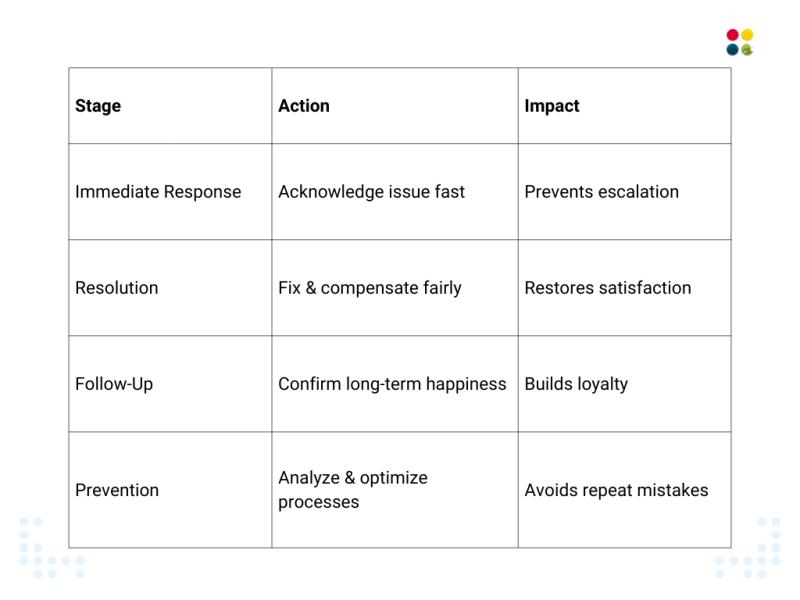
CX Recovery Loop
Thoughts to Ponder
● What’s the cost of silence? How many dissatisfied customers never complain but quietly exit?
● If your brand’s apology sounds like a robot, does it negate all your marketing efforts?
● Are you spending more on acquisition than on plugging the leaks in retention?
Learn how to build a customer-first culture by aligning your people, processes, and technology around customer needs to deliver consistent, trust-driven experiences that fuel long-term business growth.
Wrap-Up
Bad moments are unavoidable—but permanent harm isn’t. Companies that react with urgency, authenticity, and purpose can transform ire into loyalty. Recovery is no longer an afterthought; it’s a growth strategy.
Key Takeaways
● Act quickly: Acknowledge before frustration can develop.
● Own the mistake: Accountability equals respect.
● Solve & follow up: Right it first, then verify satisfaction.
● Learn & prevent: Apply learnings to improve forever.
● Blend tech + empathy: Automation manages volume; humans manage hearts.
Conclusion
Customer experience recovery isn’t about saving losses—it’s about maximizing opportunity. Each complaint is a map to betterment, each apology an opportunity to further connect. The brands that succeed in 2025 will be those that dominate the recovery art as well as the art of acquisition.
Ready to turn every customer interaction into a success story?
DialDesk’s Customer Service Excellence Solutions help businesses deliver 24/7 support, AI-driven insights, and human-first engagement—so no customer is ever left behind.