OVERVIEW
Most companies collect feedback.
Very few use it well.
Surveys go unanswered, insights stay in dashboards, and customers feel unheard. This blog explains how to collect customer feedback that actually drives improvement, not just reports. You’ll learn what to ask, when to ask, which channels work best in India, and how brands use feedback loops—supported by partners like Dialdesk—to improve customer experience at scale.
Introduction
Customer Feedback isn’t a checkbox activity.
It’s a strategic input.
Yet, many businesses still rely on:
● Long surveys
● Generic rating questions
● Feedback collected too late
According to Microsoft, 77% of customers view brands more favorably when feedback is actively requested and acted upon.
The difference between useful feedback and noise lies in intent, timing, and action.
Why Most Customer Feedback Fails?
Before improving feedback, understand why it doesn’t work:
● Questions are too broad
● Feedback is collected after emotions fade
● No visible action is taken
● Customers never hear back
Result: Customers stop responding altogether.
Principle #1: Ask at the Right Moment
Best moments to collect feedback:
● Immediately after issue resolution
● After the first purchase or delivery
● After a renewal or cancellation request
Why Timing Matters: Feedback collected within 24 hours is 3x more accurate (Qualtrics).
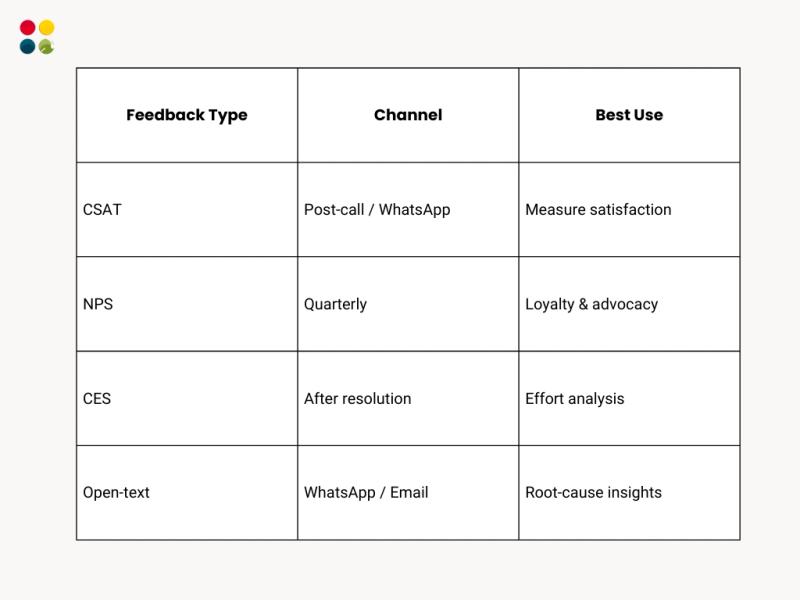
DialDesk Angle: DialDesk triggers automated feedback requests right after call or WhatsApp resolution—capturing real sentiment.
Principle #2: Keep Feedback Short and Focused
What works:
● 1–3 questions max
● One clear objective per survey
● Simple language
What doesn’t:
● 10+ question surveys
● Leading or vague questions
● Jargon-heavy language
Example of effective feedback question: “Was your issue fully resolved today?”
Principle #3: Use Multiple Channels, Not Just Email
In India, email response rates are low.
High-performing feedback channels:
● SMS
● IVR (post-call)
● In-app prompts
Zendesk Insight: Omnichannel feedback increases response rates by 28%.
DialDesk Angle: DialDesk enables post-call IVR and WhatsApp feedback collection, increasing response volume and quality.
Principle #4: Collect Both Quantitative and Qualitative Feedback
Quantitative (Numbers)
● NPS ● CSAT ● CES
Qualitative (Context)
● “What could we improve?”
● “What frustrated you most?”
Numbers show what. Words explain why.
Principle #5: Close the Feedback Loop
What closing the loop means:
● Acknowledge feedback
● Act on it
● Inform the customer
Harvard Business Review: Companies that close feedback loops improve retention by up to 15%.
Simple loop:
1. Collect feedback
2. Analyze trends
3. Fix the issue
4. Communicate changes
DialDesk Angle: DialDesk provides feedback dashboards and call insights that highlight recurring CX issues—helping brands act faster.
Principle #6: Route Feedback to the Right Teams
Feedback shouldn’t live only with support.
● Product → feature gaps
● Operations → delivery issues
● Marketing → expectation mismatches
Example: D2C brands use delivery complaints to optimize courier partners and reduce repeat issues.
Feedback Types & Use Cases
Thoughts to Ponder
● Are customers motivated to respond to your feedback requests?
● Do you act on feedback—or just report it?
● How fast does feedback reach decision-makers?
● Do customers see visible changes from their input?
Key Takeaways
● Feedback must be timely, short, and actionable
● Channel choice impacts response rates
● Numbers need context to drive decisions
● Closing the loop builds trust and loyalty
● DialDesk helps collect and analyze feedback across channels
Learn proven ways to how to train your staff for exceptional customer experience and explore how the right training frameworks, tools, and coaching strategies can help your team.
Conclusion
Customer feedback only matters when it leads to action. Brands that listen actively and respond decisively build stronger relationships and reduce churn.
In a customer-driven market, feedback isn’t optional—it’s your roadmap.
Wrap Up
Collect feedback with purpose, act with urgency, and communicate clearly. That’s how feedback transforms from data into growth.
Want feedback that actually improves customer experience?
DialDesk helps brands collect, analyze, and act on customer feedback across voice and digital channels.