How Do Shared Call Centers Reduce Operational Costs?
Shared Call Centers reduce operational costs by distributing fixed infrastructure, technology, and management overhead across multiple client accounts — so no single business bears the full cost of a dedicated operation. A Shared Services Center model delivers 40–60% lower per-interaction cost compared to equivalent dedicated in-house operations (Deloitte, 2024), through shared agent pools, shared telephony infrastructure, shared QA systems, and shared workforce management — all enabled by AI that makes multi-client operations coordinated, compliant, and consistently quality-scored.
What is a Shared Call Center and How Does the Cost Model Work?
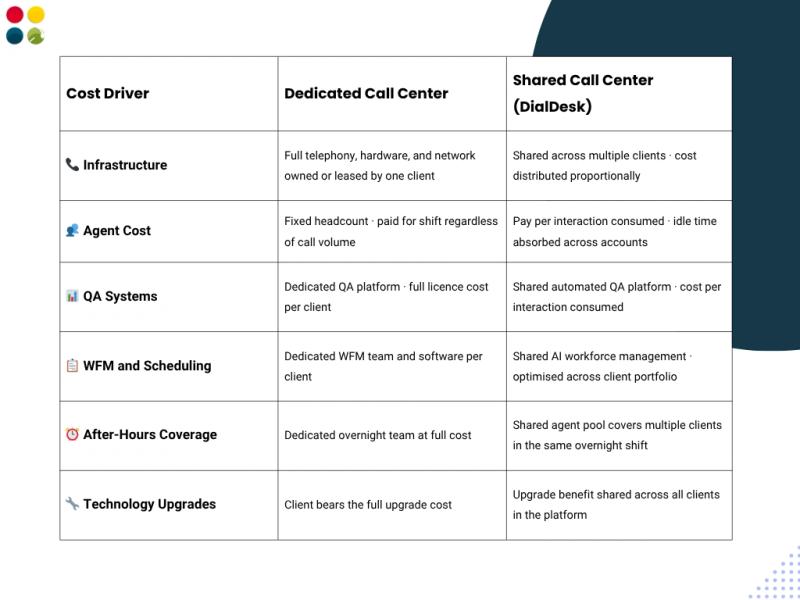
A Shared Call Center is a contact center operation where agents, infrastructure, and management are shared across multiple client accounts — rather than dedicated exclusively to a single business. Each client pays for the interaction capacity they consume, not for an entire team on standby.
The Shared Services Center model differs fundamentally from dedicated outsourcing in how costs are allocated: in a dedicated model, a client pays for agent headcount regardless of interaction volume. In a Shared Call Center, agents handle interactions across multiple accounts during the same shift — filling idle time that a dedicated model bills without producing customer interactions.
For growing businesses and seasonal operations, the Shared Call Center is the most efficient path to enterprise-grade contact center capability: pre-built infrastructure, trained agents, AI-powered quality management, and 24/7 coverage — without fixed cost proportional to peak capacity.
💡 Why It Matters
Businesses operating a dedicated in-house contact center carry 100% of infrastructure and staffing costs even during off-peak periods. A Shared Call Center model reduces this fixed cost burden by 40–60% — paying only for capacity consumed, not capacity reserved (Deloitte, 2024).
Shared Call Center vs. Dedicated Call Center: The Cost Comparison
How AI Makes Shared Call Centers More Effective in 2025
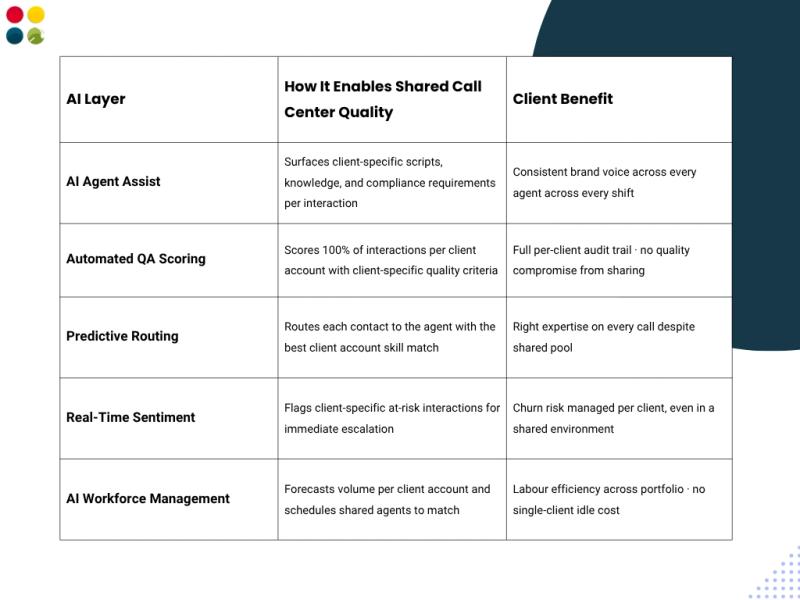
The traditional objection to the Shared Call Center model was quality consistency: if agents are switching between client accounts mid-shift, how do you ensure they maintain client-specific knowledge, tone, and compliance standards for each account?
AI solves this problem completely. In DialDesk’s Shared Services Center model, AI agents assist in surfacing the correct client-specific knowledge, script guidelines, compliance requirements, and product context the moment an agent accepts a call from a given client account — without the agent manually switching systems or relying on memory across accounts.
Business Impact: The Numbers Behind Shared Call Center Cost Reduction
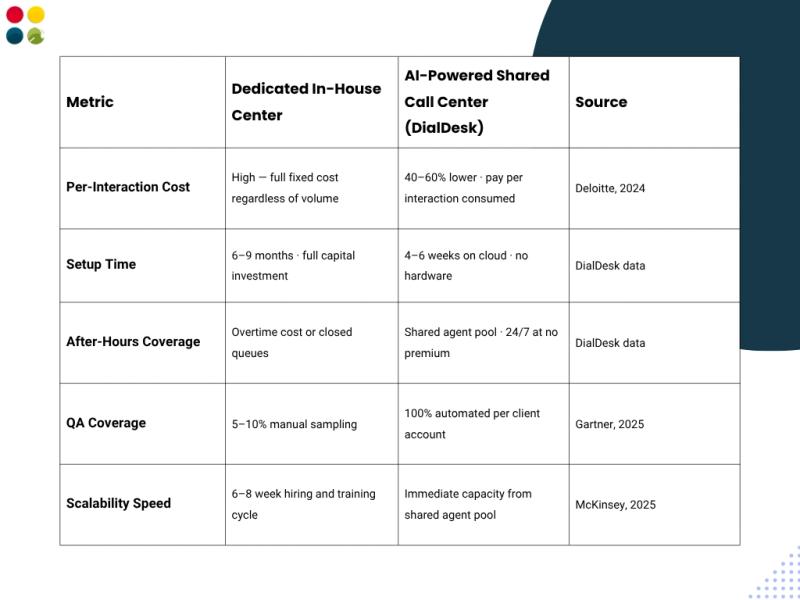
Businesses moving from dedicated in-house contact centers to AI-powered Shared Call Centers achieve measurable cost and performance improvements within the first 90 days (Deloitte, 2024; McKinsey, 2025):
✅ Trusted by 500+ Businesses Across India
DialDesk’s Shared Call Center and Shared Services Center platform is ISO 9001:2015 and ISO 27001:2013 certified — delivering AI-powered shared contact center operations for businesses from 20 seats to 2,000+ with full per-client QA isolation and data security.
Key Takeaways
• Shared Call Centers reduce operational costs by 40–60% vs. dedicated in-house operations by distributing fixed infrastructure, agent, and technology costs across multiple client accounts (Deloitte, 2024).
• The Shared Services Center model is most cost-effective for businesses with variable or seasonal interaction volumes — paying for capacity consumed, not capacity reserved.
• AI solves the quality consistency challenge in Shared Call Centers: agent assist, automated QA, and predictive routing ensure client-specific quality on every interaction from every agent.
• DialDesk’s AI-powered Shared Call Center deploys in 4–6 weeks on the cloud — with 100% automated QA per client account, 24/7 shared coverage, and no hardware investment.
• Businesses moving to Shared Call Centers achieve measurable per-interaction cost reduction within 30 days and full operational efficiency within 90 days of go-live.
Conclusion
Shared Call Centers solve the fundamental economics problem of contact center operations: the fixed cost of peak capacity that sits idle during off-peak hours. By distributing that cost across multiple client accounts, the Shared Services Center model delivers enterprise-grade contact center capability at 40–60% of the per-interaction cost of a dedicated operation.
AI makes the Shared Call Center model viable at quality standards that were previously impossible in shared environments. Client-specific agent assist, automated QA with per-client criteria, and AI workforce management across a shared agent portfolio ensure that sharing infrastructure does not mean sharing quality compromise.
Explore how DialDesk’s Shared Call Center platform connects with your IVR and call routing and cloud telephony India infrastructure to deliver full-stack shared contact center capability from day one — across voice, chat, and WhatsApp, with no hardware required.
Shared cost. Individual quality. DialDesk delivers both from a single platform.
📅 Want to Move to a Shared Call Center Model?
DialDesk’s Shared Services Center platform delivers AI-powered shared contact center operations — with per-client QA isolation, 24/7 shared coverage, predictive routing, and real-time analytics — from a single cloud integration across voice, chat, and WhatsApp.
Join 500+ businesses across India already reducing operational costs with DialDesk’s Shared Call Center model.