How Do Remote Work and BYOD Enable 24/7 Service for Mid-Market BPOs?
Remote work and BYOD (Bring Your Own Device) empower mid-market BPOs to deliver 24/7 service by removing geographic and infrastructure constraints. A Remote Call Center model powered by cloud telephony allows agents to handle voice, chat, and WhatsApp interactions from any location, on their own devices, without a fixed facility. DialDesk’s cloud-native platform makes 24/7 service available to mid-market BPOs in India with zero hardware investment and full AI quality monitoring across every shift.
Why 24 7 Service Is Now a Mid-Market BPO Expectation — Not a Premium
Customers do not observe business hours. An eCommerce buyer expecting a resolution at 11 PM, a patient with a healthcare query on a Sunday, or a fintech user facing a transaction issue at midnight, all expect a response. For brands, 24/7 service is no longer a differentiator. It is a baseline expectation.
Historically, round-the-clock operations required large, fixed contact center infrastructure — expensive for enterprise, unaffordable for mid-market. Remote Work and BYOD have dismantled this barrier. Today, a mid-market BPO can activate a fully operational Remote Call Center across multiple time zones without a single square foot of office space.
💡 Why It Matters
Salesforce’s 2025 State of Service report found that 83% of customers expect an immediate response regardless of time of day, and 71% say a slow response after hours negatively affects their loyalty to a brand. (Salesforce, 2025)
What the Remote Call Center Model Delivers for Mid-Market BPOs?
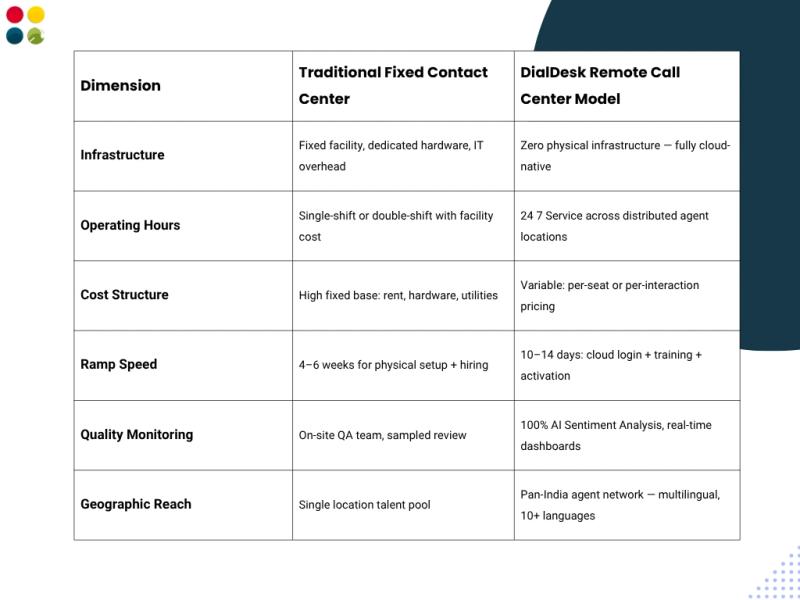
A Remote Call Center is not a compromise on quality. When built on cloud telephony with AI-augmented quality tools, it is operationally equivalent to a physical center and, in several dimensions, superior:
How BYOD Enables 24 7 Service Without Hardware Investment?
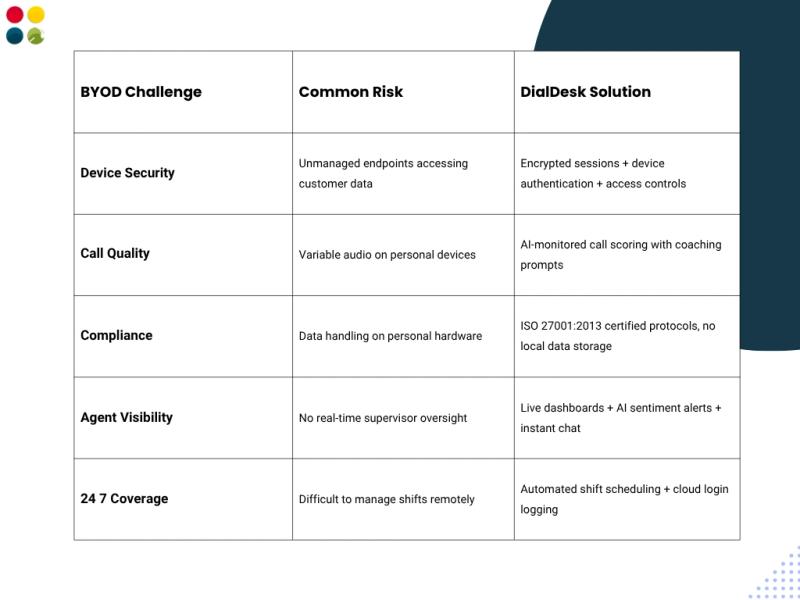
BYOD (Bring Your Own Device) allows agents to use personal smartphones, laptops, or tablets to access the contact center platform securely. For mid-market BPOs, BYOD eliminates the largest single capital cost in Remote Call Center setup: endpoint hardware procurement.
With DialDesk’s cloud-native platform, BYOD agents access the full contact center stack, CRM, call handling, AI Sentiment Analysis, quality monitoring, and omnichannel messaging through a secure, browser-based interface. Security protocols include device authentication, encrypted data transmission, and session-level access controls that meet ISO 27001:2013 standards.
✅ Trusted by 500+ Contact Centers Across India
DialDesk’s Remote Call Center and BYOD platform is ISO 9001:2015 and ISO 27001:2013 certified — enabling mid-market BPOs to deliver 24/7 service with enterprise-grade security and zero hardware investment. See our full cloud telephony India platform.
Business Impact: What 24 7 Service Delivers for Mid-Market BPOs
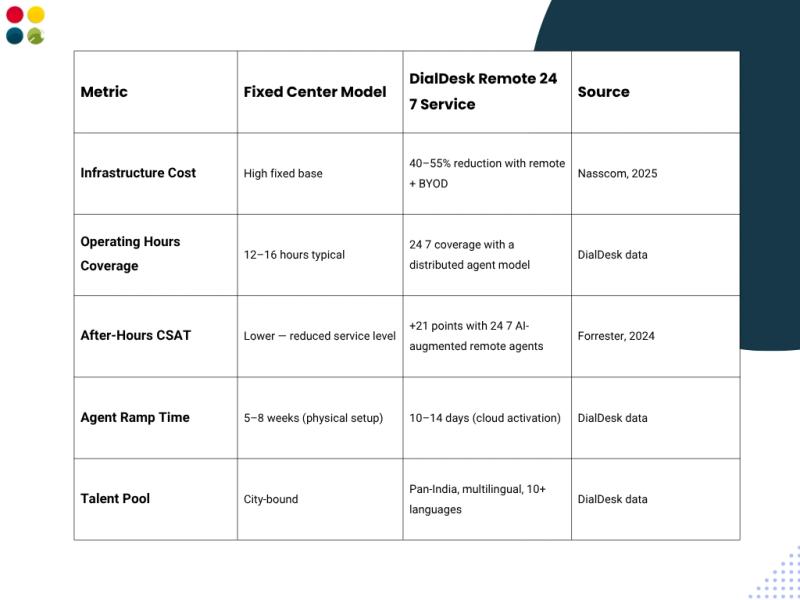
Mid-market BPOs that activate Remote Call Center operations with BYOD and cloud telephony report compounding improvements across cost, coverage, and customer experience (Salesforce, 2025 / Forrester, 2024):
Key Takeaways
- 24/7 Service is now a customer baseline expectation, 83% of customers expect an immediate response regardless of time of day. (Salesforce, 2025)
- Remote Call Center models powered by cloud telephony deliver 24/7 Service without fixed facility costs, making always-on support viable for mid-market BPOs.
- BYOD eliminates hardware procurement costs while maintaining enterprise-grade security through ISBring Your Own DeviceO 27001:2013 certified protocols.
- DialDesk’s remote model reduces infrastructure costs by 40–55% and activates a fully trained 24 7 contact center team in 10–14 days.
- 100% AI Sentiment Analysis across every remote interaction ensures quality does not degrade in a distributed, BYOD environment.
Conclusion
The combination of remote work and BYOD has permanently changed what 24/7 Service costs and what it requires. The fixed infrastructure model — expensive premises, dedicated hardware, single-location talent pools - is no longer the only path to always-on customer support.
For mid-market BPOs, this shift is an opportunity. Cloud telephony, AI quality tools, and a distributed agent model make 24/7 Service achievable at a cost structure that was previously only available to enterprise operations.
Explore how DialDesk’s Remote Call Center platform integrates with your IVR and call routing, WhatsApp and chat support, and AI Sentiment Analysis stack to deliver a 24/7 customer experience from day one, no hardware required.
24/7 Service is no longer a luxury. DialDesk makes it the standard.
📅 Need to Deliver 24 7 Service with a Remote Call Center?
DialDesk’s cloud-native BYOD platform gives mid-market BPOs always-on coverage, AI-powered quality monitoring, and pan-India multilingual agents, activated in under 14 days.
Join 500+ contact centers across India already delivering 24 7 CX excellence with DialDesk.