BPO

Top 5 Trends That Will Shape the BPO Sector

DialDesk Team
August 17, 2020
11 min read

OVERVIEW

● Geo-based insights help BPOs deliver localized, personalized customer experiences at scale.
● Location intelligence enables region-specific support, language routing, and cultural alignment.
● Helps optimize workforce distribution, response time, and service efficiency across geographies.
● Strengthens customer trust and satisfaction by addressing local needs in real time.
● Supports data-driven decisions for expansion, compliance, and market-specific strategies.

Introduction

During the initial years, outsourcing was only used for basic processes such as data entry and payroll processing. However, as connectivity expanded and the technological skills of BPO companies advanced, businesses started outsourcing more and more processes/services. Today, you can outsource many backend processes and financial/operational functions such as invoice management, accounts payable processing, survey reporting, and utility bill management, to name a few.

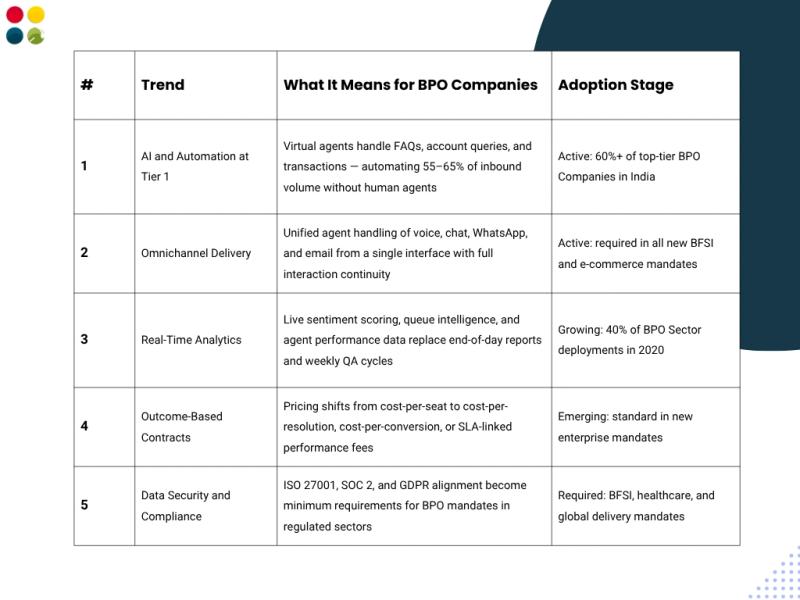
In this era of constant digital transformation and evolution, here are the top 5 BPO Sector trends that will rule the market in 2024 and the years to come:

1. Cloud-Based Management Platforms

This is the most talked about business process outsourcing trend on the outsourcing horizon, and yes, you’ve got it right! We are talking about cloud computing that will overhaul the traditional way of doing things.

Cloud computing is steadily digitizing businesses across the world. According to a recent study by Gartner, INC., the worldwide public cloud services market is expected to further expand by 17% in 2020 to $266.4 billion, up from $227.8 billion in 2019. Isn’t that huge?

A cloud is basically an interconnected network of internet servers that store, analyze, and process data in the virtual space. Cloud computing refers to a network that is used for the delivery of software services and data.

Cloud computing provides stability, security, and greater flexibility in outsourcing processes. A cloud-based platform works as a great collaborative platform for companies with locations in different countries, as it allows data visualization that provides businesses with real-time data and information. It is further estimated that the next generation of business process outsourcing solutions will be all cloud-enhanced solutions

Cloud Computing and business process outsourcing have evolved beyond an imaginable scale over the past decade. The Cloud, which was considered a mere concept not so long ago, is making waves in the industry today. Small businesses are the ones who have benefited the most, as they now have access to larger computing resources and high-performance infrastructure, which they could never have dared to afford before. Since the high demand for the ‘cloud’ has led to numerous innovations, organizations, no matter what scale, are prioritizing acquiring superior cloud-based services and computing resources for increasing business process speed and efficiency.

Finding the right strategic fit has become an intimidating task, especially for entrepreneurial start-up ventures. Small-scale businesses usually lack market knowledge, skills, proper information, and experience, which restricts them from finding a suitable computing service provider. As a rule of thumb, the better the service, the higher the expectations, the higher the results. This means that acquiring the right service is necessary if you expect to achieve significant results in terms of improved business processes and value chain engagement.

2. Artificial Intelligence or AI

Attention! The fears were true; artificial intelligence is taking over the world and outsourcing is next!

Scared you pretty good, didn’t we? Well, jokes aside, it is a fact that artificial intelligence, or AI, is becoming an increasingly vital feature in every industry, and the outsourcing business is no different.

AI is being increasingly employed to automate several data entry and processing functions, including accounts payable processing, invoice management, and utility bill processing.

AI streamlines all these processes by identifying and segregating data and even automatically filling in missing details. As an example, let’s say you need to process a large number of invoices in every format, ranging from physical documents to email attachments and digital invoices. Once the document conversion process is over, AI can automatically detect and fill in any missing information to complete the invoice document and increase the chances of swift approval and payment.

The applications of AI in business process outsourcing are endless and will revolutionize business process outsourcing solutions in the years to come.

Artificial Intelligence is fast invading various industries, so it is dictating to business process outsourcing companies. To put it in a nutshell, Artificial Intelligence is transforming industries by researching Big Data and Cloud computing. As such, BPO is the one that is most affected as it is intimately related to both the former and the latter. Moreover, it acts as an epicenter for numerous kinds of business process outsourcing companies. The centrality of the BPO industry also paves the way for meeting the growing customer expectations. Therefore, it would not be wrong to point out that a thriving BPO industry would flourish with AI intervention.

In the post-globalized world, businesses are eager to pile up their revenues. To make it happen, they want to cut down on unnecessary costs and further scale their operations, especially in the untapped markets where favorable business conditions are present. Hence, they desire the outsourcing units to leverage the power of AI so that not only the subsidiary company benefits, but the parent company also becomes a partner in the road to rapid monetary progress.

BPO Companies worldwide are now fast responding to this changing business climate. Using Big data and cloud computing, they are mining large sets of data and generating a comprehensive graphical analysis from the raw and randomly stacked data sets. These analytical data sets are not only useful for the scaling up of business operations in general, but also for tracking customer satisfaction by review monitoring in particular.

Hence, when we are talking about the superposition principle in the case of AI and BPO, we are referring to the mutual benefits one can bring for the other. Put in simpler words, AI can make the BPO industry thrive in the form of revolutionizing the processes related to the chatbot. On the other hand, the BPO industry can benefit from AI by acting as a hotbed of research and a new genre for researchers interested in this field.

3. Reinvention and Innovation In Outsourcing Solutions

Outsourcing has moved beyond simple, repetitive, and basic tasks. Today, businesses are looking for smart solutions to their everyday problems that involve the perfect combination of human innovation, automated efficiency, and technical accuracy, i.e., people, process, and technology.

Outsourcing firms have risen splendidly to this challenge with a range of customized technological solutions. From custom-built automation bots to cloud-based collaboration platforms, the process of outsourcing has become a smart sourcing one.

By Reinvention and innovation, BPO doesn’t just hand you the same list of services with the same processing solution. BPO’s these days study your business model and your current processes to identify the cogs in the wheel and then optimize each step to create a flawless workflow with a customized solution that is tailored to your company’s specific needs.

BPO teams comprise college-educated, well-experienced members with analytical minds and strong problem-solving skills. These skills translate into successful business solutions with the efficient employment of advanced automation and machine learning technologies.

BPO providers should look to build Omni channels as true “human services companies.” They have the data in place to do great analytics, but can’t always manage it from a technical and operational point of view.

One key issue is that improvements tend to be small, isolated, and almost exclusively under the umbrella of the English language. In a truly global market, BPO providers are missing out on key improvements that have the power to ensure clients maintain innovative practices and high-profit margins.

When BPO providers can nail areas like customer service, the benefits of new technology like AI and automation can be unlocked, and services will be more affordable, which is, of course, the bottom line for customers.

Ultimately, it all comes down to disrupting before you’re disrupted. It’s time for BPO providers to grab the opportunities to adapt, innovate, and reinvent successfully for the future.

4. Robotic Process Automation

Robotic process automation, or RPA, refers to the application of specialized computer programs to automate secondary or repetitive tasks such as data entry or mining for higher accuracy and reduced operating costs

However, for a complete digital solution, you need a blended approach that uses artificial intelligence and machine learning with the right human intervention and supervision to create successful solutions.

The first step in the implementation of robotic process automation is a thorough analysis of the existing business process and the creation of an optimized solution to eliminate all errors. Once the new process has been defined, special software robots, i.e., bots, are coded and assigned to the existing workstream, wherein they start performing tasks with greater speed, accuracy, and precision.

The purpose of automation goes beyond just reducing costs; bots speed up your processing time drastically, while also delivering high-quality, consistent data with greater accuracy.

The option of customized coding elevates robotic process automation over enterprise automation solutions, as RPA offers more than just automation; it gives you a super-efficient work-stream, manages your workload effectively, and frees up your time and office resources so that you can focus on developing your core competencies and scaling your business.

Robotic process automation is set to revolutionize the outsourcing industry by transforming raw, unstructured data into measurable performance. Let’s keep a lookout for it, shall we?

5. Increased Focus on Cybersecurity

Ironically, one of the biggest fears about outsourcing is also one of the biggest myths about outsourcing.

Cyberattacks are on the rise; as per RiskBased Security, data breaches exposed approx 4.1 billion records in the first half of 2019 alone.

According to Fundera, around 43% of cyber attacks target small businesses. Statistics further indicate that healthcare, retail, and manufacturing are the most targeted industries for cyberattacks. This means that providing high-grade data security will be one of the major business process outsourcing trends in 2020.

For any company, one of the primary outsourcing concerns while outsourcing data processing services is the fear of data theft and the negative impact it may have on their business. Their fear is entirely justifiable, and that’s why outsourcing companies are paying greater attention to data security measures and protocols.

BPO should recognize that with data security comes great responsibility.

They must be extremely particular about our clients’ data security, and thus, they should have their VPNs, SSLs, encryption protocols, HIPAA, PCI, GDPR compliance, and security protocols in place.

In addition to security compliance and protocols, they should be extremely careful about who they expose your data to. Access to sensitive data is strictly on a need-to-know basis, and they must have measures in place that ensure that your data cannot be moved, edited, or seen by all.

They should also take special care to hold sensitive data only for a strict time limit. Once they are done with the data and have successfully delivered it, it should be disposed of after the specified date. BPO clients trust them with sensitive data because they know that they can. They should also regularly review and update their security measures to manage the client’s documents and data entry securely.

There are some more trends going on for Top BPO Companies in India, and we will keep discussing them in our upcoming blogs. Keep reading, stay tuned, and more importantly, fine-tuned.

Conclusion

In 2024, the BPO sector will see big changes with AI, automation, remote work, and a stronger focus on data security and customer experience. As businesses adapt to these trends, outsourcing will become smarter, faster, and more efficient. Companies that embrace new technology and flexible work models will stay ahead in the game.

If you’re in the BPO industry or planning to outsource, keeping up with these trends will help you make better decisions. The future of BPO is exciting, and those who evolve with it will enjoy growth, efficiency, and success in the years to come.

Want to leverage geo-based intelligence to future-proof your BPO operations?

Book a demo today and see how DialDesk helps you deliver smarter, location-driven customer experiences.

Frequently Asked Questions

Find answers to common questions about this topic

Share this article

About the Author

D

DialDesk Team

The DialDesk team is dedicated to helping businesses improve their customer experience through innovative solutions and insights.

Related Articles

BPO

What is a BPO Call Center and How Does it Work?

Learn how a BPO Call Center operates in India, helping brands streamline customer support, improve efficiency, and scale faster.

BPO

Top Sales and Marketing Challenges in BPO Industry

Get insights into the sales and marketing challenges in the BPO Industry and best tips to build stronger pipelines and win more clients.

BPO

The Evolution of the BPO Services Industry

Learn how the BPO Call Centre industry has adapted to changing customer needs through automation, data, and digital tools.

Ready to Transform Your Customer Experience?

See how DialDesk can help your business deliver exceptional support

Get Weekly CX Insights

Join 1,000+ professionals receiving expert tips on customer experience and support automation.