OVERVIEW
● In this blog, we look at how businesses and individuals are leveraging voice-to-text converters driven by AI to speed up documentation and productivity while improving multilingual communication.
● You’ll learn how automatic voice transcription works, the technology behind it, its use in the real world, and which tools lead the market when it comes to accuracy and efficiency.
Introduction
Conversations are turning into data.
Every call, meeting, or voice note holds immense insight, but this often gets lost in the noise unless captured and analyzed.
Now, imagine this: you just had a 20-minute client conversation full of key requirements. Instead of replaying it multiple times, you simply upload it to a Voice Note to Text Converter — and within seconds, you have an editable, searchable transcript ready to share or analyze.
That’s not the future. That is how smart businesses and professionals work today.
With AI-driven Voice Recording to Text tools, companies can save up to 60% of their time in manual documentation. According to the IBM AI Productivity Report, 2024, teams are able to communicate smarter, faster, and across languages.
So, how exactly does this work? Let’s decode it.
The Technology Behind Voice-to-Text Conversion
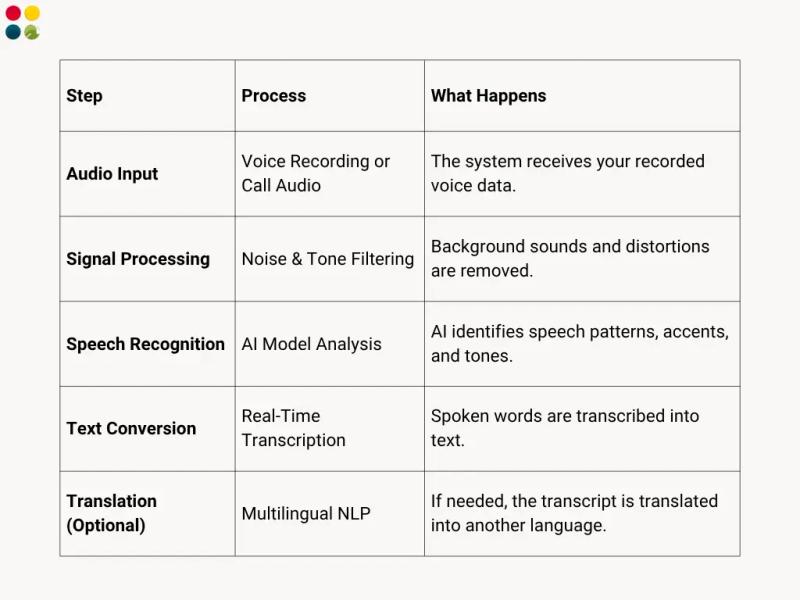
At its very core, voice-to-text conversion is based on Automatic Speech Recognition, or ASR in short, a blend of linguistics, signal processing, and machine learning.
Here’s a simple breakdown of how it functions:
Why Automatic Conversion Matters in Today’s Workflows?
Organizations in today’s time rely heavily on calls, meetings, and customer interactions. Transcription of voice recordings presents three major advantages:
1. Saves Time and Resources
Manual Voice Transcription takes up to 6x longer than automated transcription.
AI-powered transcription software can process an hour of conversation in less than 5 minutes.
2. Boosts Accessibility & Compliance
Transcripts also help companies in record keeping for audit trails, quality checks, and CX analysis.
3. Enables Multilingual Reach
AI voice recording translators support more than 100 languages and can help international teams to cooperate smoothly.
Stat: As outlined by Grand View Research in 2025, the speech-to-text market is expected to reach a value of $11.2 billion by 2030, growing at a CAGR of 17.8%, driven by automation, voice assistants, and AI analytics.
The Real-World Applications
Here’s how different industries use Voice Note to Text Converters:
● Customer Support: Call centers use it to analyze conversations for quality assurance and sentiment tracking.
● Healthcare: Physicians write down notes about patients that get auto-transcribed for their medical records.
● Legal: Lawyers have clients’ conversations and depositions transcribed into computer-searchable text files.
● Education: Students use it for the transcription of lectures or research interviews.
● Sales & Marketing: Teams transform sales calls into insights for CRM and follow-ups.
In addition, with platforms like Voice-to-text by DialDesk, businesses go beyond just recording calls to auditing, analyzing, and improving interactions through in-built AI transcription and intent detection.
The Translation Advantage: Breaking Language Barriers
Translate Voice Recording to Text is more than just a change in words; you are unlocking understanding.
With NLP, AI tools are now able to understand context, tone, and emotion, making much more accurate translations possible.
For instance:
● A customer call in Hindi can be converted and translated into English in seconds.
● Multilingual support teams can respond faster without requiring separate translators.
Fact: According to Statista (2025), 43% of global businesses now rely on AI translation tools for daily communication.
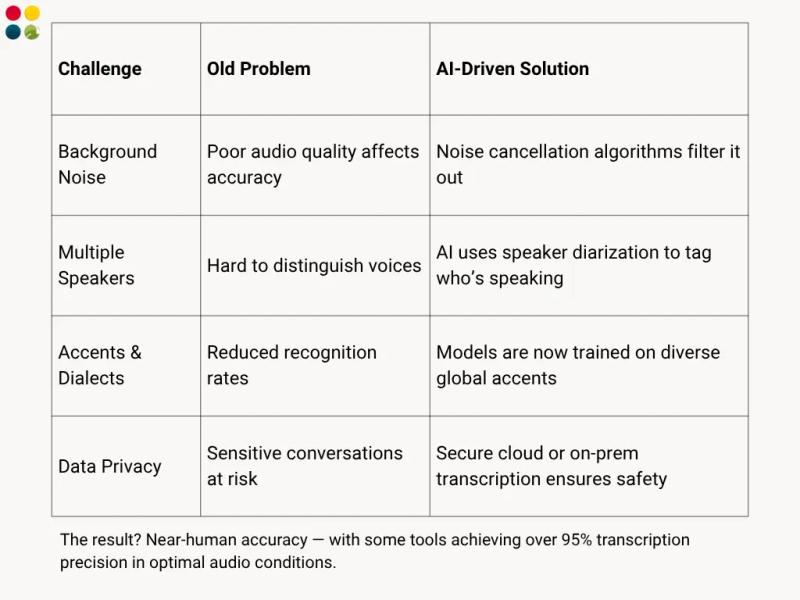
Challenges and How AI Solves Them
Choosing the Right Voice-to-Text Converter
To evaluate a Convert Voice Recording to Text, consider:
● Real-Time Transcription Speed
● Accuracy in Accent Detection
● Multi-Language Translation
● Integration with CRM or Support Tools
● Data Security Compliance (GDPR, ISO 27001)
Popular examples include Google Speech-to-Text, Amazon Transcribe, OpenAI Whisper, and Voice-to-text by DialDesk, which combines call analysis + transcription + actionable insights — all in one dashboard.
Thoughts to Ponder
● How much business intelligence is buried in your call recordings?
● Could automating transcription help your team make faster, data-backed decisions?
● Imagine if every customer conversation automatically provided a new business insight.
Key Takeaways
● AI Voice-to-Text is transforming the way spoken data is captured and used.
● It’s fast, scalable, and accurate — ideal for support, sales, and analysis.
● Translation features remove all barriers in communication around the world.
● Companies using AI Transcription save up to 30–50% on operational costs.
● The Future Is Voice-First — and It’s Happening Now.
Wrap Up
Voice recordings are no longer dead data. You can now convert, Translate Voice Recording, and analyze conversations at unmatched speeds with the right AI-powered Voice Note to Text Converter.
Whether you’re improving customer experience, enhancing team productivity, or ensuring compliance, automation gives you the edge.
Conclusion
The journey from voice to text is more than a technological upgrade; it’s a communication revolution.
It’s helping businesses listen better, document smarter, and connect globally.
And platforms like Voice-to-text by DialDesk make this transformation easy — converting every customer call into actionable insight.
Want to see how it works?
Explore Voice-to-Text by DialDesk— your all-in-one platform for voice-to-text transcription, call analysis, and CX optimization.