OVERVIEW
● This blog dissects the most efficient and effective Voice-to-Text converters for call centers, with a heavy emphasis on how AI customer service is powering transcription accuracy, speed, and intelligent automation.
● You’ll have an in-depth look at the best tools, must-have features to consider, industry insights, expert recommendations, and why transcription is no longer merely about compliance—but CX intelligence.
● Whether you have an inbound support center or outbound sales team, this blog assists you in selecting the ideal voice-to-text solution for your requirements.
Introduction
A standard call center operates thousands of calls a day. But here’s the uncomfortable reality: most of those interactions disappear into thin air once the call ends—unless you’ve got the correct Voice-to-Text solution recording them in real-time.
In high-stakes environments such as customer service, context is money. Agents can’t spare the time to scribble down copious notes. Supervisors can’t monitor every call. And your CRM? That’s just as good as the information you put into it.
That’s where AI-driven voice-to-text transcription comes in—not as a nice-to-have add-on but as a building block in your CX tech stack.
Here in this blog, we’re cutting through the hype to bring you the best Voice to Text Converter that are driving real-world improvements in call center performance, agent productivity, and customer satisfaction.
Why Voice-to-Text Matters More Than Ever in Call Centers?
● 80% of customers indicate the experience a company delivers is as significant as its products or services. (Salesforce, State of the Connected Customer, 2023)
● Real-time transcription results in 40% quicker issue resolution and a 25% decrease in agent after-call work. (McKinsey CX Insights, 2024)
● AI-powered customer service boosts first-call resolution rates by as much as 35%. (Gartner, 2023)
Voice-to-text isn’t merely about accessibility or record-keeping—it’s about data-driven CX.
Top Voice-to-Text Converters for Call Centers in 2025
Below is a curated list of the most effective voice-to-text tools tailored for call center operations. We’ve compared them across key parameters: accuracy, real-time capability, integration, and support for Indian languages.
1. DialDesk Voice-to-Text
Best for Indian Call Centers | Regional Language Support
● Real-time transcription with 95%+ accuracy
● Supports multiple Indian languages & dialects
● Integrated with Customer Service CRM, IVR, and WhatsApp
● Comes with auto-tagging, sentiment detection, and call insights
USP: Specifically designed for Indian call center dynamics, such as network fluctuation and mixed-language use.
2. Google Speech-to-Text API
● Highly scalable and developer-friendly
● Works efficiently for global call centers
● Provides real-time streaming functionality
● Strong language model enhancements from Google AI
USP: Ideal for tech teams who want a customizable option.
Note: Needs strong backend support and has usage-based pricing.
3. Amazon Transcribe
● Automatic speaker identification and punctuation
● Supports batch transcription and real-time
● Functions with the AWS ecosystem
USP: Most suitable for companies already on AWS.
Limitation: Not designed for the regional language sensitivity of Indian call centers.
4. Microsoft Azure Speech Services
● Comes integrated with Teams, Dynamics, and Power BI
● Speech translation + live transcription
● High enterprise reliability
USP: If you are a Microsoft-first environment, it’s an easy fit.
5. Otter.ai for Business
● Most suitable for meeting transcription and training within the organization
● Supports team collaboration
● Voice notes and summaries in real-time
USP: Perfect for internal ops and document-intensive BPOs.
Live customer calls are not recommended owing to the limited support of real-time capabilities.
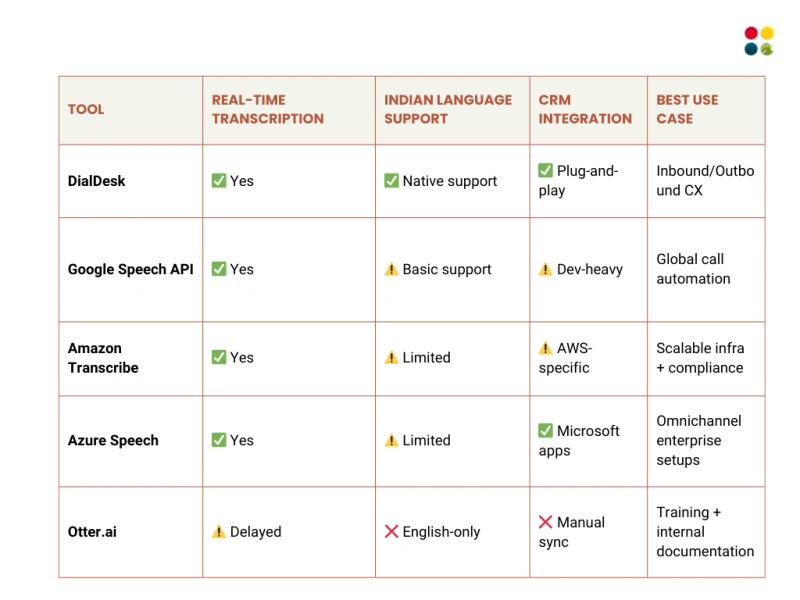
Comparison Table: Voice-to-Text Tools for Call Centers
Key Features to Look For in a Voice-to-Text Tool
Before you sign on the dotted line, here’s a checklist call centers should take precedence:
● Real-Time Capability
● Accent & Dialect Recognition
● Multilingual Support
● CRM/IVR Integration
● Auto-tagging & Categorization
● Security & Compliance Standards
● Sentiment & Intent Detection
The higher the contextual intelligence of a tool, the greater the value it provides above and beyond transcription.
Also Read: Voice to Text: Future of Real-Time Transcription
Thoughts to Ponder
● Are you still using agent memory to record significant call results?
● How much customer insight are you losing because your voice data is unstructured?
● Would your customer experience be 2x better if you had real-time transcripts + intent tagging?
Wrap Up
Voice-to-text is no longer a “nice to have” in Call Centers—it’s now a must-have driver of smart, compliant, and customer-first operations. The transition from manual note-taking to AI-driven transcription is enabling businesses to decrease churn, enhance CSAT, and streamline agent coaching.
Whether you’re scaling support or streamlining compliance, these tools can be the missing link in your CX stack.
Key Takeaways
● AI in customer service is amplifying the power of voice-to-text tools by enabling real-time, multilingual transcription and contextual analysis.
● Choose tools that offer native support for Indian languages, integrate easily with your existing stack, and provide AI-based tagging for intent and sentiment.
● DialDesk is the best choice for Indian call centers with a mix of speed, regional precision, and intelligent insights.
Conclusion
As call centers become experience centers, tools such as Voice and Text enable businesses to hear better, respond faster, and serve smarter. The customer service winners will be those who don’t just hear their customers—but get them, in real-time, at scale.
Supercharge Every Call with DialDesk Voice-to-Text
DialDesk’s Voice-to-Text offering is Indian business-built, multilingual, real-time, and integrated with your CX engine.
Increase compliance, speed, and customer satisfaction—without increasing pressure on your agents.