What's the Feature Difference Between Cloud Based Call Centers and On-Premise Systems?
Cloud Based Call Centers run on remotely-hosted infrastructure accessible from any device, offering built-in call recording, real-time analytics, and instant scalability, while on-premise systems require physical hardware, tie agents to a single location, and need dedicated IT staff for maintenance. Feature-for-feature, Cloud Based Call Center Software generally matches or exceeds on-premise capability at a fraction of the setup cost and time.
Why a Feature Comparison Matters More Than a Cost Comparison Alone
Most cloud versus on-premise comparisons focus entirely on cost, which understates the decision. The real difference shows up feature by feature — in what each system can actually do once it's running.
A business comparing Cloud Based Contact Center platforms against on-premise systems needs to look past pricing sheets and evaluate call routing flexibility, recording coverage, integration depth, and reliability side by side.
This comparison breaks down Cloud Based Call Centers against traditional on-premise systems across the features that actually affect daily operations, not just the initial invoice.
💡 Why It Matters
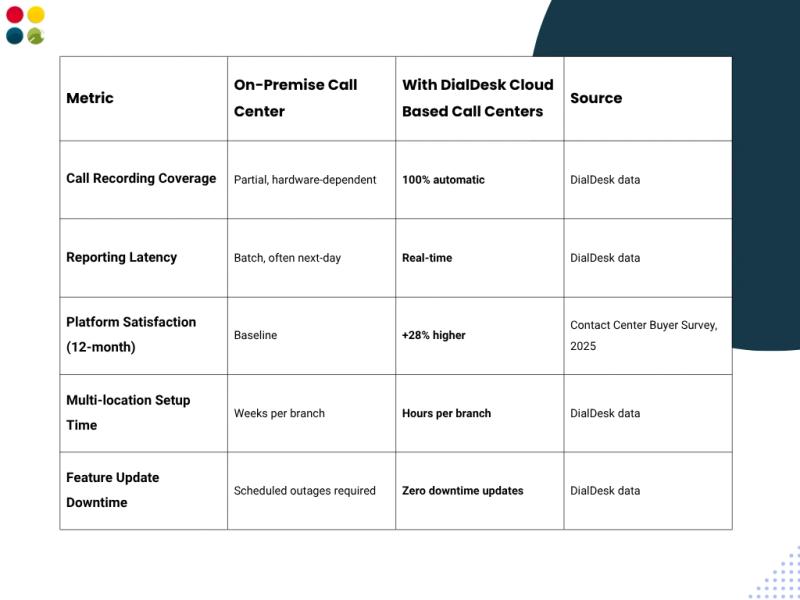
Organisations that evaluate contact center platforms on features rather than price alone report 28% higher satisfaction with their final choice after 12 months (Contact Center Buyer Survey, 2025).
Cloud Based Call Centers vs On-Premise: Full Feature Comparison
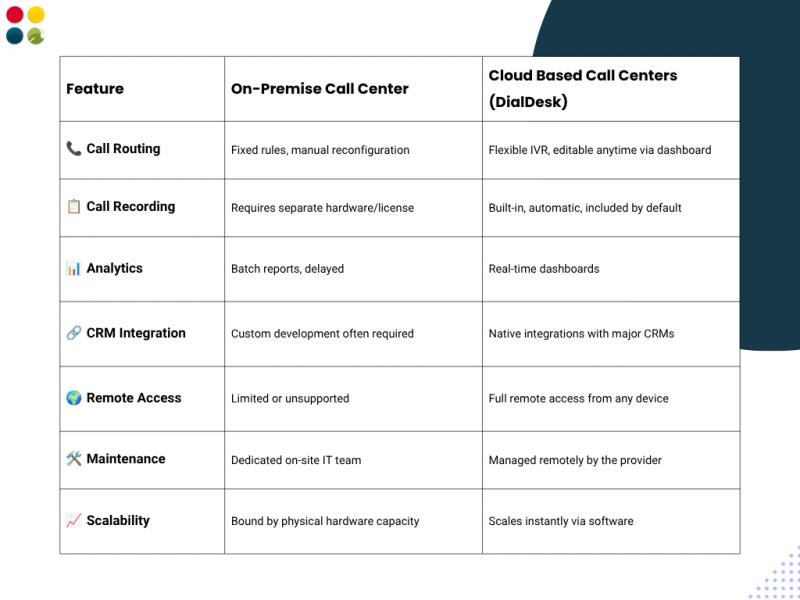
How Cloud Based Calling Matches or Exceeds On-Premise Capability
Cloud Based Calling doesn't just replicate on-premise features remotely — in several areas, it delivers capabilities that on-premise hardware simply can't offer at any price.
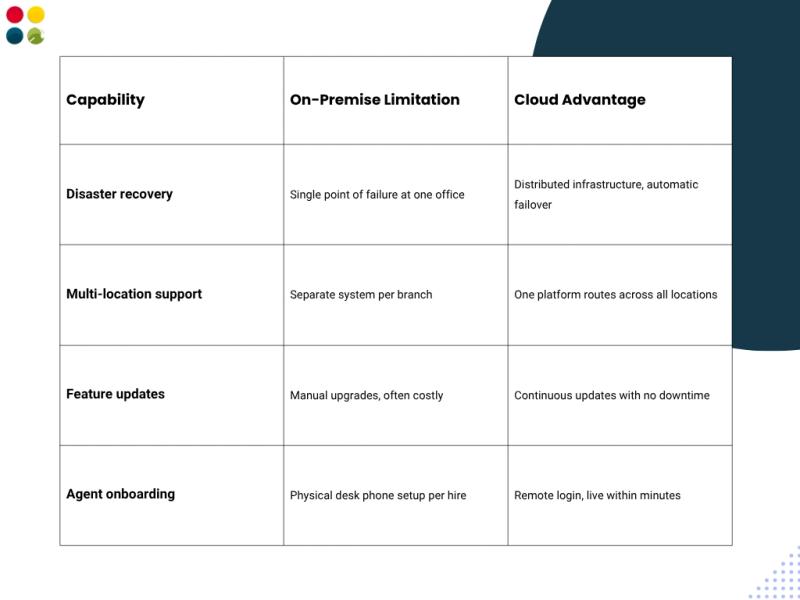
This is where Cloud Based Call Center Software pulls ahead decisively — not by matching on-premise feature-for-feature, but by offering capabilities on-premise hardware structurally cannot provide.
Business Impact: The Numbers Behind Cloud vs On-Premise Feature Gaps
Businesses that switch from on-premise to Cloud Based Call Centers see measurable gains across the features that matter most operationally (Contact Center Buyer Survey, 2025).
✅ Trusted by 500+ Contact Centers Across India
DialDesk's Cloud Based Call Centers platform is ISO 9001:2015 and ISO 27001:2013 certified — feature-rich infrastructure built to outperform on-premise systems. See our full call center software India platform.
Key Takeaways
● A feature-by-feature comparison reveals gaps that a cost-only comparison misses entirely.
● Cloud Based Call Centers include call recording, real-time analytics, and CRM integration by default.
● On-premise systems are bound by physical hardware capacity, limiting scalability and remote access.
● Cloud infrastructure offers disaster recovery and multi-location support that on-premise hardware can't structurally match.
● DialDesk's ISO-certified platform delivers this full feature set with enterprise-grade reliability.
Conclusion
A true feature comparison between Cloud Based Call Centers and on-premise systems shows the gap isn't just about cost — it's about capabilities that on-premise hardware structurally cannot offer, regardless of budget.
Businesses that compare on price alone often discover the feature gap only after they've committed to a system, by which point switching becomes disruptive. Comparing features upfront avoids that mismatch entirely.
Explore how DialDesk's Cloud Based Call Centers platform connects with your CRM integration and Call Analytics stack to see the full feature comparison in action.
Same call, better features. DialDesk proves cloud doesn't mean compromise.
📅 Want to Compare Features for Yourself?
DialDesk's Cloud Based Call Centers platform matches and exceeds on-premise capability — call recording, real-time analytics, and instant scaling, all included. Join 500+ contact centers across India already choosing cloud over on-premise with DialDesk.