What Makes Call Center Training Effective?
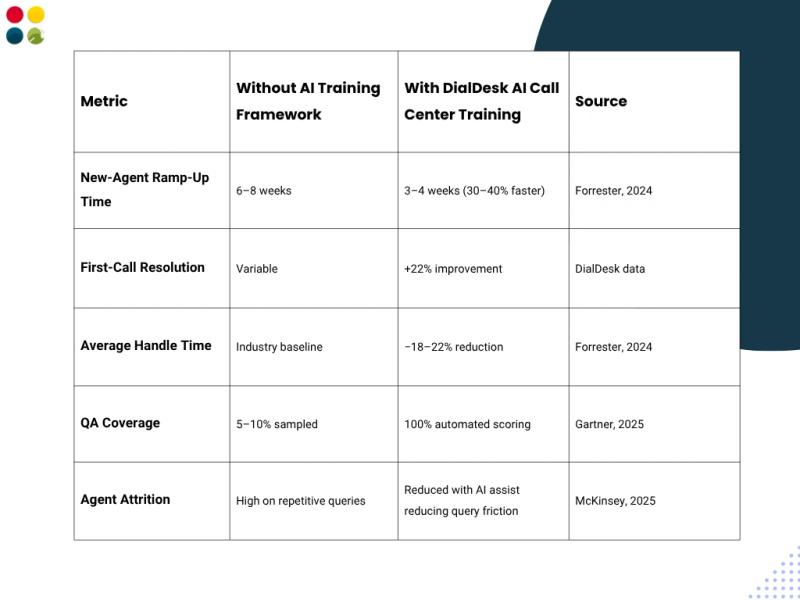
Call Center Training is effective when it combines structured onboarding with product and process knowledge, real-time AI agent assist during live calls, automated QA feedback on 100% of interactions, and continuous coaching loops driven by performance data — not quarterly reviews. Effective Call Center training reduces Average Handle Time by 18–22%, improves First-Call Resolution by 22%, and cuts new-agent ramp-up time by 30–40% through AI-assisted learning and live call guidance.
Why Call Center Training Is the Highest-Leverage Investment in Agent Performance?
The Call Center is the most people-intensive operation in any customer-facing business. The quality of every interaction — every resolved complaint, every prevented churn, every upsell conversion — flows directly from agent capability. Yet most contact centers still treat training as a front-loaded event: a week of onboarding, a script, and a supervisor available for escalations.
This model fails at scale for a predictable reason: agents forget 60–70% of training content within one week when it is not reinforced in the flow of live work (Gartner, 2025). By the time a quality issue surfaces in a weekly QA sample, the same error has occurred across hundreds of unscored interactions.
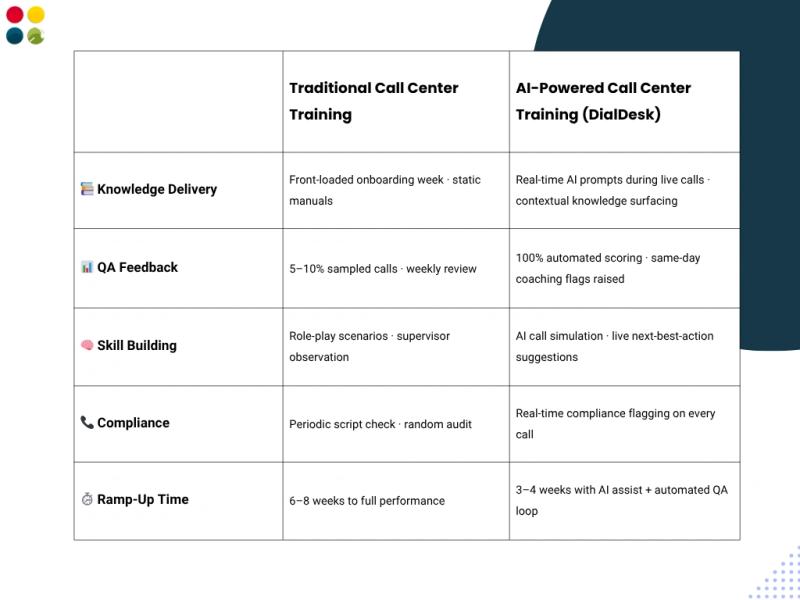
Call Center Training in 2025 is not an event. It is a continuous performance system — where AI surfaces the right knowledge at the right moment, automated QA scores every interaction the same day, and coaching is driven by real data rather than supervisor observation of a 5% sample.
💡 Why It Matters
Contact centers that replace periodic Call Center Training events with continuous AI-assisted coaching reduce new-agent ramp-up time by 30–40% and achieve measurable FCR improvement within 45 days of deployment (Forrester, 2024). The training investment pays back in reduced repeat contacts and lower escalation rates from the first billing cycle.
Traditional vs. AI-Powered Call Center Training: What Changes
The 5-Layer Call Center Training Framework That Actually Empowers Agents
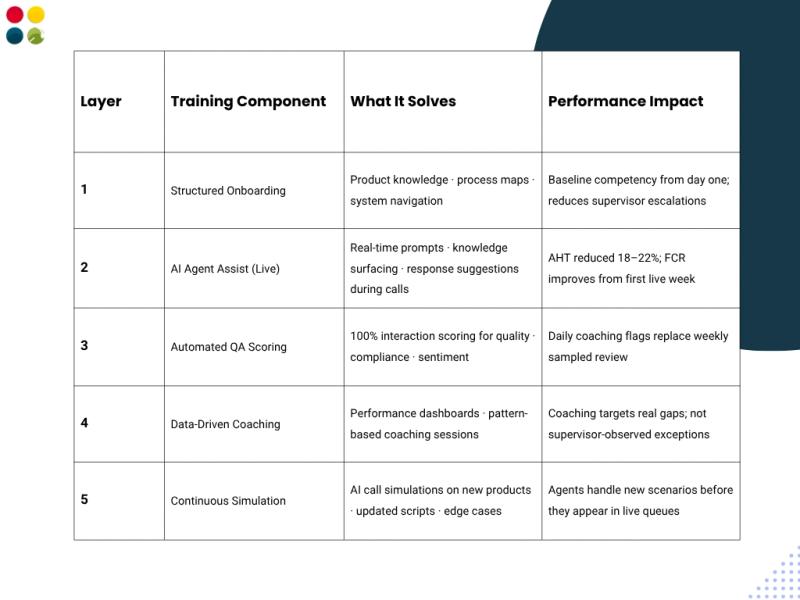
Call Solution providers that deliver consistent agent performance use a five-layer training architecture. Each layer addresses a specific performance gap that single-event training cannot close:
How AI Transforms Call Solution Training in Real Contact Centers?
The most significant shift in Call Center Training over the past two years is not the content — it is the delivery mechanism. AI agent assist means every agent has a training-quality response available during every live call, regardless of experience level.
When a Call Center deploys AI agent assist, new agents stop freezing on edge-case queries. They receive contextual knowledge — account history, product documentation, suggested resolution steps — surfaced automatically as the customer speaks. Senior agents use the same prompts to maintain compliance consistency under high-volume pressure.
The result: the Call Solution’s training value is no longer concentrated in the first week. It compounds daily, with every scored interaction feeding coaching data back into the agent’s development path.
Business Impact: The Numbers Behind Effective Call Center Training
Contact centers deploying AI-powered Call Center Training frameworks achieve compounding performance improvements (McKinsey, 2025):
✅ Trusted by 500+ Contact Centers Across India
DialDesk’s Call Center Training and agent assist platform is ISO 9001:2015 and ISO 27001:2013 certified — an enterprise-grade training infrastructure deployed across BFSI, healthcare, e-commerce, and telecom contact centers in India.
Key Takeaways
• Call Center Training is most effective as a continuous performance system — not a front-loaded onboarding event — reinforced by AI assist and daily QA feedback.
• AI agent assist reduces new-agent ramp-up time by 30–40% by surfacing the right knowledge in real time during live calls — not in post-call review.
• Automated QA scoring 100% of interactions replaces the 5–10% manual sample that lets training gaps compound invisibly across hundreds of unreviewed calls.
• The five-layer Call Center Training framework covers onboarding, AI assist, automated QA, data-driven coaching, and continuous simulation.
• DialDesk’s Call Solution deploys AI-powered training infrastructure in 4–6 weeks on the cloud, with no hardware required and measurable FCR improvement within 45 days.
Conclusion
Call Center Training is not a one-time cost. It is the operational foundation that determines whether every agent interaction builds or erodes customer loyalty — and whether your Call Center compounds in performance or drifts toward inconsistency as teams grow.
The five-layer AI-powered training framework closes the gap between what agents learn in onboarding and what they deliver on the 1,000th live call. AI agent assist ensures the right knowledge is always available. Automated QA ensures no performance gap goes uncoached. And continuous simulation ensures agents handle tomorrow’s edge cases before they reach the live queue.
Explore how DialDesk’s Call Solution connects with your IVR and call routing and cloud telephony India infrastructure to deliver AI-powered Call Center Training intelligence from day one — across voice, chat, and WhatsApp, with no hardware required.
Empowered agents. Consistent CX. Better outcomes. DialDesk delivers the training stack that makes it happen.
Want to Reshape Your Call Center Training Programme?
DialDesk’s AI-powered Call Center Training platform covers agent assist, automated QA, data-driven coaching, and call simulation — from a single cloud integration across voice, chat, and WhatsApp.
Join 500+ contact centers across India already empowering agents with DialDesk.