What Is the Difference Between a Call Center and Contact Center?
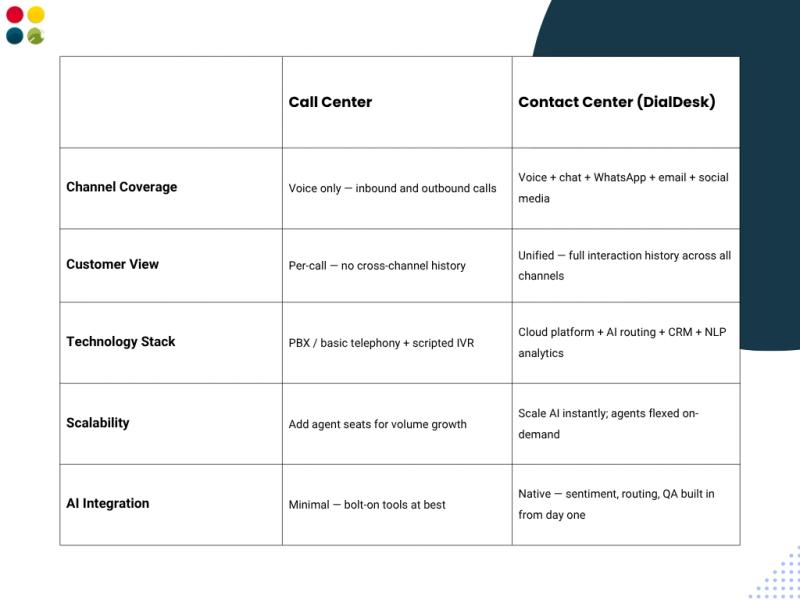
Call Center and Contact Center: A Call Center handles inbound and outbound voice calls only. A Contact Center manages customer interactions across all channels simultaneously — voice, live chat, WhatsApp, email, and social media — from a single unified platform. In 2025, the Contact Center is the operational standard for brands that want to meet customers wherever they communicate. DialDesk powers both models.
Why the Call Center vs Contact Center Distinction Matters in 2025?
85% of global consumers now interact with brands through digital channels — not just phone calls (LivePerson, 2024). Businesses relying exclusively on a traditional Call Center are structurally invisible to a large share of their customers at the moments that matter most. Yet voice remains the highest-value channel for complex, emotionally sensitive interactions.
The question is not which channel to choose. It is whether your operational model, Call Center or Contact Center, is built to serve customers the way they actually want to communicate.
💡 Why It Matters
76% of customers expect consistent service quality across every channel — voice, chat, WhatsApp, and email (Salesforce, 2024). A Call Center that operates only on voice cannot meet this expectation. A Contact Center that unifies all channels can.
Call Center vs Contact Center: The Core Differences
When to Choose Each Model
When a Call Center Is the Right Fit
A traditional Call Center is optimal when your customer base contacts you exclusively by phone; your interaction volume is predominantly inbound voice; and your product requires real-time spoken communication — healthcare consultations, financial services, insurance claims. In these contexts, optimising voice operations is the correct strategic focus.
When a Contact Center Is Non-Negotiable
A Contact Center becomes essential when customers use multiple channels — some call, some WhatsApp, some email; when you need AI-powered quality assurance, cross-channel routing, and real-time sentiment monitoring. Most D2C, SaaS, FMCG, and retail brands in India have already crossed this threshold.
The Cost of Choosing Wrong
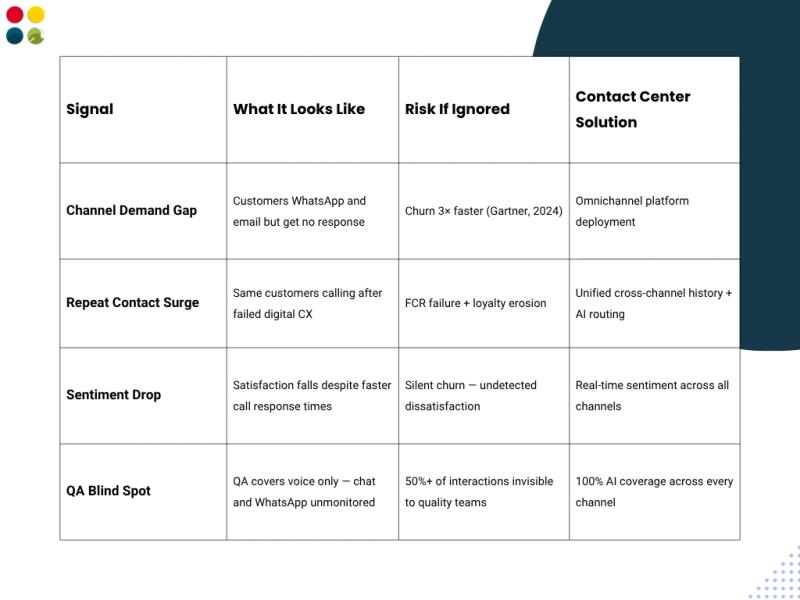
A business that runs a Call Center when it needs a Contact Center is invisible on every channel where its customers prefer to communicate. Gartner (2024) documents that customers who cannot reach support on their preferred channel churn at 3× the rate of those who can.
The Four Signals That Indicate a Business Needs a Contact Center
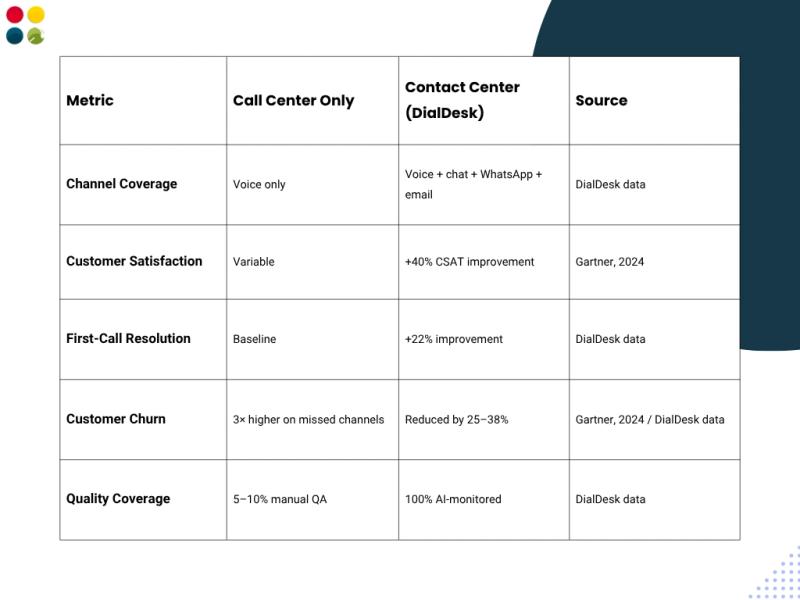
Business Impact: Contact Center vs Call Center in Numbers
Brands that move from a Call Center to an AI-powered Contact Center achieve compounding CX improvements (McKinsey, 2025):
✅ Trusted by 500+ Contact Centers Across India
DialDesk powers Call Center and Contact Center operations — ISO 9001:2015 and ISO 27001:2013 certified, with 21+ years of CX across 12 industries. See our full call center software India platform.
Key Takeaways
• Call Center and Contact Center: a Call Center handles voice only; a Contact Center unifies voice, chat, WhatsApp, and email on a single platform.
• 85% of consumers now use digital channels to interact with brands — making multi-channel Contact Centers the 2025 operational standard (LivePerson, 2024).
• Call Centers remain optimal for voice-first industries — healthcare, financial services, insurance, where real-time spoken communication is core to service delivery.
• Contact Centers are essential when customers communicate across multiple channels and expect consistent, contextual service on each.
• Customers who cannot reach support on their preferred channel churn at 3× the rate of those who can (Gartner, 2024).
• DialDesk delivers both models — AI routing, omnichannel coverage, and 100% quality monitoring from a single managed platform.
Conclusion
Call Center and Contact Center are not competing models, they are different stages of CX maturity. The right choice depends entirely on how your customers want to communicate and what proportion of your interaction volume is voice versus digital.
In 2025, most Indian businesses are already operating in a multi-channel world — whether their support infrastructure reflects it or not. The brands closing that gap with an AI-powered Contact Center are delivering better CX, retaining more customers, and building an advantage that compounds with every interaction.
Explore how DialDesk's platform connects IVR and call routing with WhatsApp and chat support and cloud telephony India — delivering omnichannel intelligence from day one, no hardware required.
One platform. Every channel. All customers served. That is DialDesk.
✅ Trusted Signal: DialDesk's Certifications
ISO 9001:2015 (Quality Management) · ISO 27001:2013 (Information Security) · 21+ years CX operations · 500+ contact centers · 12 industries across India.
📅 Want to Move Beyond the Call Center Model?
DialDesk delivers AI-powered Contact Center solutions — omnichannel CX across voice, chat, WhatsApp, and email, with 100% AI quality monitoring and real-time sentiment. Join 500+ contact centers across India already transforming CX with DialDesk.