OVERVIEW
● In this blog, we discuss how automated WhatsApp follow-ups can turn one purchase into a lifelong customer.
● You will know why WhatsApp is a post-purchase loyalty powerhouse.
● We will see what types of automated follow-ups build retention.
● Learn how to make automation personal at scale with WhatsApp API and Automation.
● What brands of all types are getting it right—and where you can improve.
● And understand why ignoring post-purchase engagement is killing your repeat revenue potential.
Introduction: Most Brands Stop Too Soon
Everybody’s in pursuit of conversions. But unfortunately, nobody’s following up as they care.
The reality is, the sale is only the beginning. Consider it—when a customer purchases from you, they’re not buying for good. They’re rolling the dice. If the follow-up process is subpar, automated, or worst of all—non-existent—they’ll be gone.
And they’ll not forget that silence.
In a world where switching brands has never been easier, loyalty is not purchased with offers or points. It’s gained through proactive, one-to-one follow-ups that are perceived as service—not spam.
And the best platform to do just that? WhatsApp.
It’s already in your customer’s pocket. They check it more than 100 times a day (Statista, 2024).
It gets 98% open rates (Meta Business Study, 2023).
Yet most brands only use WhatsApp Customer Service for basic alerts or support tickets.
You’re leaving loyalty on the table.
This blog is your blueprint to flip that.
Why Use WhatsApp for Automated Follow-Ups?
1. It’s Where the Customer Is
No app fatigue. No unread inboxes. WhatsApp is where your customer already talks to their family, friends—and now, brands.
2. Higher Engagement
● Open rates: 98%
● Click-through rates: 45%
● Response times: 60% within 15 minutes
Source: Meta Business Messaging Insights, 2024
3. Always-On, Yet Personal
With the WhatsApp API and Automation Tools, your brand can send timely, contextual reminders 24/7—without sounding automated.
What Makes a Follow-Up Drive Loyalty?
All follow-ups aren’t created equal. These are the characteristics that differentiate spammy messages from loyalty-generating touch points:
● Timely: Based on real behavior or lifecycle triggers
● Contextual: Appears related to what the customer purchased or engaged with
● Conversational: Feels like a helpful ping, not a broadcast
● Actionable: Provides value, not just noise
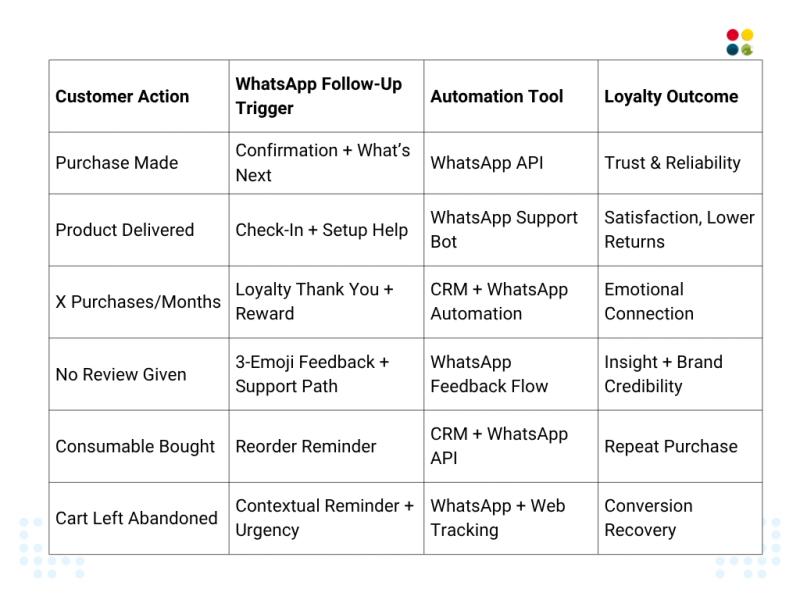
6 Automated WhatsApp Follow-Ups That Build Loyalty
1. Order Confirmation + “What to Expect”
Don’t merely say “thank you”—use this opportunity to prove yourself thoughtful.
● Include estimated delivery timeframes
● Provide immediate support if the information is inaccurate
● Use CTA buttons like “Track Order” or “Contact Agent.”
Tool: WhatsApp API + Transactional Trigger
2. Delivery Follow-Up + Quick Support
Send a message 24–48 hours after delivery.
● “Was everything okay?”
● “Need assistance setting up your product?”
● Route responses to live WhatsApp Support instantly.
Tool: WhatsApp Business Automation + Customer Support Routing
3. Loyalty Milestone Acknowledgement
Celebrate customer journey moments.
● “You’ve been with us 3 months—thank you!”
● “5 purchases! Here’s something special.”
● Add reward points, coupons, or early access.
Tool: CRM Integration + WhatsApp API
4. Feedback Requests That Don’t Feel Like Work
● Use emojis for quick rating.
● Ask one simple question: “How was your experience?”
● Unhappy customers? Offer to resolve right there via WhatsApp.
Tool: Feedback Bot + Support Escalation
5. Smart Reorder Nudges
Consumable products? It is recommended to create reorder triggers.
● “Time to restock your serum?”
● Add auto-fill cart buttons inside WhatsApp.
Tool: WhatsApp + Inventory/Purchase Cycle Data
6. Cart Abandonment with Context
Make it helpful, not annoying.
● “We saw that you were looking at the Black Joggers—want us to save your size for 24 hours?”
● Add buttons: “Resume Order” | “Ask a Question.”
Tool: WhatsApp Automation + Website Behavior Integration
WhatsApp Loyalty Follow-Up Map
Thoughts to Ponder
● Are your customers hearing from you only before the sale, not after?
● Are your automations serving customers—or merely reminding them you’re around?
● What if your follow-ups left a sense of value, rather than nagging?
Data & Research to Back It Up
● 26% of customers who are followed up via WhatsApp post-purchase are more likely to return within 30 days. (Source: Yotpo Loyalty Trends Report 2024)
● 2.3x repeat purchase uplift by brands that utilize WhatsApp Automation for reorders. (Gartner CX Study, 2024)
● 41% of Gen Z customers prefer to interact with brands on WhatsApp over email or app-based chats. (HubSpot Messaging Survey 2023)
Key Takeaways
● WhatsApp is the most underused loyalty engine in your tech stack.
● Follow-ups aren’t about reminders—they’re about relationship reinforcement.
● Combine behavioral triggers + contextual messaging + automation for results.
● Customers want to hear from you—but only if you’re saying something meaningful.
Wrap-Up
The brands that win loyalty in the current market don’t merely sell better—they follow up better.
With WhatsApp Support, API, and Automation, your brand can change from transactional to transformational relationships.
Because a message at the right moment isn’t a “follow-up”- It’s a follow-through.
Conclusion
Loyalty is no longer a bonus metric—it’s a business strategy.
And in the attention economy, you don’t earn it with points. You earn it with presence.
Smart, automated, empathetic WhatsApp follow-ups are the way contemporary brands remain relevant in a customer’s life—without intruding.
The question is no longer “Should we do WhatsApp follow-ups?” It’s “How can we not afford to?”
Automate Customer Love with DialDesk
DialDesk makes it easy for you to send automated, tailored WhatsApp follow-ups that delight, serve, and retain customers at scale.
From API installation to conversational journey mapping, we simplify automating loyalty.
Let’s make your customers brand advocates.