What Is Auto Tagging in Call Centers and Why Does AI Do It Better?
Auto Tagging in call centers is the automatic classification and labelling of customer interactions by query type, outcome, sentiment, churn risk, and resolution status — without requiring agents to manually tag each call. AI does Auto Tagging better than manual processes for three reasons: it tags 100% of interactions (not a sampled subset), it tags in real time during or immediately after the interaction (not days later), and it applies consistent classification logic across every interaction without the variation and fatigue that affect human taggers. DialDesk’s AI Support platform delivers automated, real-time Auto Tagging across voice, chat, WhatsApp, and email for 500+ contact centers across India.
Why Manual Tagging Is a Hidden Quality Failure in Most Call Centers?
Manual interaction tagging is one of the most consequential quality failures in call center operations — and one of the least discussed. When agents manually tag interactions post-call, three structural problems compound simultaneously: coverage is limited to the fraction of time agents have for documentation; consistency is variable across agents, shifts, and tenure levels; and speed is too slow to generate actionable business intelligence within the response window that matters.
The result is a Call Center that believes it understands its interaction data but is actually working from a heavily biased, incomplete sample. The insights generated from manual tagging — most common query types, resolution rates, churn-risk patterns — do not reflect the full interaction population. They reflect the subset that agents tagged correctly, consistently, and on time. That subset is rarely representative.
💡 Why It Matters
McKinsey’s 2025 Contact Center Operations report found that manual interaction tagging in call centers has an average accuracy rate of 71% — meaning 29% of interactions are either untagged, mistagged, or tagged inconsistently across agents. AI Auto Tagging in the same environments achieves 96–98% accuracy across 100% of interactions. (McKinsey, 2025)
What AI Auto Tagging Classifies and How
AI Auto Tagging in a call center classifies interactions across six dimensions simultaneously, in real time, using natural language processing of the interaction transcript and AI Sentiment Analysis of the caller’s emotional state:
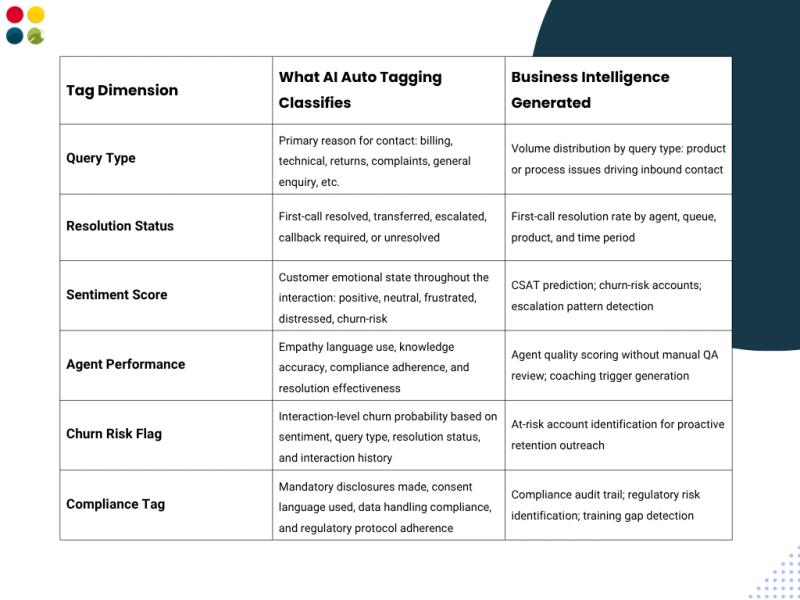
Manual Tagging vs. AI Auto Tagging: The Complete Comparison
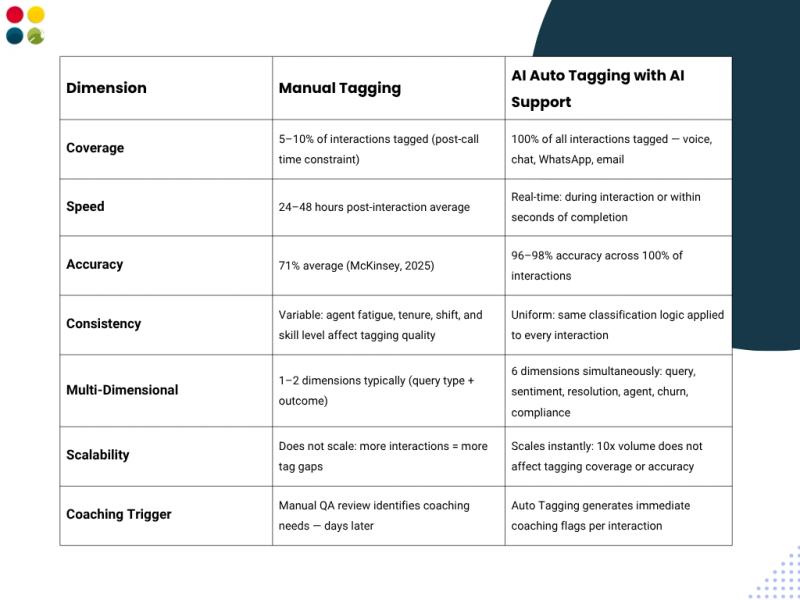
How AI Support Turns Auto Tagging Data Into Business Intelligence
AI Auto Tagging is not just a documentation tool — it is the data foundation for every business intelligence application that makes a call center smarter over time. With 100% accurate, real-time Auto Tagging from AI Support, five intelligence loops that were previously impossible become operational:
1. Product and process issue detection: When the same query type spikes across multiple interaction tags in a 4-hour window, AI Support detects the pattern before a supervisor would notice it in a weekly report. The product team is alerted in hours, not weeks.
2. Predictive churn modelling: Churn-risk tags from individual interactions accumulate into account-level risk scores. Customers with three or more churn-risk-tagged interactions in 30 days are flagged for proactive outreach — before they initiate cancellation.
3. Agent coaching prioritisation: AI Support uses Auto Tagging data to generate agent-level coaching reports that rank coaching priorities by interaction volume and impact. Supervisors coach based on data, not observation samples.
4. Compliance audit readiness: Auto Tagging compliance flags create a structured audit trail for every interaction. Regulatory audits that previously required manual review of call recordings are now answered with AI-generated compliance reports.
5. Real-time CSAT prediction: Sentiment tags from completed interactions feed a CSAT prediction model that gives contact center managers a projected satisfaction score before the formal survey is distributed — enabling interventional outreach to low-predicted-CSAT customers.
✅ Trusted by 500+ Contact Centers Across India
DialDesk’s AI Support platform delivers AI Auto Tagging across 100% of interactions in real time — ISO 9001:2015 and ISO 27001:2013 certified, covering all six tag dimensions simultaneously across voice, chat, WhatsApp, and email. Trusted by 500+ contact centers across India. See our full AI Sentiment Analysis platform.
Business Impact: What AI Auto Tagging Delivers
Call centers that replace manual tagging with AI Auto Tagging through AI Support platforms report measurable improvements across quality, compliance, and operational intelligence (McKinsey, 2025 / Forrester, 2024 / DialDesk data):
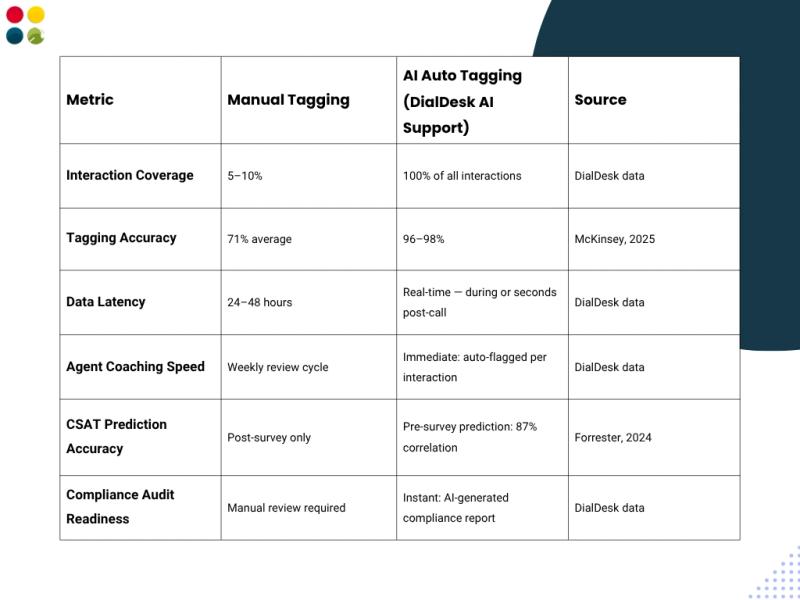
Key Takeaways
• Manual Auto Tagging in call centers achieves 71% accuracy on 5–10% of interactions. AI Auto Tagging achieves 96–98% accuracy on 100% of interactions. (McKinsey, 2025)
• AI Auto Tagging classifies six dimensions simultaneously: query type, resolution status, sentiment score, agent performance, churn risk flag, and compliance tag.
• AI Support turns Auto Tagging data into five intelligence loops: product issue detection, predictive churn modelling, agent coaching prioritisation, compliance audit readiness, and real-time CSAT prediction.
• Real-time Auto Tagging eliminates the 24–48 hour data latency of manual tagging — enabling product, retention, and compliance interventions within hours of issue emergence.
• DialDesk’s AI Support platform deploys AI Auto Tagging across all channels in 10–14 days — ISO-certified, 100% coverage, real-time, six dimensions.
Conclusion
Auto Tagging is the data foundation on which every other call center intelligence application is built. Without accurate, comprehensive, real-time Auto Tagging, product issue detection is slow, churn risk is invisible, agent coaching is based on anecdote rather than data, and compliance audit is a manual burden rather than an automated output.
AI Auto Tagging from AI Support platforms does not just improve this data — it transforms the quality ceiling of what is knowable from call center interactions. The 29% of interactions that manual tagging misses are not evenly distributed: they tend to be the complex, emotionally charged, and compliance-sensitive interactions that matter most.
Explore how DialDesk’s AI Auto Tagging integrates with your AI Sentiment Analysis, IVR and call routing, and cloud telephony India stack to deliver 100% interaction intelligence from day one — no hardware required.
Manual tagging tells you what agents remember to record. AI Auto Tagging tells you what actually happened. DialDesk delivers the truth.
📅 Want to Deploy AI Auto Tagging in Your Call Center?
DialDesk’s AI Support platform delivers real-time Auto Tagging across 100% of interactions — six classification dimensions, 96–98% accuracy, ISO-certified, and activated in 10–14 days.
Join 500+ contact centers across India already running on DialDesk’s AI Auto Tagging.