OVERVIEW
● A CSAT score offers a quick snapshot of customer satisfaction, but it rarely reveals the deeper story behind loyalty, engagement, or churn risk.
● This blog will unpack why CSAT alone is misleading, highlight the blind spots it leaves—like loyalty, emotion, and silent churn—and identify the real metrics and signals CX leaders should be watching for a true 360° view of customer experience.
● Readers will gain a practical playbook for moving beyond “just satisfaction” to drive stronger retention and engagement.
Introduction
Your CSAT score is somewhat akin to the “like” button on Instagram—it’s immediate feedback, nice to feel when high, and painful when low. But does it actually indicate that your audience is loyal, engaged, or willing to recommend you to their peers?
The reality: CSAT is a snapshot, not a narrative.
Consider this:
● A customer may rate you 5/5 because the agent was polite… but they might never come back.
● Another may score you 3/5 because delivery was late… but they’re still a loyal repeat buyer.
So, Customer Satisfaction in BPO may look good on your dashboards, but it’s usually just surface-level. And in today’s subscription-based, loyalty-focused market, surface-level won’t fly. Businesses that want to win in Customer Experience & Engagement need to dig deeper into what CSAT doesn’t reveal.
Why CSAT isn’t the Full Picture?
Here’s why relying only on CSAT is like judging a book by its cover:
● It’s moment-driven: CSAT picks up on how a customer felt at a particular transactional interaction, not the larger journey.
● It’s biased toward the extremes: Annoyed and thrilled customers are more likely to answer, excluding the quiet middle majority.
● It misses future intent: CSAT doesn’t capture if someone will repurchase, churn, or become an advocate.
70% of customer journeys are driven by how customers perceive that they are being treated, and not necessarily single-point satisfaction scores, according to a Gartner study.
What CSAT Doesn’t Tell You (The Blind Spots)?
This is where most CX teams get blindsided:
1. Customer Loyalty
○ Repeat business isn’t always assured by a high CSAT.
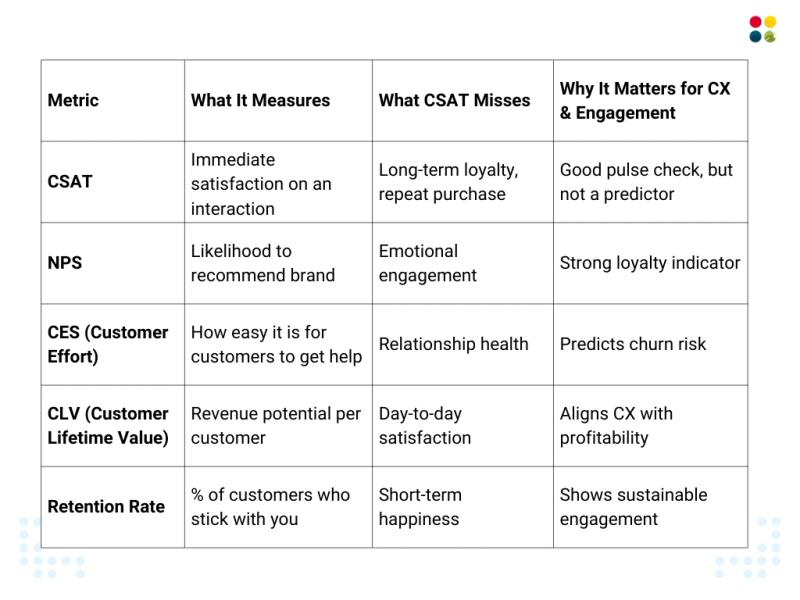
○ Loyalty is actually better measured with NPS (Net Promoter Score) and retention rates.
2. Emotional Engagement
○ Customers can be “satisfied” without being emotionally engaged.
○ Emotional connections drive 3x greater lifetime value (Forrester, 2024).
3. Silent Churn Risk
○ Certain “satisfied” customers quietly depart when competitors do something better.
○ CSAT does not measure likelihood to switch.
4. Employee-CX Connection
○ High Customer Experience often reflects high EX (Employee Experience).
○ A polite agent can boost CSAT, but burnout behind the scenes eventually hurts service.
5. Operational Gaps
○ CSAT reports “customers were happy/unhappy.”
○ It does not report why (product defect, delivery delay, pricing confusion).
Expert-Level Insights: Beyond CSAT
● The multi-metric approach is non-negotiable.
Leading CX brands merge CSAT with NPS, CES, and churn analysis for a 360° perspective.
● Emotion is the hidden KPI.
59% of customers indicate that emotional connection is more significant than transactional convenience in selecting a brand, as reported by PwC.
● Behavioral data > survey scores.
Your customer’s behavior—repeat buys, referrals, drop-offs—speaks volumes over a flash rating.
● AI-powered sentiment analysis is the game-changer.
With NLP and conversational AI, brands are able to decipher customer mood across touchpoints, filling in the gap CSAT creates.
Thoughts to Ponder
● If your CSAT is good but churn is up—what’s amiss?
● Are you asking customers the right questions, or merely the simple ones?
● What if you quit fixating on scores and began charting feelings and behaviors?
Wrap-Up
CSAT is valuable, but it’s not the North Star. It’s one chapter in your customer story, not the full book. By combining CSAT with loyalty, effort, lifetime value, and sentiment analytics, you’ll unlock a richer view of Customer Engagement and experience.
Data shows that companies that use multiple CX metrics grow revenue 2.3x faster than those relying on a single score (Bain & Company, 2024).
Key Takeaways
● CSAT is just a snapshot, not the whole journey.
● It does not track loyalty, emotion, or risk of churn.
● Use NPS, CES, CLV, and retention for the whole picture.
● Combine survey data with behavioral data to make better decisions.
● The future of CX is multi-metric and emotionally intelligent.
Conclusion
Your CSAT score is a helpful pulse check—but if you use it as the entire diagnosis, you’ll miss what actually fuels growth: loyalty, emotion, and engagement. To succeed in 2025 and beyond, brands need to hear beyond the numbers and care about the entire customer journey.
At DialDesk, we enable companies to move beyond surface-level scores. With our collaborative CX growth engine, you don’t just measure satisfaction—you drive retention, engagement, and revenue.
Ready to reveal the tale behind your CSAT?
Let’s talk. No customer left behind, no lead lost.