What are Inbound and Outbound Calls?
Inbound Calls are customer-initiated voice interactions received by a business, such as support queries, purchase confirmations, billing questions, and escalations. Outbound Calls are business-initiated contacts made to customers or prospects, sales outreach, follow-ups, surveys, and appointment reminders. Together, the Inbound and Outbound Calling Process forms the complete voice communication infrastructure of any customer-facing organisation. Inbound and Outbound BPO are both managed at scale on a unified platform. DialDesk’s cloud contact center handles both call types with AI-powered routing, real-time analytics, and full CRM integration, from a single interface.
What is an Inbound Call? Definition, Purpose, and Use Cases
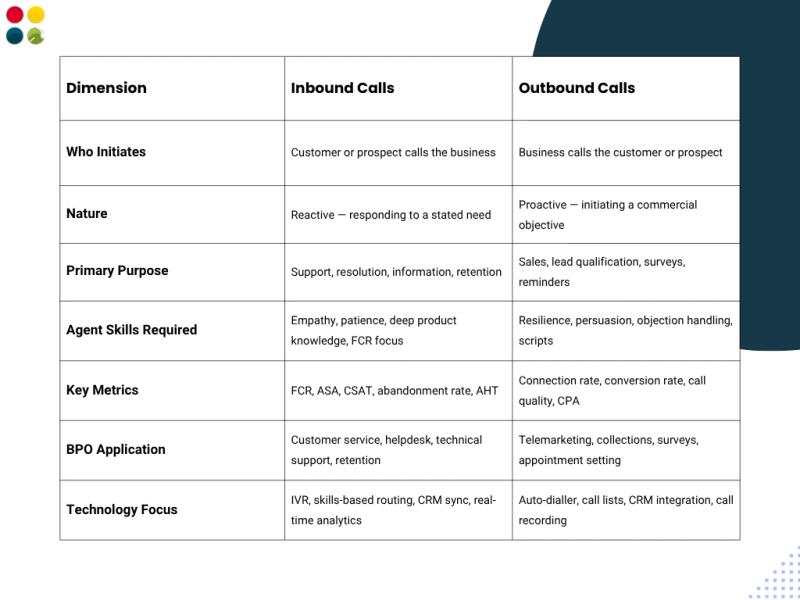
An inbound call is a voice interaction initiated by a customer or prospect and received by a business. Inbound calls are reactive; the business responds to a need the customer has already identified. The Inbound Calling Process is built to handle this volume quickly, accurately, and empathetically, routing each caller to the right agent or automated resolution path.
Common inbound call types include technical support, order status queries, billing clarifications, product information, complaints, refund requests, and appointment bookings. In Inbound and Outbound BPO environments, inbound volume typically peaks at predictable times, making demand forecasting and skills-based routing essential to performance.
💡 Why Inbound Calls Matter
76% of customers still prefer calling a business when their issue is important or urgent (Salesforce State of Service Report, 2024). Inbound calls are the highest-intent customer touchpoint, and the most measurable.
What is an Outbound Call? Definition, Purpose, and Use Cases
An outbound call is a business-initiated voice interaction made to a customer, lead, or prospect. Unlike the reactive nature of inbound, the Outbound Calling Process is proactive, designed to achieve a specific commercial or operational objective before the customer identifies a need.
Common outbound call types include sales outreach, lead qualification, appointment reminders, NPS and CSAT surveys, renewal follow-ups, payment reminders, and market research. In Inbound and Outbound BPO, outbound teams operate from structured call lists, scripted workflows, and auto-dialling systems, with performance measured by connection rate, conversion rate, and call quality score.
What is Inbound and Outbound Calls: The Complete Comparison
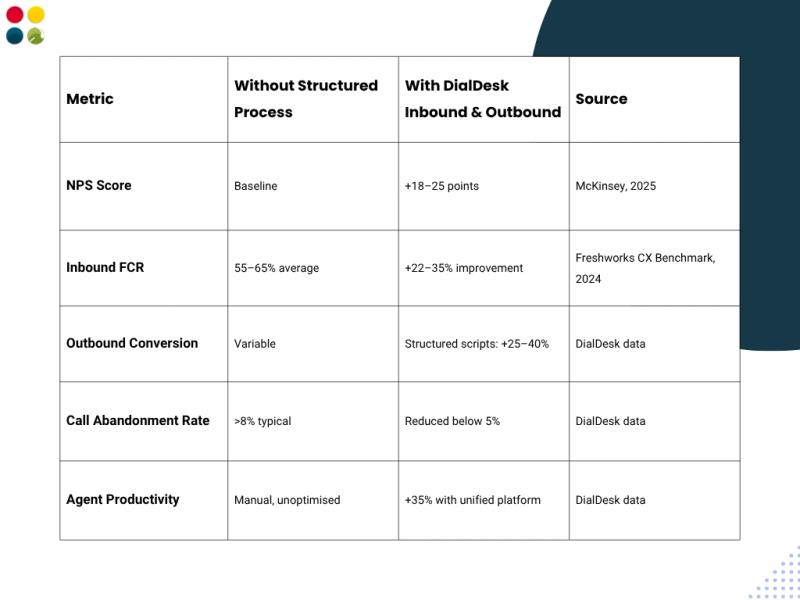
Business Impact: What the Right Inbound and Outbound Calling Process Delivers
✅ Trusted by 500+ Contact Centers Across India
DialDesk’s Inbound and Outbound BPO platform is ISO 9001:2015 and ISO 27001:2013 certified, enterprise-grade infrastructure for both call types, trusted by 500+ contact centers across India. India’s only PAY AS YOU USE call center model.
Key Takeaways
• What is Inbound and Outbound Calls? Inbound = customer-initiated, reactive, resolution-focused. Outbound = business-initiated, proactive, commercially targeted.
• The Inbound and Outbound Calling Process requires different agent skills, technologies, and KPIs, but both are measurable, trainable, and optimisable.
• Inbound and Outbound BPO at scale requires a unified platform, one interface for both call types, with full CRM sync and real-time analytics across all interactions.
• A blended call center model (agents handling both inbound and outbound based on live volume) improves agent utilisation by up to 35% without adding headcount.
• DialDesk’s cloud platform handles both call types, with AI routing for inbound and auto-dialling for outbound, deployable in 48–72 hours.
• ISO 9001:2015 and ISO 27001:2013 certification ensures quality and data security across all inbound and outbound operations from day one.
Conclusion
Understanding what is Inbound and Outbound Calls is the foundation of any effective customer communication strategy. The two call types serve different purposes, require different skills, and are measured by different KPIs, but they share a common dependency: the right platform, the right process, and the right performance measurement.
In India’s Inbound and Outbound BPO market, the brands that win are those that deploy both call types on a unified platform, where inbound resolution and outbound conversion are measured together, optimised in real time, and scaled without proportional headcount increases.
Explore how DialDesk’s Inbound and Outbound Calling Process platform connects with your CRM, cloud telephony, and AI automation stack to deliver both call types from a single interface, live in 48–72 hours.
Inbound resolves. Outbound converts. DialDesk optimises both.
📅 Want to Optimise Your Inbound and Outbound Calling Process?
DialDesk’s unified Inbound and Outbound BPO platform deploys in 48–72 hours — IVR, auto-dialler, CRM integration, QA, and real-time analytics for both call types from day one.
Join 500+ contact centers across India running smarter inbound and outbound operations with DialDesk.