Inbound calls are calls a customer makes to a business, such as support queries, orders or complaints. Outbound calls are calls a business makes to customers or prospects, such as sales, follow-ups, surveys or reminders. The key difference is who starts the call: the customer for inbound, the business for outbound.
Key Takeaways
- Inbound calls are customer-initiated, reactive and focused on resolution; outbound calls are business-initiated, proactive and focused on outreach.
- Inbound and outbound calling need different agent skills, technologies and KPIs, but both are measurable, trainable and can be improved.
- Running inbound and outbound calls at scale works best on one platform, with full CRM sync and real-time analytics across all interactions.
- A blended call center model (agents handling both inbound and outbound based on live volume) keeps agents productive when inbound queues are quiet, without adding headcount.
- DialDesk’s cloud platform handles both call types, with AI routing for inbound and auto-dialling for outbound, deployable in about 72 hours.
- ISO 9001:2015 and ISO/IEC 27001:2022 certification ensures quality and data security across all inbound and outbound operations from day one.
What Are Inbound and Outbound Calls?
Together, both call types form the voice channel of any customer-facing business. In a BPO, inbound and outbound calls are often managed on one platform. DialDesk’s cloud contact center handles both call types with AI-powered routing, real-time analytics, and full CRM integration, from a single interface.
What Is an Inbound Call?
An inbound call is a voice interaction initiated by a customer or prospect and received by a business. Inbound calls are reactive; the business responds to a need the customer has already identified. The inbound calling process is built to handle this volume quickly, accurately, and empathetically, routing each caller to the right agent or automated resolution path.
Common inbound call types include technical support, order status queries, billing clarifications, product information, complaints, refund requests, and appointment bookings. In inbound call center services, volume typically peaks at predictable times, making demand forecasting and skills-based routing essential to performance.
💡 Why Inbound Calls Matter
Customers often choose to call when an issue is important or urgent. Inbound calls are the highest-intent customer touchpoint, and the most measurable.
What Is an Outbound Call?
An outbound call is a business-initiated voice interaction made to a customer, lead, or prospect. Unlike the reactive nature of inbound, the outbound calling process is proactive, designed to achieve a specific commercial or operational objective before the customer identifies a need.
Common outbound call types include sales outreach, lead qualification, appointment reminders, NPS and CSAT surveys, renewal follow-ups, payment reminders, and market research. When businesses work with a call center outsourcing company, outbound teams operate from structured call lists, scripted workflows, and auto-dialling systems, with performance measured by connection rate, conversion rate, and call quality score.
Businesses that run sales, renewal or collection campaigns often use outbound call center services to manage these calls at scale.
Inbound vs Outbound Calls: Key Differences
Who starts the call
Inbound: The customer calls the business.
Outbound: The business calls the customer or prospect.
Main goal
Inbound: Answer questions and resolve issues.
Outbound: Generate sales, follow up or share information.
Nature
Inbound: Reactive: the business responds to a need.
Outbound: Proactive: the business starts the conversation.
Common examples
Inbound: Support queries, order status, billing questions, complaints, bookings.
Outbound: Sales calls, lead qualification, renewals, payment reminders, surveys.
Key KPIs
Inbound: First call resolution, CSAT, average handle time, wait time.
Outbound: Connect rate, conversion rate, cost per lead, right-party contact.
Main tools
Inbound: IVR, skills-based call routing, CRM.
Outbound: Auto dialer, call lists, scripts, CRM.
Inbound and Outbound Call Meaning in Hindi
In Hindi, an inbound call means आने वाली कॉल (incoming call), and an outbound call means जाने वाली कॉल (outgoing call). In a BPO, the inbound voice process handles incoming customer calls, and the outbound process makes calls to customers.
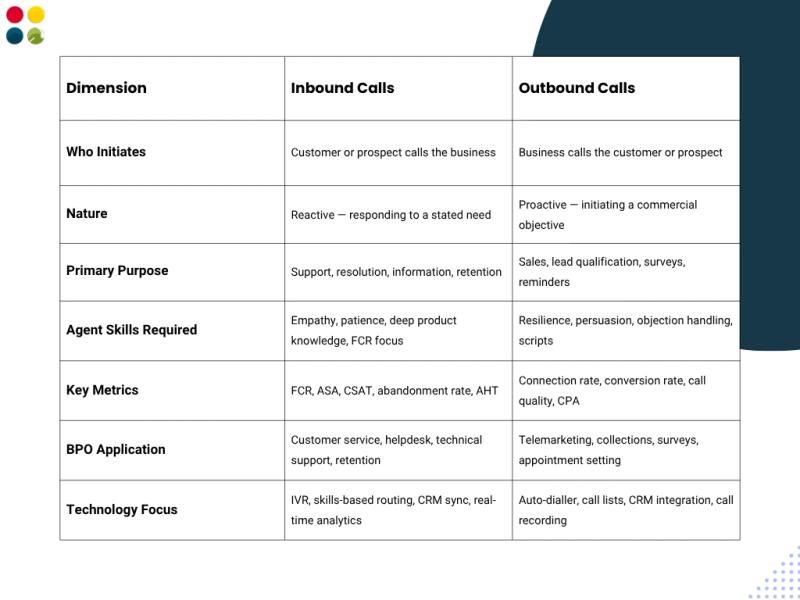
Inbound vs Outbound Calls: Comparison Chart
Inbound and Outbound Call Examples by Industry
- E-commerce: Inbound calls cover order status, returns and refunds. Outbound calls cover order confirmation, cash-on-delivery verification and cart recovery.
- Banking and NBFC: Inbound calls cover account and loan queries. Outbound calls cover loan offers, EMI reminders and renewals.
- Healthcare: Inbound calls cover appointment bookings and patient queries. Outbound calls cover appointment reminders and follow-ups.
- Telecom and ISP: Inbound calls cover network complaints and billing questions. Outbound calls cover plan upgrades and renewal reminders.
- Education: Inbound calls cover course and admission enquiries. Outbound calls cover lead follow-ups and enrollment reminders.
Business Impact: What the Right Inbound and Outbound Calling Process Delivers
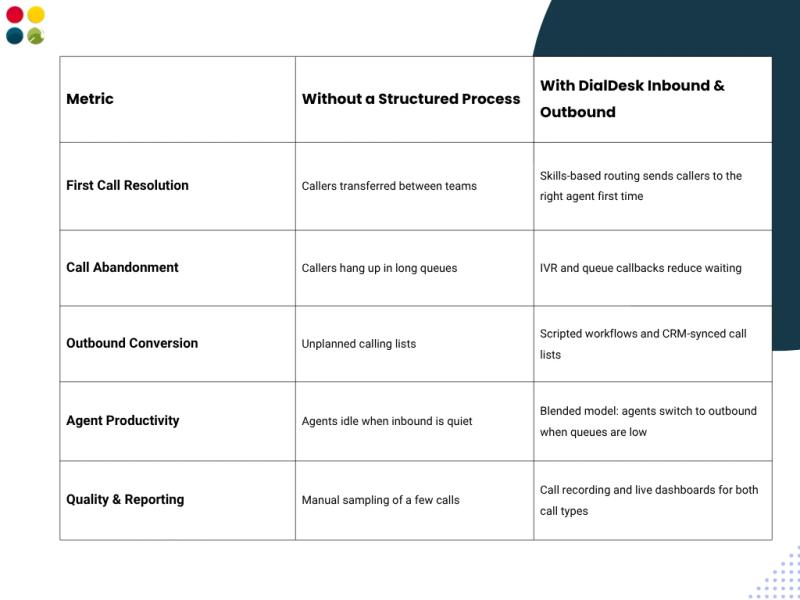
In short, a well-run inbound and outbound calling process helps teams resolve customer issues faster, reach more prospects and track both types of calls on one dashboard.
✅ Trusted by 250+ Clients Across India
DialDesk’s Inbound and Outbound BPO platform is ISO 9001:2015 and ISO/IEC 27001:2022 certified, with 18+ years in customer support and 250+ clients across India.
Explore how DialDesk’s Cloud Contact Center platform connects with your CRM, cloud telephony, and AI automation stack to deliver both call types from a single interface, live in about 72 hours.
Which Calling Process Does Your Business Need?
Most businesses need both: inbound to answer customer calls and outbound to reach customers first.
Start with inbound if customers mostly call you for support, orders or complaints. Add outbound when you need sales, renewals or reminder calls, and run both on one platform so you can measure them together.
To plan the right mix for your business, book a demo below.