What is AI in Customer Support?
AI in customer support is the application of NLP, machine learning, sentiment analysis, and automation to handle, assist, and improve customer interactions at scale — automating 40–60% of routine queries, reviewing 100% of interactions for quality, and enabling agents to resolve issues 26%+ faster through real-time AI assistance.
Why AI in Customer Support is No Longer Optional?
Customer expectations have moved faster than most support operations can track. Customers expect instant responses at 11 PM. They expect the agent to already know their order history before they finish their first sentence. They expect consistency across every channel- phone, WhatsApp, chat, without repeating themselves each time they switch.
Meeting these expectations with a traditional support model requires headcount that most businesses cannot sustain. Every query handled by a human agent at full cost, every ticket triaged manually, every call reviewed by a QA team that can only sample 5–10% of interactions, this model breaks under the weight of modern demand volumes.
AI in Customer Support changes mathematics entirely. It does not replace human agents. It handles the high-volume, predictable, repeatable interactions that consume agent bandwidth, freeing support teams to do the work that genuinely requires their skills: empathy, nuanced problem-solving, and complex resolution.
This guide explains exactly what AI in customer support means operationally — how it works, what it delivers, where it fits into a helpdesk environment, and what mistakes to avoid when deploying it.
The Scale of the Problem AI Solves
73% of customers say experience is a key factor in purchase decisions — yet only 49% feel brands consistently deliver (PwC, 2024). Fewer than 7% of customers complete post-call surveys (Qualtrics, 2024). And 60% of support leaders say they cannot identify the root cause of customer frustration fast enough to act on it (Gartner, 2025). AI in customer support addresses all three gaps simultaneously.
What is AI in Customer Support — Properly Defined
AI in customer support is often reduced to chatbots that answer FAQs, but that is only the most basic layer. It represents a small part of what AI can actually do in a fully developed support environment.
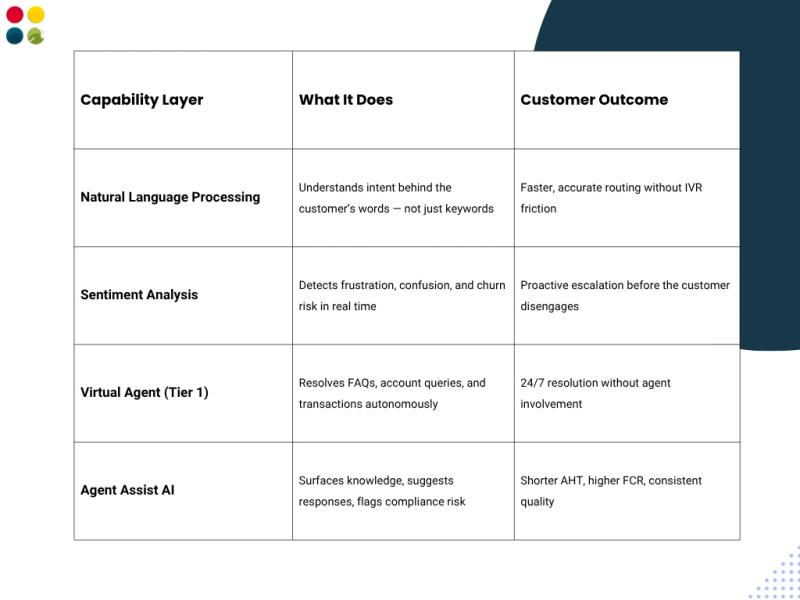
A complete AI-driven support system works across multiple layers, each handling a different part of the workflow and strengthening the overall impact when combined.


These eight layers work together as a continuous intelligence system. NLP understands what the customer means. Sentiment analysis reads how they feel. Predictive analytics anticipates what they will need next. Automated QA reviews how every interaction went. And the machine learning layer ensures the whole system improves with every completed conversation.
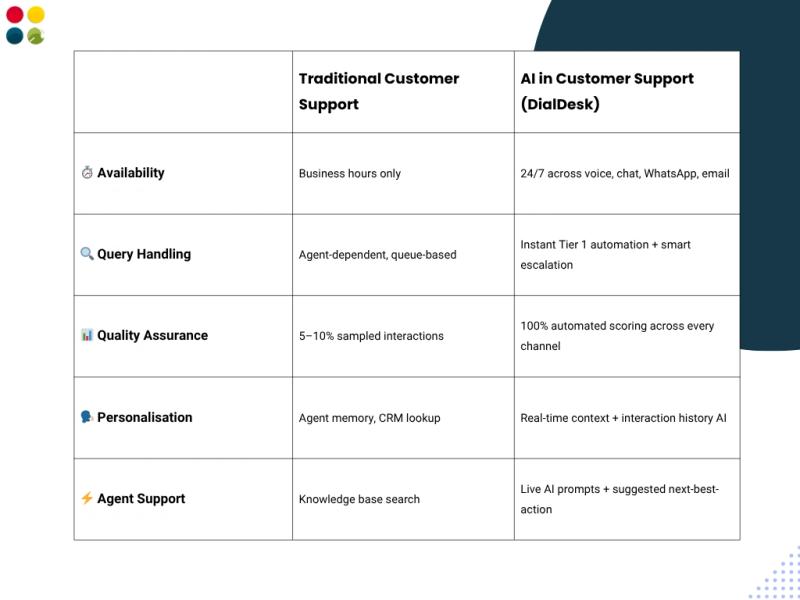
AI Customer Support vs. Traditional Support: The Full Comparison
To really understand what AI customer support delivers, you have to compare it to how support actually works today, not an ideal version of manual operations, but the reality most contact centres operate in.

✅ 500+ contact centres across India trust DialDesk's AI support platform. In documented deployments: 40–60% query automation, 35% faster resolution, measurable CSAT improvement — within 30 days of going live. No internal IT team required.
See AI Customer Support in Action — Live
Watch DialDesk's AI handle a real support interaction from first contact to resolution — across voice and WhatsApp. Real AI. Real conversations.
▶ Watch a 3-Minute Live Demo → dialdesk.in
AI HelpDesk: What a Modern AI Support Platform Does
An AI HelpDesk is the operational infrastructure through which AI customer support capabilities are delivered. It is the platform layer, connecting the AI intelligence to the agent workflow, the ticketing system, the quality process, and the management dashboard.
Here is what a genuine AI helpdesk does at every stage of the support interaction:

✅ DialDesk's CallMaster AI provides 100% automatic interaction auditing — every call, WhatsApp thread, and chat is scored, summarised, and flagged for coaching, automatically. ISO 9001:2015 and ISO 27001:2013 certified. No QA reviewer involvement required.
The AI + Human Model: Why the Partnership Outperforms Either Alone
The most common misconception about AI in customer support is that it is a replacement strategy. It is not. The data from every successful AI customer support deployment consistently shows the same pattern: AI + human outperforms either operating independently.
What AI Handles Best
• High-volume, repetitive tier-1 queries — order status, FAQs, account checks, authentication
• 24/7 availability across all channels — without overtime, fatigue, or inconsistency
• 100% quality monitoring — every interaction reviewed, scored, and summarised automatically
• Real-time knowledge surfacing — the right answer delivered to the right agent at the right moment
• Pattern detection at scale — trends, anomalies, and emerging issues that no human team could spot manually
What Humans Do Best
• Emotional intelligence — reading and responding to genuine distress, frustration, or vulnerability
• Complex problem-solving — multi-variable situations that require judgment, not pattern matching
• Relationship building — high-value retention conversations that require trust and genuine empathy
• Novel situations — queries that fall outside any pattern the AI has been trained on
• Ethical judgment — decisions that require human accountability
The brands winning in AI customer support are not the ones that automated the most. They are the ones who used AI to make their human agents better — and their human agents to make their AI more effective.
5 Common Mistakes When Implementing AI in Customer Support
Most AI customer support failures are not technology failures. They are implementation and strategy failures. Here are the five most common and how to avoid each one.

DialDesk: AI Customer Support Built for India's Market
Most global AI support platforms were designed for Western contact centre environments- large IT teams, single-language operations, and enterprise procurement cycles measured in quarters. DialDesk was built for a different reality: India's multilingual customer base, WhatsApp-first communication culture, D2C and BFSI growth pace, and the need for enterprise-level AI without enterprise-level overhead.
• CallMaster AI: 100% automatic call auditing, sentiment tagging, quality scoring, and coaching flag generation — across voice, WhatsApp, and chat.
• Voice Bot (Multilingual): Handles tier-1 queries in Indian English, Hindi, and regional accents with voice biometric authentication capability.
• WhatsApp Automation: AI-powered query handling, order updates, escalation routing, and ticket creation on WhatsApp Business — 24/7.
• Real-Time Agent Assist: Surfaces scripts, knowledge, and empathy prompts to agents during live interactions — based on live sentiment and conversation context.
• Predictive Routing: Matches each incoming query to the agent most likely to resolve it efficiently — reducing transfers and improving FCR.
• Omnichannel Unified Dashboard: Single view across voice, WhatsApp, chat, email, and ticketing — with full customer interaction history across all channels.
• Managed Onboarding: No internal IT team required — DialDesk's team configures, trains, and optimizes the platform from day one.
Key Takeaways
- AI Customer Support works as a multi-layered system, combining technologies like NLP, machine learning, sentiment analysis, and real-time assistance to create a support engine that keeps learning and improving with every interaction.
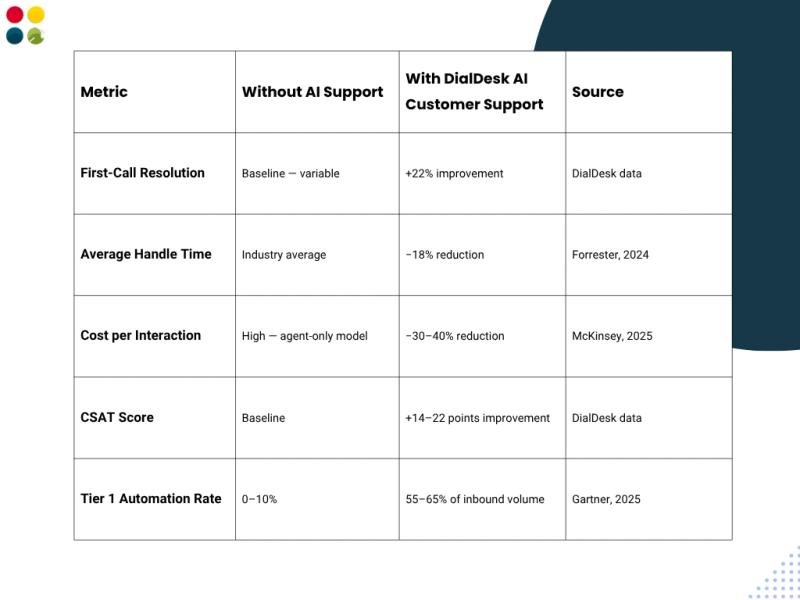
- The impact is measurable. Teams see over 26 percent reduction in AHT, 25 to 38 percent fewer escalations, and 30 to 50 percent improvement in CSAT, along with 12 to 18 percent lower operational costs.
- An AI-powered helpdesk does much more than manage queues. It routes conversations, supports agents in real time, summarises interactions, scores performance, and learns continuously, all without relying on manual QA for most of the workload.
- The best results come from combining AI with human agents. AI handles repetitive and predictable tasks, while humans focus on conversations that need empathy and judgment.
- There are a few common pitfalls to avoid, like over-automating without a fallback, using AI only after interactions, deploying generic bots, tracking the wrong metrics, or keeping AI limited to a single channel.
- DialDesk’s AI support platform is built for the realities of the Indian market, with multilingual capabilities, strong WhatsApp integration, and a setup that does not require an internal IT team and can be deployed quickly.
Conclusion
AI in customer support isn’t just another tool you plug into your existing setup. It changes how the entire operation works. Every interaction is tracked, agents get support in real time, quality gaps are visible, and decisions are driven by actual data instead of assumptions.
The brands leading in customer experience today aren’t the ones with the biggest teams or budgets. They’re the ones using AI thoughtfully to move faster, support their agents better, and deliver a more consistent experience to customers.
And it doesn’t have to be complicated. With the right platform, built for your market, your channels, and your scale, AI can become one of the most meaningful improvements your support team makes this year.
AI in customer support is not a future investment. It is the present standard, and every month without it is a month of conversations you are not learning from.
DialDesk makes the transition simple, fast, and measurable — from day one.
Ready to Replace Your Helpdesk with AI That Actually Works?
DialDesk's AI helpdesk combines intelligent ticketing, real-time agent assist, 100% automated QA, voice bots, WhatsApp automation, and omnichannel support — in one managed platform. 500+ brands. No IT team needed.
▶ Book Your Free Demo → dialdesk.in/book-demo