OVERVIEW
This blog breaks down:
● What AI sentiment scoring entails in customer call.
● How AI Calls are revolutionizing sales and support.
● Why scoring AI Customer sentiment is not merely about feelings—it’s about growth.
● Industry use cases, tools, benefits, and warning signs.
● How to harness this insight engine to decrease churn, drive CSAT up, and drive conversions.
Introduction: The Call That Changed Everything
A tired customer support agent answers a call at 6:47 PM. The customer on the phone is angry—not yelling, just quietly chilly. No cussing. No yelling. But under the surface? They’re finished with the brand.
The agent is thinking, “Good call, wrapped up nicely.” But that call was the start of a silent churn.
Suppose an AI engine had marked that AI Call as “high churn risk,” based on tone changes, hesitation, keyword usage, and silence patterns. That one flag could’ve led to a follow-up, a win-back campaign, or even a script change.
That’s what scoring sentiment in AI Calls can do. It’s no longer sci-fi. It’s here now. It’s business-critical.
What is AI Sentiment Scoring in Calls?
AI sentiment scoring is the process of monitoring customer emotions, tone, language, and speech patterns when on a call through Natural Language Processing (NLP), Machine Learning (ML), and acoustic signal processing.
It doesn’t merely monitor what the customer says—it analyzes how they say it.
Think of it as your brand’s emotional intelligence engine for each AI Call.
Why It Matters: The Business of Emotions
Here’s why customer sentiment isn’t just fluff—it’s $$:
● 33% of customers abandon a brand after one poor interaction (PwC, 2024)
● Companies leveraging AI sentiment analysis achieve 15-25% more customer retention (McKinsey CX Report, 2025)
● AI-driven call analysis enhances agent performance by up to 40% (Deloitte, 2025)
How Does it Work?
Here’s how AI Call sentiment scoring generally works:
1. Speech-to-Text Conversion
Transforms call audio into text through ASR (automatic speech recognition).
2. Sentiment Analysis Engine
NLP algorithms detect tone, emotion, and keyword patterns (e.g., “annoyed”, “waited”, “cancel”).
3. Scoring & Tagging
Each AI Call Monitoring receives a sentiment score (positive, neutral, negative) as well as intent categories (e.g., refund, escalation, churn risk).
4. Actionable Alerts
Real-time alerts to agents/supervisors to intervene or improve.
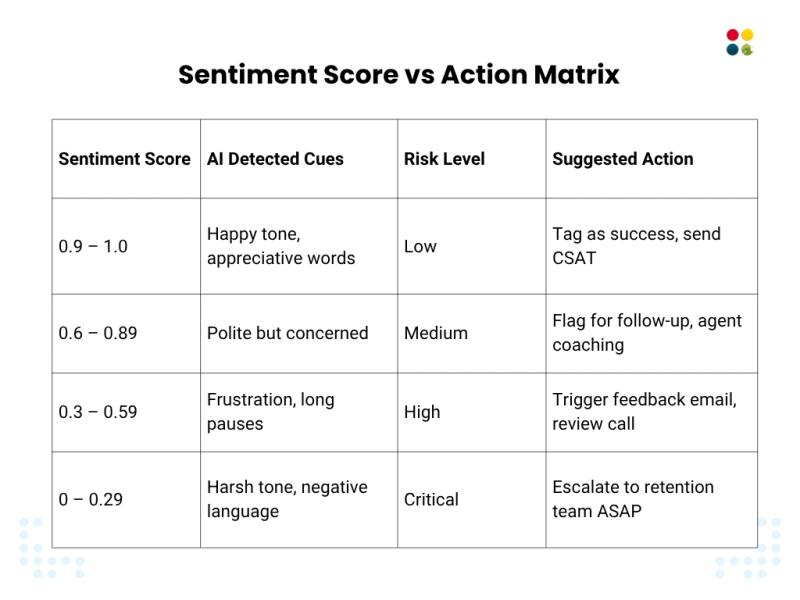
Sentiment Score vs Action Matrix
Use Cases: Real Business Applications
1. Support Centers
● Identifies burnout-at-risk agents by reviewing their tone throughout AI Calls.
● Auto-escalate calls identified as “emotionally high-risk.”
2. Sales Teams
● Grade pitch effectiveness in real-time.
● Find “hesitant but interested” prospects for personalized nudges.
3. Compliance & QA
● Identify aggressive tone, script drift, and empathy gaps.
● Score agent brand tone + regulatory script adherence.
4. Churn Prediction
● Combine sentiment scores + historical ticket history to train churn models.
Expert Take: It’s Not About Happy or Sad
Here’s a widely misunderstood truth:
Sentiment isn’t so much about being “happy” or “angry.”
It’s all about micro-emotions—the tiny discomfort in a nice “it’s okay,” the deep breath before a “no worries.” These micro-signals foretell whether your customer will stay, churn, or become an advocate.
AI Customer scoring closes the emotional gap between what agents hear and what customers perceive.
Red Flags to Watch Out For
● Over-reliance on keywords without context of tone
● Ignoring multilingual subtleties in AI Calls
● Not combining scores with CRM or support workflows
● No human-in-loop to audit AI anomalies
Tools & Tech Stack to Get Started
● DialDesk Call Master – Sentiment + Intent + Script compliance in real time
● Google Contact Center AI – Enterprise-grade NLP sentiment scoring
● Observe.AI – Agent performance and behavior analytics
● IBM Watson Speech-to-Text – Multilingual Support and emotion-rich ASR
Thoughts to Ponder
● Is your support team tracking “how the customer felt”?
● Are you auditing only transcripts—or the emotion behind the transcript?
● What’s the ROI of saving only 10% of customers who quietly churn from poor sentiment?
Key Takeaways
● AI sentiment scoring is a critical component of contemporary AI Customer Support.
● It converts AI Calls to insight-based engagement engines.
● Real-time analysis allows for quicker recovery, retention, and personalization.
● Micro-emotions are more powerful than scripted feedback.
● Brands that connect emotionally win loyalty quietly.
Wrap Up
In 2025, every call is an information point. Every emotion is an insight.
If you’re not measuring your customer emotions in calls, you’re not really listening.
You’re capturing voices. Not experiences.
With AI Call sentiment analysis, brands don’t just manage customers—they get them.
Ready to Score Every Customer Emotion in Real-Time?
DialDesk empowers you to catch frustration before it turns into a 1-star review.
With Call Master, you get:
● Live AI Call Scoring
● Sentiment and intent insights
● Real-time agent nudges
● Actionable dashboards
Start listening beyond the script.
Talk to DialDesk — Your shared CX engine for better outcomes.