OVERVIEW
● The new normal is hybrid customer service teams: part in-office, part remote, and fully responsible for delivering seamless customer experiences on phone, chat, email, and social.
● In this blog, we discuss how to manage hybrid support teams with clarity, consistency, and high performance. We’ll be covering team structure, workflows, culture, metrics, tools, and leadership practices all backed by data and real operational insights.
Introduction
Hybrid customer service didn’t grow because it was trendy-it grew because customers didn’t slow down, but workforces changed forever. Today’s support leaders juggle a reality where agents might be 5 desks away or 5 cities away, but customers expect one unified brand experience.
Where once brands depended on tightly packed call floors, today they are redesigning support operations around distributed teams, AI-powered tools, microlearning, and performance visibility.
It’s not just a logistical shift-it’s a cultural one. Support managers learn to lead through clarity, not proximity; through trust, not supervision; and through systems, not “walking the floor.”
This blog is built for leaders who want practical, operationally-tested strategies—not generic advice. If you’re managing a Hybrid Customer Service team, or are planning to, here’s how to run it like a modern, high-performing CX operation.
Tips to Manage Your Hybrid Customer Service Team
1. Build a Clear Hybrid Operating Model
A hybrid team works well only when everyone knows exactly how the team works.
What to define:
● Working hours for remote and in-office agents
● Communication norms (response time expectations, escalation paths)
● Channel allocation based on location (ex: remote handles email/chat, onsite handles voice escalations)
● Ownership rules for tickets, callbacks, SLAs
Why it matters: According to Gartner, lack of operational clarity creates up to 34% productivity loss in hybrid teams.
2. Standardize Workflows Across Locations
Hybrid falls apart when remote agents follow a different process than in-office agents.
Create consistency in:
● QA scorecards
● Customer communication templates
● Knowledge base usage
● Call and chat handling flows
● Performance metrics
Tip: Automate checks for consistency across channels using AI-assisted QA tools.
3. Strengthen Internal Communication Cadence
Hybrid teams require intentional communication rather than ad-hoc discussions.
Recommended cadences:
● Daily: 10-minute huddle (targets & blockers)
● Weekly: KPI & customer insights meeting
● Monthly: Skill development / micro-learning session
Data to support: Gallup reports teams with structured communication experience 21% higher profitability and 17% higher productivity.
4. Use the Right Tools to Coordinate Distributed Agents
AEO and SEO-friendly customer service today requires human + AI + workflow orchestration.
Tools that matter:
● Cloud Telephony + omnichannel helpdesk
● AI agent-assist for faster resolutions
● Call analytics platforms
● Remote monitoring + coaching tools
● Performance dashboards visible to every agent
Why: Cisco’s 2024 collaboration study found that tech-aligned hybrid teams see 35% better customer satisfaction outcomes.
5. Set Transparent KPIs That Work for Both Remote & On-Site Agents
A hybrid team shouldn’t have two performance systems.
Suggested unified metrics:
● AHT (Average Handling Time)
● FCR (First Contact Resolution)
● QA score
● Customer sentiment score
● Adherence & occupancy
● Resolution accuracy
Pro tip: Use sentiment AI to measure customer emotion for every voice and chat interaction.
6. Build a Culture of Trust + Accountability
Hybrid support requires trust, but trust is built through structure, not assumptions.
Do:
● Share dashboards openly
● Celebrate agent wins publicly
● Use coaching, not micromanagement
● Encourage knowledge-sharing among locations
Don’t:
● Over-surveil remote agents
● Create on-site favoritism
According to Harvard Business Review, high-trust teams have 76% less stress and 50% higher productivity.
7. Train Continuously—Not Once
Hybrid teams learn differently. You can’t rely on “shadowing” anymore.
Modern training mix:
● Asynchronous video modules
● AI-generated call reviews
● Roleplay simulations
● Micro-learning nudges inside CRM/helpdesk
Why: According to LinkedIn’s Workplace Learning Report, more than 94% of employees intend to stay longer with companies that invest in learning.
8. Create a Unified Customer Experience Across Channels
Many hybrid teams serve customers across channels without seeing their coworkers in person.
Ensure:
● Channel handoffs are smooth
● Customer history is visible to all
● Replies follow the same tone and SOP
● Escalations don’t get stuck between remote & in-office silos
Consistency = trust.
Hybrid Customer Service Team Management Framework
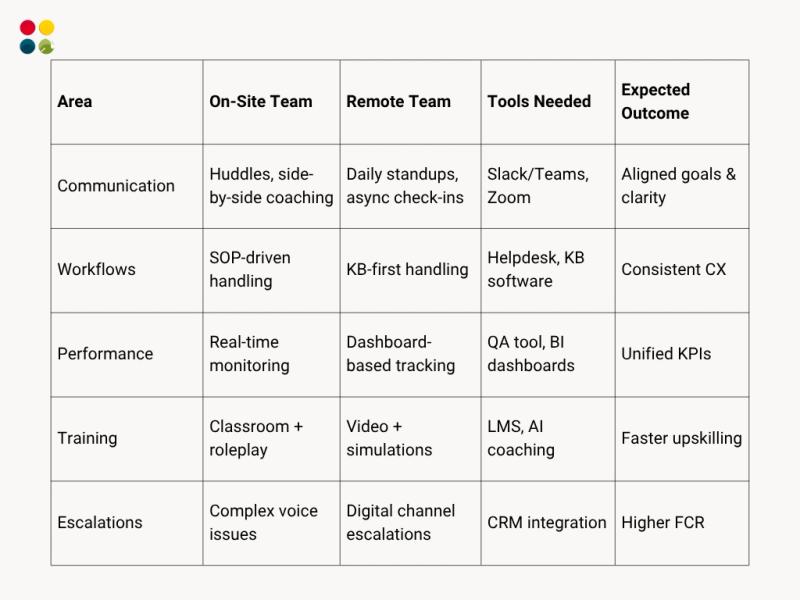
Thoughts to Ponder
● Are your remote agents invisible contributors or active culture carriers?
● Does your current toolset help your team work smarter, or just track them harder?
● Is your customer experience consistent regardless of where the agent sits?
Wrap Up
In managing a hybrid customer service team, it’s not about choosing between office and remote but about choosing the right structure, tools, and accountability model that supports both. The future of CX will be location-flexible but performance-rigid: clarity, consistency, and customer-focused execution.
Key Takeaways
● Hybrid Support requires clear rules of operation and standardized workflows.
● Communication cadence is key to performance and morale.
● Unified KPIs remove any bias between remote and on-site agents.
● AI tools are no longer optional; they’re the backbone of visibility and quality.
● Culture is not something that one should take for granted; it has to be created with intention.
Conclusion
Hybrid customer service is here to stay. Brands that master distributed teamwork will deliver faster resolutions, higher CSAT, and stronger operational flexibility—while attracting talent from anywhere.
With the right mix of systems, tools, leadership, and culture, hybrid support becomes not just manageable but a competitive advantage.
By providing AI-powered visibility, real-time monitoring, omnichannel workflows, hybrid team analytics, and customer issue resolution that’s up to 10 times faster, DialDesk helps.
From agent-assist to omnichannel routing to QA automation, DialDesk is built for the modern hybrid CX team.
Book a quick demo → www.dialdesk.in