OVERVIEW
In this blog, we discuss how technological integration in 2025 and beyond is shaping the future of small businesses. We’ll break down practical tools, real-world trends, advanced capabilities becoming mainstream, and how small businesses can stay ahead without overspending. Expect a structured, skimmable, expert-level guide built for entrepreneurs, founders, and growing brands.
Introduction
Technology for small businesses is no longer optional; it’s an unspoken rule for survival. But the real shift happening in 2025 isn’t about which tools businesses adopt; it’s about how they integrate them to work together.
Most small businesses today use bits and pieces of technology: a CRM here, a billing tool there, maybe even a chatbot or WhatsApp communication line. But fragmentation is becoming the new bottleneck. Businesses aren’t struggling because they don’t have the tools; businesses are struggling because their tools don’t talk to each other.
The next chapter of Small Business growth will be about connected systems, automation that feels invisible, AI that empowers people, and customer experiences which scale without heavy manpower. And the best part?
Small businesses no longer need enterprise budgets to leverage enterprise-grade technology. The future is about leaner systems, smarter workflows, and tech that adapts to your business—not the other way around.
This blog breaks down exactly what that future looks like.
Why Technology Integration Matters for Small Businesses in 2025?
1. Efficiency Is No Longer a Luxury
Time is the costliest currency for small businesses. Integrated tech reduces repetitive tasks by up to 45% (McKinsey 2024).
2. Customers Expect Faster Responses
79% of consumers expect a response within minutes. Integrated communication tools bridge gaps in an instant.
3. Data Becomes a Growth Engine
When CRM, support, sales, and marketing sync data, small businesses get visibility that used to be enterprise-only.
4. Scalability Without Hiring Faster Than Revenue
Automated workflows make small teams operate like large ones.
5. Better Decision-Making
Integrations turn scattered data into insights, improving forecasting by 19–25% (Deloitte SMB Report 2024).
Core Technologies Shaping the Future of SMB Integration
1. AI-Powered Automation
AI no longer replaces jobs—it replaces repetitive workload.
● Auto-transcription of calls
● Smart chat routing
● Predictive customer behaviour
● AI quality monitoring
2. Cloud-Based Ecosystems
Cloud adoption among small businesses in India grew 3× since 2020 (NASSCOM), enabling:
● Remote operations
● Lower software costs
● Better data security
3. Unified Customer Experience Platforms
Customers move across WhatsApp, calls, email, and social.
Unified CX systems track them across all channels.
4. Low-Code/No-Code Tools
Small businesses can now automate entire workflows without developers.
5. Voice + WhatsApp Automation
With customers preferring WhatsApp for every interaction, businesses need:
● AI WhatsApp chat flows
● Automated ticketing
● Integrated voice + WhatsApp support
Key Technologies Small Businesses Should Integrate in 2025
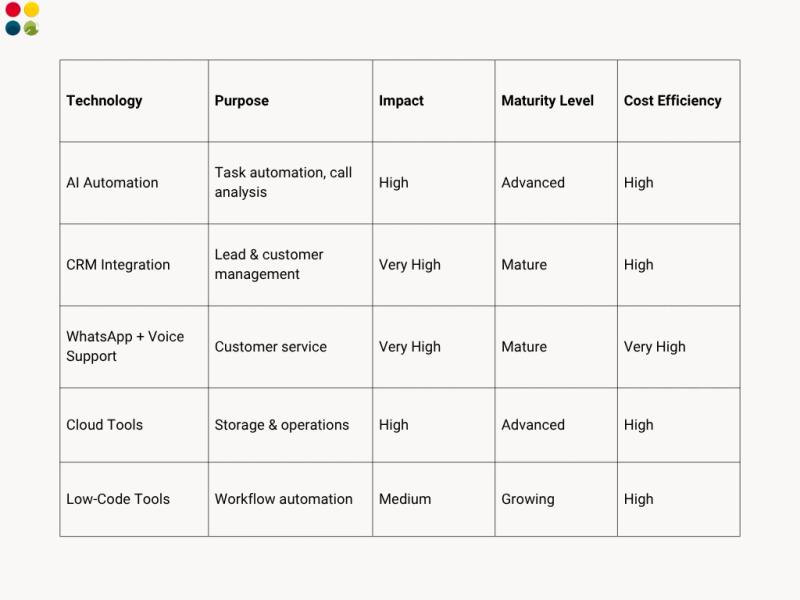
Future Trends Shaping Technology Integration for Small Businesses
1. Conversational AI Replacing Traditional Support
AI-driven voice + chat solutions reduce support workload by 30–40%.
2. Hyper-Personalized Customer Experience
With integrated systems, small businesses can offer:
● Targeted messages
● Personalized offers
● Predictive recommendations
3. End-to-End Digital Customer Journeys
From discovery to purchase to support—all interactions move online.
4. Micro-Automations for Daily Tasks
Small automated triggers that save massive time:
● Auto-assigning leads
● Auto-follow-ups
● Auto-categorization of customer queries
5. Security and Compliance Becoming Non-Negotiable
With rising cyber risks, small businesses are investing in:
● Encrypted communication
● Secure data storage
● Identity verification systems
How Small Businesses Should Approach Technology Integration?
1. Start With What’s Broken
Identify bottlenecks—support, sales leakage, missed follow-ups, manual reporting.
2. Choose Tools That Integrate Easily
API-friendly tools save time and cost.
3. Automate High-Volume, Repeatable Tasks First
Workflows that run daily give maximum ROI.
4. Create a Unified Customer Hub
Centralizing customer data enhances decision-making overnight.
5. Combine Human Support + AI
AI does the heavy lifting.
Humans handle trust and emotional moments.
Expert Insight: The New SMB Tech Stack in 2025
The most successful small businesses follow the “3C Technology Model”:
C1: Connect
Integrate systems—CRM, support, operations, WhatsApp.
C2: Communicate
Enable unified customer communication.
C3: Convert
Turn interactions into revenue with automation + insights.
This model helps SMBs grow without multiplying costs.
Statistics That Prove the Impact of Tech Integration
● 88% of small businesses say Technology Integration helps them compete with larger companies (Salesforce SMB Study 2024).
● Small businesses using integrated CRMs grow revenue 35–42% faster (HubSpot 2024).
● Automated customer support reduces operational cost by 25–40% (Gartner 2024).
● SMBs using AI tools increase productivity by 37% (McKinsey 2024).
● 70% of buyers prefer businesses offering seamless omnichannel support (Accenture 2024).
Thoughts to Ponder
● Is technology replacing manpower—or enabling small teams to do bigger things?
● Are SMBs underestimating the power of integrated data?
● Will AI soon become the default layer in every customer interaction?
Key Takeaways
● The future of small business technology is in integration, not in isolated tools.
● AI, cloud systems, and omnichannel support are fast becoming mainstream and affordable.
● Small businesses that incorporate tech will see faster growth, reduced cost, and improved customer experience.
● The smartest SMBs adopt tools that work together—not tools that work alone.
Wrap Up
The future belongs to small businesses that combine human experience with technology-enabled efficiency. Integration helps create connected workflows, unified customer views, and frictionless operations—giving small businesses the power to scale like enterprises without the overhead.
Conclusion
The new growth engine for small businesses is technology integration. This turns scattered systems into a strategic ecosystem that fuels sales, amplifies support, and reduces costs. As digital behavior continues to evolve, along with foundational AI, it will be those businesses that embrace integrated tools that will lead their respective markets.
The next decade will belong to small businesses that adopt technology not as tools but as a backbone for sustainable growth.
Looking to integrate voice, WhatsApp, AI analytics, and customer support into one powerful ecosystem?
DialDesk helps small businesses connect, communicate, and convert—smarter and faster.
Explore more at www.dialdesk.in. Book a demo now!