OVERVIEW
● This blog outlines the most critical IVR tracking metrics for defining call center success: what they mean, why they matter, and how to interpret them.
● You will learn data-backed benchmarks and expert recommendations, along with an actionable roadmap on how to optimize your IVR performance in 2025 and beyond.
Introduction
In customer communication, every second counts.
When a customer calls in to your support line, the IVR is their first impression of your brand. And in today’s digital-first service world, that experience will either build confidence or cause friction-all in less than 15 seconds.
Yet, a large proportion of businesses are still using outdated metrics to measure IVR success, focusing only on call volume or deflection rates, without regard to what customers actually experience inside the IVR flow.
In 2025 and beyond, IVR Tracking isn’t just about efficiency — it’s about empathy and optimization.
It’s about knowing:
● Where callers drop off
● How many reach the right department
● How long it takes to self-resolve issues
● And whether your IVR design is improving satisfaction or silently driving churn
According to Gartner’s CX Forecast 2024, more than 68% of customer complaints start with a poor IVR experience, due to confusing menus or lack of personalization.
The good news? With the right IVR Tracking metrics, you can turn this challenge into a measurable advantage.
Why IVR Tracking Deserves Boardroom Attention?
For most brands, IVR is the front door of the customer journey. If it’s inefficient, it’s not just a CX issue — it’s a revenue risk.
According to Forrester, for every 10% improvement in IVR containment and routing accuracy, companies can save 20-25% of support costs annually.
That is why monitoring IVR performance with precision is no longer an option. It’s how you align your automation strategy with what customers actually need.
Core IVR Tracking Metrics That Matter Most
Here are the top IVR KPIs that reveal the real story behind your call experience:
1. Call Containment Rate
What It Measures:
The percentage of callers who resolve their query completely within the IVR, without needing a live agent.
Why It Matters:
● High containment = effective self-service
● Low containment = poor design of the IVR or vague menu options
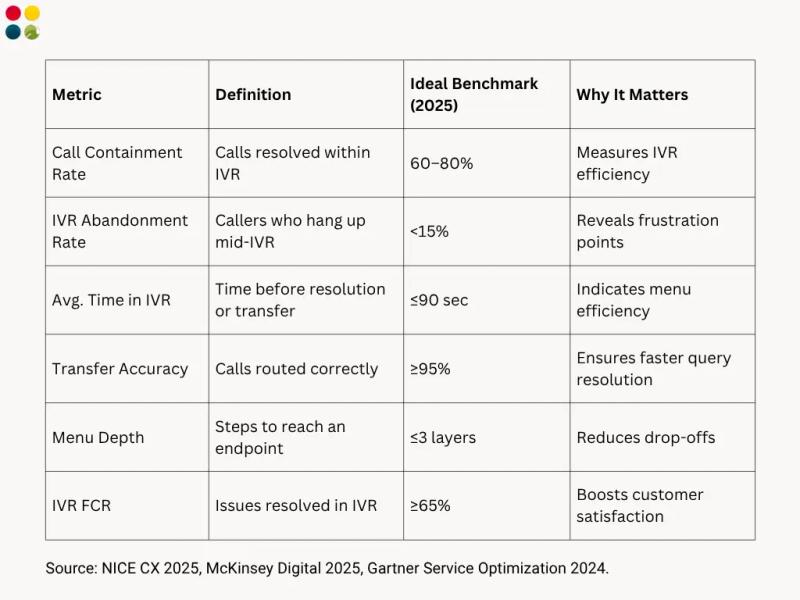
Benchmark: The estimated containment rate varies between industries, which should be 60–80% (Source: NICE CX Report 2025).
2. IVR Abandonment Rate
What It Measures:
How many callers hang up before completing their interaction or reaching an agent.
Why It Matters:
A high abandonment rate signals caller frustration or overly complex menu paths.
Expert Tip: If more than 15% of your callers drop off within the first 30 seconds, simplify your IVR tree immediately.
3. Average Time in IVR
What It Measures:
The average duration callers spend navigating the IVR Call before resolution or transfer.
Why It Matters:
● Longer time ≠ better performance
● Efficient IVRs route callers to answers within less than 90 seconds.
Insight: In fact, according to Zendesk’s 2024 CX Study, 70% of customers prefer a short, context-aware IVR over a longer “personalized” one.
4. Transfer Accuracy Rate
What It Measures:
The percentage of callers correctly routed to the right department or agent on the first attempt.
Why It Matters:
Misrouted calls frustrate both customers and agents — and inflate average handling time (AHT).
Pro Benchmark: Ensure ≥95% routing accuracy by utilizing smart IVR logic and intent detection.
5. Menu Depth and Navigation Paths
What It Measures:
How many steps or levels a user must navigate before reaching resolution or human assistance.
Why It Matters:
Each additional layer increases the risk of drop-off by 8-10% (Source: McKinsey CX Intelligence Report, 2025).
Best Practice: Keep your IVR to 3 layers deep or less for quicker decisions and improved CX.
6. First Call Resolution (FCR) within IVR
What It Measures:
The percentage of issues completely resolved with no follow-ups or escalations.
Why It Matters:
FCR is directly related to customer loyalty: an improvement of at least 1% in FCR could raise NPS by as much as 5 points (Source: Qualtrics Voice of Customer Study 2024).
IVR Tracking Metrics Snapshot
How to Build a Data-Driven IVR Strategy?
1. Audit Your Current IVR Flows Regularly
Map your customer journeys quarterly, and then track which paths are causing the most drop-offs or confusion.
2. Integrate IVR Data with CRM Insights
Connect your IVR tracking data with your CRM Software to see how IVR performance affects CLV and customer retention.
3. Deploy Voice Analytics
Leverage AI-driven IVR tracking tools, which analyze the tone, intent, and emotional cues to dynamically fine-tune the call scripts.
4. Continuously A/B Test Menu Options
Small enhancements, like phrasing or order of options, can help increase call containment up to 15% (Source: Talkdesk AI Report 2025).
5. Combine Human + Machine Feedback
Blend customer survey data with AI-driven insights to craft empathetic IVR flows that feel intuitive.
Expert Take: The Future of IVR Tracking Is Predictive
By 2026, IVR tracking will evolve beyond static reports to predictive IVR analytics — systems that alert managers to potential drop-off spikes, agent overload, or sentiment dips before they happen.
It’s not about counting calls anymore.
It’s about understanding behavior in motion.
Thoughts to Ponder
● Is your IVR measuring speed, or is it actually measuring Client Satisfaction?
● Do your metrics align with customer emotions or only with operational efficiency?
● Can you find out when and why callers give up mid-IVR?
Wrap Up
Your IVR is the invisible voice of your brand, and it’s what you measure that defines how it evolves.
Tracking the right IVR metrics informs the design of experiences that are faster, smarter, and more human. The key isn’t to overwhelm the dashboards with data; rather, it’s to translate metrics into moments that matter to customers.
Key Takeaway
“Every IVR metric tells a story — but only when you listen beyond the numbers.”
Conclusion
The next wave of IVR tracking will combine automation precision with emotional intelligence. Companies investing in these analytics today can reap the benefits of a reduction in call volumes, improved NPS scores, and leaner support costs by 2026.
Identify your top 3 IVR KPIs, and benchmark them against industry data every quarter.
Because what gets measured, gets mastered.
Ready to Transform Your IVR Experience?
Partner with DialDesk, your CX Growth Engine, to unlock data-backed IVR tracking and AI-powered performance insights.
Smarter IVR tracking can bring a difference to your customer experience; visit www.dialdesk.in to see how.