OVERVIEW
● India’s FMCG landscape is not only expanding — it’s changing. From tier-1 supermarkets to digital payment-powered kirana shops, India’s Retail FMCG Industry is redefining its growth narrative.
● This blog delves into how FMCG retailers are leveraging India’s demographic advantage, changing consumer behaviors, and digital penetration to create the next growth frontier.
We will discuss market trends, digital revolution, rural emerging demand, and the retail revolution in a hybrid format that is changing the industry today.
Introduction
There was a time when FMCG growth in India was just about shelf space in metros. Now it is about mind space in Bharat.
In the post-pandemic era, India’s shoppers have turned the FMCG playbook on its head. They’re digitally native but fundamentally price-sensitive, loyal but provocative, and rural markets are no longer merely “potential” — they’re actual profit pockets.
With a growth rate of ~10.7% per annum (IMARC, 2024) and market size forecasted to reach USD 220 billion by 2028, the Indian FMCG Industry is now the world’s most vibrant consumption universe.
Not long ago, retailers were competing on availability and distribution. Today, they are competing on speed, personalization, and sustainability. This is not evolution — it’s a retail revolution fueled by a billion diverse buying journeys.
Let’s crack the code on how India’s FMCG industry became the next global growth frontier — and what this means for contemporary retailers.
India’s FMCG Growth Snapshot (2025 Edition)
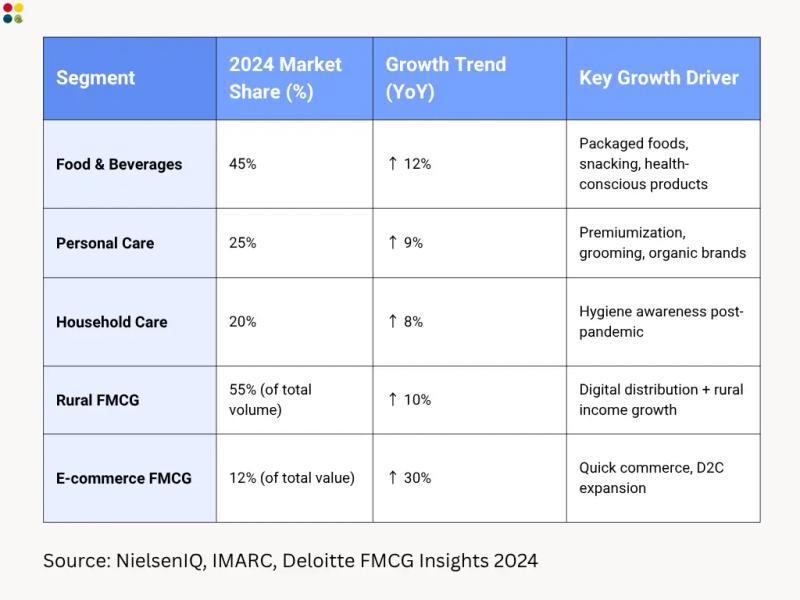
1. India’s FMCG Story: From Distribution to Discovery
The Indian FMCG industry was once a game of logistics and reach. Whoever reached deeper into rural India won.
It’s a consumer discovery today. Meesho, JioMart, Blinkit, and Zepto have made access democratic — giving even regional brands a national presence.
Stat check: India boasts more than 800 million internet users, and almost 65% of rural consumers have online shopping channels at their fingertips (TRAI, 2024).
For FMCG retailers, this means:
● Increased touchpoints influencing purchase behavior.
● A blended combination of offline trust and online presence.
● Data-driven insights over inventory planning based on instinct.
2. The Rural Revolution: Bharat Is the New Brand Battleground
Rural India accounts for more than 55% of aggregate FMCG volume sales (NielsenIQ, 2024). What is driving it?
● Growing disposable incomes and mobile penetration.
● Government initiatives such as Digital India and PM-GatiShakti are enhancing logistics.
● Inexpensive SKUs and sachet innovation.
Unique Take: Rural is no longer “low-value volume.” Savvy retailers are now creating micro-distribution models — lower pack sizes, higher rotation, and higher retention.
For example, HUL’s Project Shakti enabled more than 160,000 rural women entrepreneurs to build a sustainable last-mile network.
3. E-commerce & Quick Commerce: The New Retail Rhythm
India’s Retail FMCG Industry has witnessed its rhythm changing from monthly grocery lists to instant gratification.
Zepto and Blinkit-type apps have made 10-minute delivery a habit. Quick Commerce FMCG sales are expected to reach USD 5 billion by 2026 (RedSeer, 2025).
Retailers that incorporate data-driven personalization and inventory insight are reaping a lion’s share of this increasing demand.
“Speed is no longer a USP — it’s the new normal. The winners are those who pair speed with personalization.”
4. Changing Consumer Behavior: Health, Trust & Transparency
The modern Indian consumer isn’t only purchasing — they’re asking questions.
More than 68% of consumers in Tier-2 and Tier-3 cities prefer health-oriented or green products today (Deloitte FMCG Report, 2024).
This has presented opportunities for:
● Local D2C brands (such as mCaffeine, WOW, and Kapiva).
● Transparency-first marketing, with ingredient honesty driving loyalty.
● Tech-led feedback loops through WhatsApp Commerce and chatbots.
The takeaway?
Health is the new hero. Sustainability is the new selling point.
5. The Tech Transformation: AI, Analytics, and Automation
FMCG retailers are not only selling quicker — they’re selling smarter.
Artificial intelligence is assisting brands in predicting demand, monitoring sentiments, and streamlining logistics. Retailers leveraging predictive analytics have witnessed:
● 25% less stockouts
● 18% increased conversion through targeted campaigns
Expert Insight: Combining Voice AI and Chatbots (such as DialDesk’s CX solutions) allows for 24/7 multilingual customer interactions — essential in a nation with 22 official languages.
6. Challenges Ahead: Complexity in Abundance
The story of growth is not without hiccups:
● Price sensitivity in varied markets.
● Counterfeit products and inefficiencies in distribution.
● Increasing cost of online ads and influencer fatigue.
But here’s the silver lining — innovation finds a way through complexity. India’s start-up-led FMCG ecosystem, ranging from local D2C brands to digital enablers, is redefining what agility looks like in retail.
Thoughts to Ponder
● Can Indian FMCG retailers sustain growth while developing sustainable supply chains?
● Will local D2C brands displace legacy FMCG behemoths once and for all?
● How much can AI and automation customize the shopping experience before it loses its human touch?
Key Takeaways
● The Indian FMCG Industry is evolving from distribution to digital discovery.
● Rural India powers more than half of FMCG volume — it’s the real frontier.
● Quick commerce and D2C models are redefining retail expectations.
● AI and automation are not a nice-to-have — they’re must-have growth levers.
● Retailers who combine tech, trust, and transparency will rule the next decade.
Wrap-Up
India’s FMCG industry is at a turning point. It’s not about scale anymore — it’s about resilience. Retailers who listen, learn, and go local will hold the next phase of FMCG triumph.
The Indian consumer has evolved — and so should the manner in which we sell to them. From kirana shops to AI-based commerce, the path of Indian retail is not merely about consumption; it’s about bonding.
Conclusion
The Indian Retail FMCG Industry is not just a marketplace — it’s a movement.
A movement fueled by ambition, access, and agility.
The future for FMCG retailers is not a geography — it’s a mindset:
Think Local. Act Digital. Deliver Human.
Power the Next Wave of FMCG Customer Experience with DialDesk
At DialDesk, we enable FMCG and retail businesses to provide world-class customer support across all touchpoints — voice, WhatsApp, chat, and more.
● Bigger smiles. Happier customers. Better results.
● Smarter insights.
● Stronger connections.
Turn customer interactions into brand loyalty.