What is the Difference Between Inbound vs Outbound Call Centers?
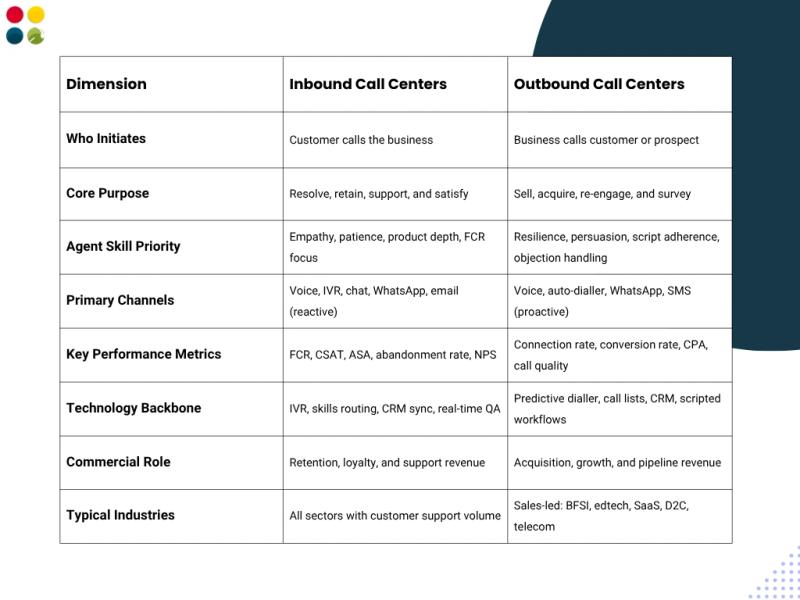
Inbound vs Outbound Call Centers represent two fundamentally different customer communication models. Inbound Call Centers receive customer-initiated contacts, support, queries, complaints, and purchase confirmations, focusing on resolution, retention, and satisfaction. Outbound Call Centers make business-initiated contacts, sales outreach, lead follow-up, renewals, and surveys, focusing on revenue growth and proactive engagement. Inbound vs Outbound Call Center Services are not competing options: the highest-performing businesses in India deploy both as a blended Inbound and Outbound model on a unified platform, achieving 89% customer retention vs 33% for single-channel operations (Aberdeen Group, 2024).
Inbound vs Outbound Call Centers: Complete Side-by-Side Comparison
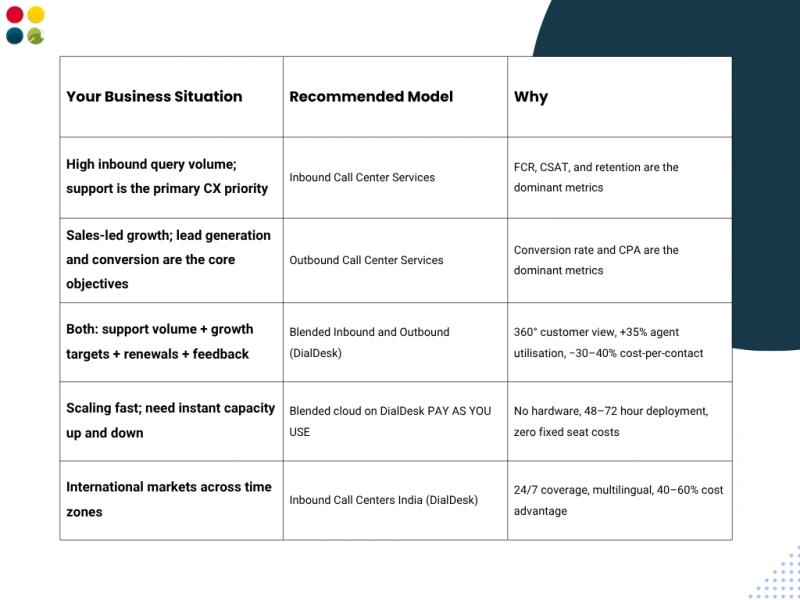
Which is Right for You: The Decision Framework
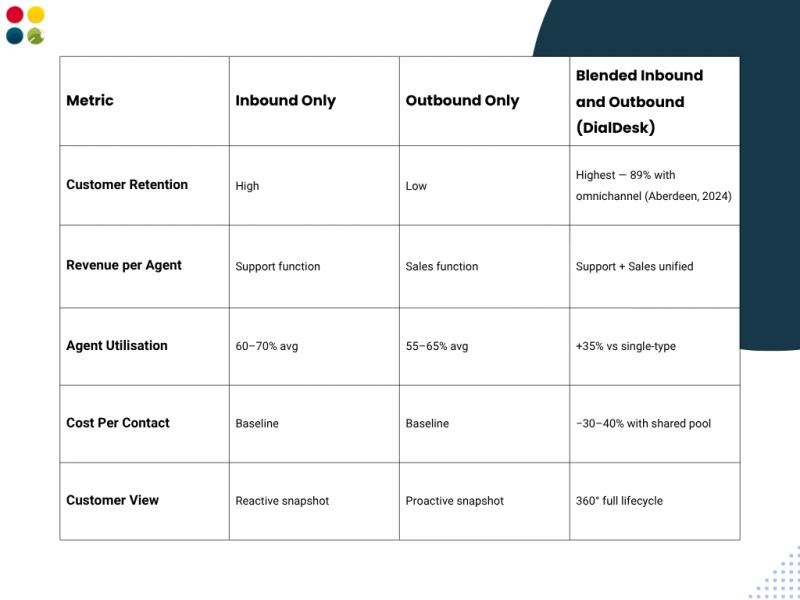
The Blended Inbound and Outbound Model: Why Leading Businesses Choose Both
The most commercially effective call center strategy in India is not a choice between Inbound vs Outbound. It is a deliberate combination of both, managed on a unified platform where inbound resolution and outbound conversion share the same customer data, quality standards, and real-time analytics.
Companies that prioritise omnichannel Inbound and Outbound engagement retain 89% of customers vs 33% for those using single-channel models (Aberdeen Group, 2024). A D2C brand that handles inbound order queries and outbound post-delivery re-engagement from the same agent pool achieves higher CLV, lower churn, and better agent utilisation simultaneously.
✅ Trusted by 500+ Contact Centers Across India
DialDesk’s blended Inbound vs Outbound Call Center Services platform is ISO 9001:2015 and ISO 27001:2013 certified — managing both call types from a single interface, trusted by 500+ contact centers across India. PAY AS YOU USE pricing. 48–72 hour deployment.
Key Takeaways
• Inbound vs Outbound Call Centers serve distinct commercial purposes: Inbound builds retention and trust; Outbound builds acquisition and pipeline revenue.
• Inbound Call Centers prioritise FCR, CSAT, and NPS. Outbound Call Centers prioritise conversion rate, CPA, and call quality. Both require different agent skills and technology stacks.
• The blended Inbound and Outbound model improves agent utilisation by 35%, reduces cost-per-contact by 30–40%, and achieves 89% customer retention vs 33% for single-channel operations (Aberdeen, 2024).
• Inbound vs Outbound Call Center Services choice depends on your business growth stage: support-first businesses need inbound; sales-led businesses need outbound; scaling businesses need both.
• DialDesk deploys both Inbound and Outbound on a unified cloud platform in 48–72 hours, PAY AS YOU USE, no hardware, ISO certified from day one.
• Companies using omnichannel Inbound and Outbound engagement retain 89% of customers, the strongest retention metric in the contact centre industry (Aberdeen Group, 2024).
Conclusion
Inbound vs Outbound Call Centers is not a binary choice between support and sales. It is a strategic decision about where your business is in its growth cycle, and what customer communication model best serves that stage.
Inbound builds the trust and loyalty that makes customers stay. Outbound builds the pipeline and revenue that makes businesses grow. The most effective businesses in India deploy both, as a unified Inbound and Outbound strategy on a single cloud platform, and consistently outperform single-model competitors on every measurable CX and commercial metric.
Explore how DialDesk’s blended Inbound and Outbound Call Center Services connect your cloud telephony, AI automation, and CRM stack from one unified interface, live in 48–72 hours, PAY AS YOU USE, no hardware required.
Inbound builds loyalty. Outbound builds revenue. DialDesk builds both.
📅 Need to Deploy the Right Call Center Model for Your Business?
DialDesk’s blended Inbound vs Outbound Call Center Services deploy in 48–72 hours — AI routing for inbound, predictive dialling for outbound, 100% call monitoring, and full CRM integration from day one.
Join 500+ contact centers across India already running smarter Inbound and Outbound operations with DialDesk.